
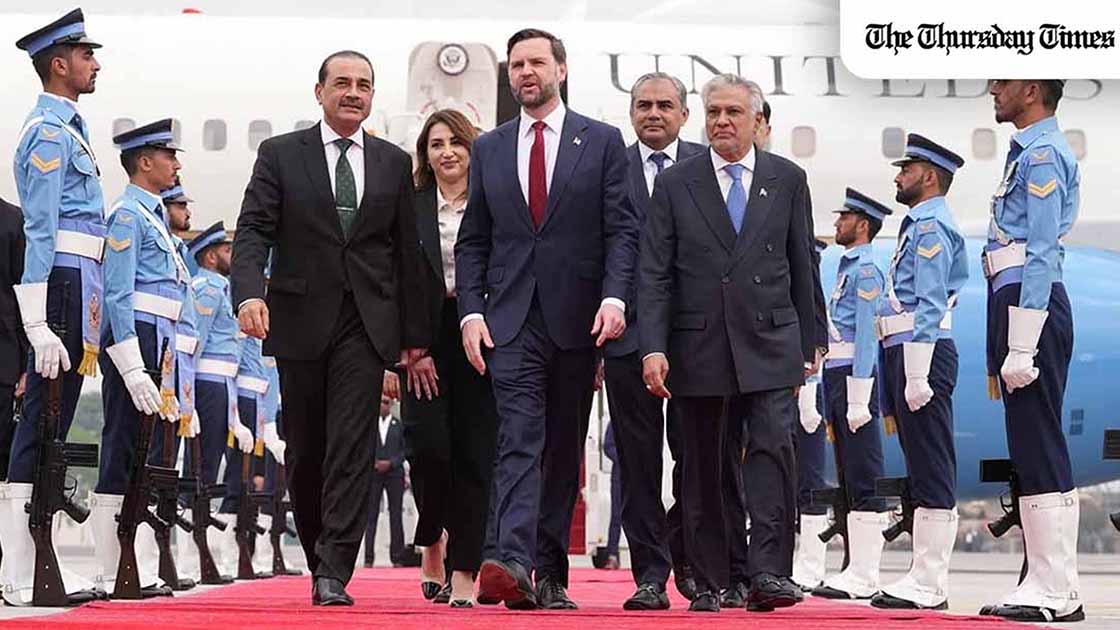
WASHINGTON (The Thursday Times) — US Vice President JD Vance has said Pakistan was involved in the diplomatic sequencing behind the release of the US-Iran peace agreement, placing Islamabad directly inside the machinery of a deal that is expected to be formally signed in Geneva on Friday.
Vance made the remarks during an interview with Fox News, when asked why the memorandum of understanding between Washington and Tehran had not yet been made public. His answer pointed not to delay or collapse, but to protocol.
“There are some diplomatic protocols, there is some sequencing that the Pakistanis have been involved in this, the Qataris have been involved,” Vance said.
JD Vance: Pakistan has played a role in the diplomatic sequencing behind the US-Iran peace agreement, alongside Qatar.
“The Pakistanis have been involved in this, the Qataris have been involved.”
The memorandum of understanding is expected to be released on Friday with the… pic.twitter.com/bRPEroEZLw
— The Thursday Times (@thursday_times) June 16, 2026
The comment offered one of the clearest acknowledgements yet from Washington that Pakistan’s role in the US-Iran process has extended beyond broad encouragement for peace. It suggests Islamabad was involved not only in pushing the two sides toward agreement, but also in the careful staging of how that agreement is being presented to the world.
Vance said the agreement is expected to be released on Friday, the same day a formal signing ceremony is due to take place. He added that President Donald Trump could still decide to release it sooner.
“What the president says is the agreement will come out on Friday,” Vance said. “He may decide to release the agreement sooner than that. But we have this formal ceremony on Friday and that’s when the president wants to release it.”
The remarks come after Prime Minister Shehbaz Sharif said Pakistan would host the formal signing ceremony in Geneva, Switzerland, describing the agreement as a historic milestone for peace after months of conflict between the United States and Iran.
For Islamabad, Vance’s comments carry political and diplomatic weight. Pakistan has sought to present itself as a credible intermediary capable of speaking to Washington, Tehran, Gulf capitals and Beijing at the same time. The acknowledgement from the US vice president strengthens that claim at a moment when the agreement remains under close international scrutiny.
The full text of the memorandum has not yet been released. Officials have indicated that it addresses the end of military operations, freedom of navigation through the Strait of Hormuz, and the framework for future negotiations on Iran’s nuclear programme. The public release of the text is now expected to become a test of whether the diplomatic optimism surrounding the agreement can survive the details.
China has also welcomed the US-Iran agreement and praised Pakistan’s mediation efforts, with Beijing calling for the swift restoration of safe and free passage through the Strait of Hormuz. That waterway remains central to the deal’s global significance, carrying a large share of the world’s oil and gas flows and linking the diplomacy of the Gulf directly to energy prices, shipping routes and inflation concerns.
The agreement follows months of conflict that disrupted regional security and placed renewed pressure on global markets. The Strait of Hormuz became a central flashpoint, with any threat to shipping through the passage carrying immediate consequences for energy supplies and market confidence.
Trump has said the agreement will bring a permanent end to military operations between the United States and Iran. Iranian officials have framed it as a step toward broader negotiations rather than a final settlement. That distinction matters, because the agreement may stop the fighting, but its longer-term durability will depend on implementation, verification and the willingness of both sides to continue negotiations.
Vance’s comments therefore arrive at a delicate moment. The agreement has been announced, praised and politically claimed, but not yet fully published. Until the memorandum is released, many of its terms remain subject to interpretation.
Still, his remarks make one point clear. Pakistan is no longer merely being described as a supportive regional actor. It is being named as part of the diplomatic sequencing behind one of the most consequential peace efforts in the Middle East this year.
For a country often viewed through the lens of crisis management, this is a different kind of visibility. It places Islamabad in the room where timing, protocol and presentation matter, not only because they shape headlines, but because they can determine whether a fragile agreement lands with confidence or confusion.
The formal ceremony in Geneva will now carry more than symbolic value. It will show whether the US-Iran understanding can move from announcement to architecture, and whether Pakistan’s role as host and mediator can help turn a pause in conflict into the beginning of a more durable peace.