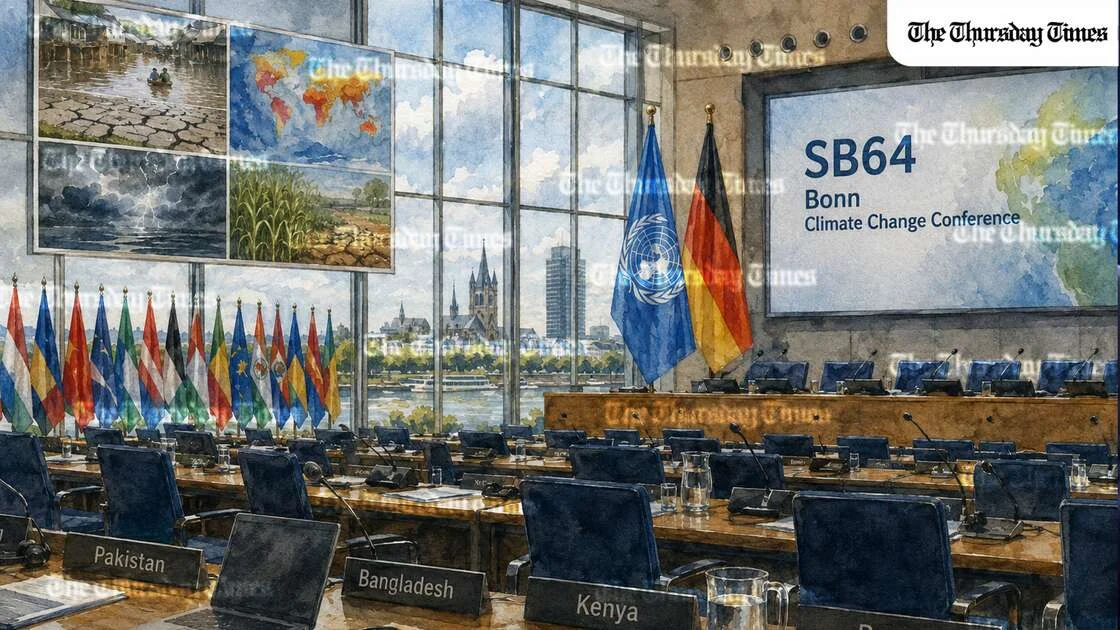
In June 2026, I took part in UN climate negotiations for the first time. I was surprised by the humbleness of the Bonn Climate Change Conference when I arrived, and I think many people I met had a different picture of global climate diplomacy. No heads of state were present, no major statements were made, and few eye-catching commitments were announced.
But Bonn could be one of the places to learn more about the direction of climate action. The 64th session of the UNFCCC subsidiary bodies, or SB64, is the technical body behind the political show of the COP process. The conference takes place between COP30 in Belém and COP31 in Antalya, and is a key factor in determining what will be achieved at the next COP. Anything that is agreed, or not agreed, here will influence what is possible at the next COP.
COP30 (Belém)
Sets context for the political process leading into the next round of negotiations.
SB64 (Bonn Climate Change Conference)
Technical subsidiary bodies session; results will be translated into COP31 discussions.
SB64 ends 18 June
The conference closes as work feeds directly into COP31.
COP31 (Antalya)
Where SB64 outputs are taken forward in the political negotiations.
As a first-time observer, one message stood out clearly: climate diplomacy is entering an implementation era.
The era of ambition is coming to an end, and the age of delivery is beginning. The age of ambition gives way to the age of delivery.
The emphasis of the past years was on the commitment to declare ambitions, such as limiting warming to 1.5°C, NDCs and net-zero targets.
The subject has now become much more complex.
How do you turn commitments into projects that are ultimately fundable, implementable and sustainable?
It is not difficult to make a grand statement. Implementation exposes the gaps between a pledge and a budget, a national plan and operational capacity, and a warning issued and a warning that reaches people in time to act.
The shift in climate technology and climate services is from “What should we aim for?” to “What can we deliver, and can it be funded?”
Messaging is no longer the main challenge. Operational capability is.
For many years, adaptation received less attention than mitigation. That is changing.
“The headlines in Bonn do not make headlines. It produces something more valuable: a reality check.”
As climate-related disasters become more frequent and severe, adaptation and early warning systems are moving to the centre of climate discussions. Global efforts to achieve universal early warning coverage are accelerating, but the focus has evolved beyond simply having systems in place.
The real questions are whether forecasts are sufficiently accurate, whether information reaches decision-makers on time, and whether communities can act on the warnings they receive.
For many countries, getting a system up and running is still a formidable task. This has made issues such as forecast quality, bias correction, operational decision support and spatial downscaling more important. These are no longer solely technical or academic questions. They directly influence whether early warning systems save lives and protect livelihoods.
If adaptation is where much of the energy lies, finance remains where much of the friction persists. Discussions on climate finance and future NDCs continue to revolve around familiar questions: who pays, how much, how quickly, and through which mechanisms?
Many developing countries do not lack plans or strategies. They lack predictable and accessible financing mechanisms to turn those plans into operational programmes.
This remains one of the central tensions of the climate process. Even the most powerful technical offers are hard to get off the ground if there are no financing structures to support them.
This means that projects that are ready for investment and have a sound set of data, methodologies and measurable outcomes are gaining favour. Good intentions alone are no longer sufficient.
Discussions have restarted under the Joint Work on Agriculture and Food Security, after agriculture lost momentum at COP30.
Climate and food security are two sides of the same coin in climate-vulnerable countries like Pakistan.
Claim trail: how the argument builds
- Commitments are no longer enough. Implementation exposes gaps between pledges and budgets, and between plans and operational capacity.
- Adaptation and early warning must be actionable. The questions are accuracy, timeliness, and whether communities can act on warnings.
- Finance is the friction point. Even strong technical offers struggle without predictable, accessible financing mechanisms.
- Local participation shapes effectiveness. Policies formed far from affected communities can miss local realities and knowledge.
- So the next challenge is delivery systems. Better forecasts, stronger climate services, access to funding, and decisions that close the capacity gap.
A failed monsoon forecast, devastating floods, or prolonged heat affecting crops is both a climate issue and a food security issue.
Treating food systems as a central component of climate adaptation and mitigation, not as a peripheral topic, is an important and necessary shift.
Local participation and capacity development were themes throughout the conference.
Speakers continually urged the inclusion of communities on the frontline of climate impacts and practitioners throughout the climate decision-making process, not only at the end.
There is growing awareness that policies formulated at a distance from affected communities are ineffective because they neglect local realities and fail to utilise local knowledge.
It is unclear what this recognition means for structural change. However, the issue is gaining significant traction within climate discussions.
What this all means going forward
Three observations stand out.
First, climate action is increasingly focused on delivery. Success will belong to countries and organisations that can transform climate data, forecasts and intelligence into practical systems that support decision-making.
Second, technical and political issues are deeply interconnected. Disagreements on finance can delay progress on adaptation, even when technical solutions are already available.
Third, some of the most striking challenges are the widening discrepancies between what countries want to be doing and what their financial, technical and institutional capacity allows them to do.
Closing this gap is now the main challenge: better forecasts, improved early warnings, stronger climate services and better decisions.
SB64 ended on 18 June, and its results will be directly translated into COP31 Antalya discussions. The headlines in Bonn do not make headlines. It produces something more valuable: a reality check.
The biggest debate in climate governance is no longer whether we know the problem or have lofty targets to set. It is whether we can create the systems, ensure access to funding and build the capacity needed to achieve those goals.
The time of making climate commitments is coming to an end, and the time of delivering on climate commitments is starting.∎
Key terms, in plain English
- SB64
- The 64th session of the UNFCCC subsidiary bodies, the technical layer behind the COP process.
- COP
- Conference of the Parties, the political summit that is supported by technical work at meetings such as SB64.
- UNFCCC subsidiary bodies
- The technical bodies that do much of the preparatory work feeding into COP outcomes.
- NDCs
- Nationally Determined Contributions, national climate plans referenced in the article as part of the ambition era.
- Net-zero targets
- Targets to achieve net-zero emissions, referenced as part of earlier ambition-focused commitments.
- Early warning systems
- Systems designed to provide forecasts and warnings, including whether information reaches decision-makers and communities in time to act.