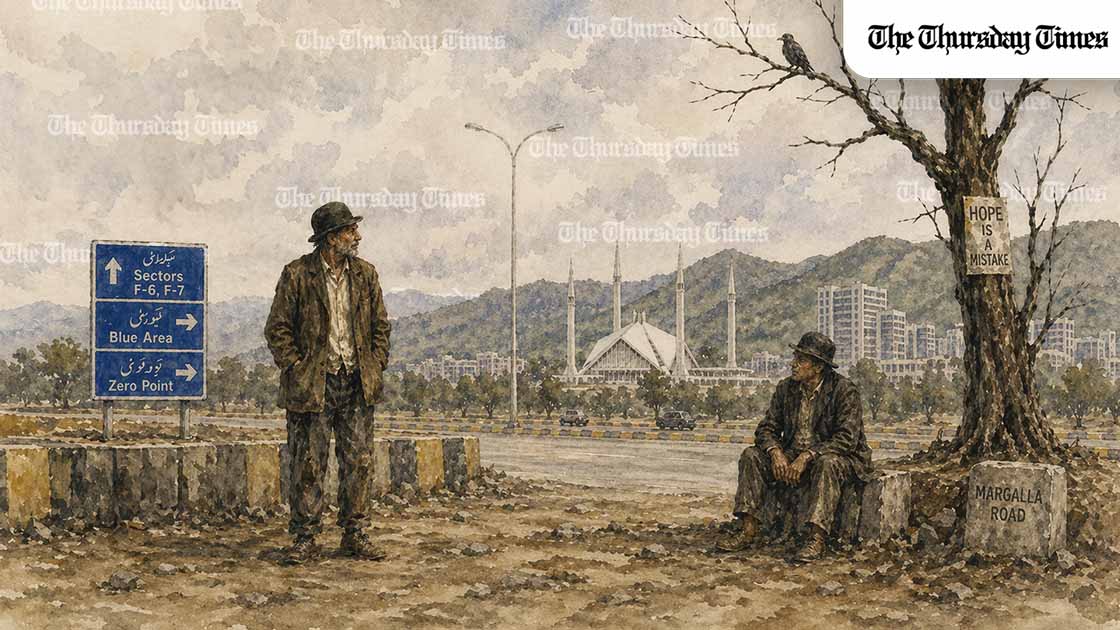

“Two men, Vladimir and Estragon, meet near a tree. They converse on various topics and reveal that they are waiting there for a man named Godot. While they wait, two other men enter. Pozzo is on his way to the market to sell his slave, Lucky. He pauses for a while to converse with Vladimir and Estragon. Lucky entertains them by dancing and thinking, and Pozzo and Lucky leave.
After Pozzo and Lucky leave, a boy enters and tells Vladimir that he is a messenger from Godot. He tells Vladimir that Godot will not be coming tonight, but that he will surely come tomorrow, and the boy departs. The next night, Vladimir and Estragon again meet near the tree to wait for Godot. Lucky and Pozzo enter again, but this time Pozzo is blind and Lucky is dumb. Pozzo does not remember meeting the two men the night before. They leave and Vladimir and Estragon continue to wait.” – Waiting For Godot, 1953
Two men, in the twin cities, meet near the red zone place called Serena Hotel. They received a call from a man called Mr. Trump: “We need peace, so please invite Iran to your country, and I will send my people to your country too for the peace talk. ” They invited the Iranians, and they agreed to come, but then Mr. Trump started tweeting, “They will not be coming today, but they will come tomorrow.” This goes on day by day and the people of the twin cities are still waiting for them to come.
Everyone in Islamabad/Rawalpindi is waiting for Mr. Godot.
So everything is on halt because Iranians and Americans might meet again for the second time for peace talks. Pakistan, no doubt, is a peace-loving country, but what about the peace of mind of the people of Islamabad and Rawalpindi? Business and life in the twin cities are also almost dead. Daily wage workers have been going to sleep hungry for the past three days. We appreciate what our government is doing for world peace, but at least we should have a solid plan for our own people. Closing everything causes so much chaos. Students are unable to attend schools or colleges; even university exams have been cancelled, and they are still waiting for the next date. Common people are already paying a high price for petroleum gas, and now those travelling extra miles just to reach their offices. Travel times have become ten times longer, from 15 minutes to 2 hours. Half of the cities – Islamabad and Rawalpindi – are closed, while the other half is suffering from the closure of the roads.
When you are sure the delegation is finally coming, close everything. All the people will understand, but putting the twin cities under curfew for the past five days is making people impatient. They have mixed feelings. On one hand, they are happy that Pakistan’s name is being praised on the global stage, but it cannot lead to challenges in their everyday lives. There hasn’t been any transportation of goods to and from the twin cities, which results in very high prices for vegetables and daily necessities. When we ask the vendors, they tell us that the roads are closed, and we have to take longer routes, so we can’t lower the prices.
“Personally, I find it very annoying. My time is wasted. Transport fares have increased. But I am happy that we are doing something positive,” she was quoted by AFP.
Islamabad residents are used to restrictions and road closures, having lived through periods of terrorist attacks, political protests, and visits by heads of state.
But the intensity and stop-start nature of this month’s measures have pushed some to the limit, especially the many small business owners and daily wage workers whose incomes have been slashed in an already struggling economy. “Our stoves do not run; we do not find food,” said a daily wage worker.
“We are giving a small sacrifice to reduce the size of the larger sacrifice,” said Syed Umar Hasnain Shah, a young doctor. “So we will continue to sacrifice.”