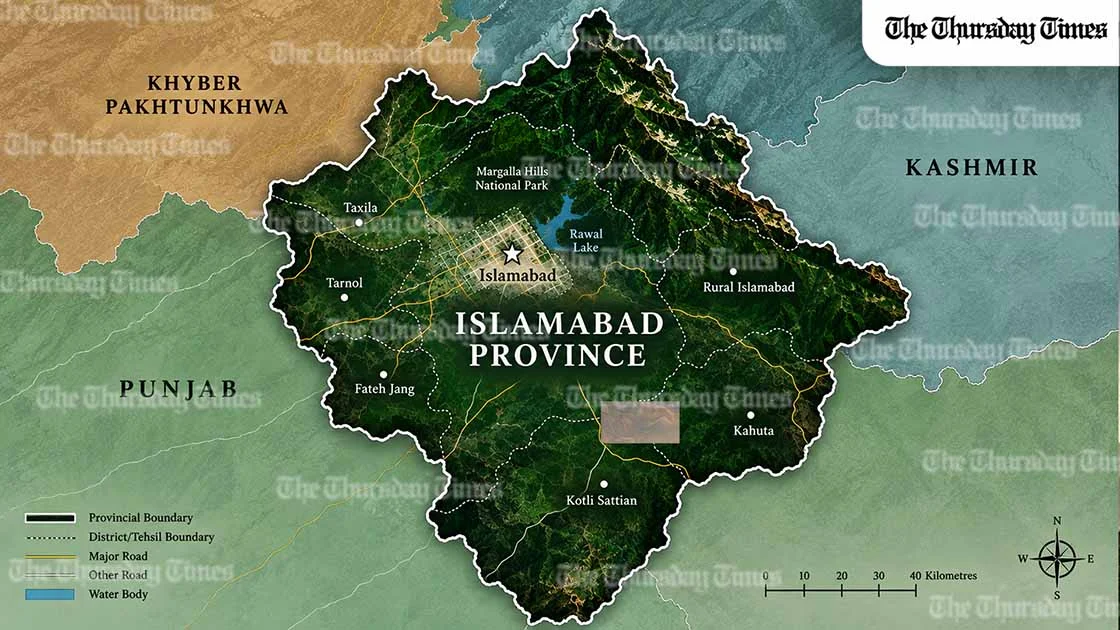
ISLAMABAD (The Thursday Times) — Pakistan’s federal capital is moving closer to genuine self-governance, with a high-level committee submitting a comprehensive governance framework to Prime Minister Shehbaz Sharif that would give Islamabad its own elected assembly, its own chief executive, and administrative and financial autonomy on the pattern of a province.
Under the proposed Islamabad Capital Territory Government Act 2026, the capital would gain a 27-member assembly, 21 directly elected members drawn from Islamabad’s National Assembly constituencies, five seats reserved for women, and one for minorities. The territory would have its own chief executive, who could be designated Chief Minister or Mayor, supported by a chief secretary and four secretaries overseeing 27 departments. Elections would be conducted by the Election Commission of Pakistan, and nearly all functions currently held by the Capital Development Authority, apart from master planning, would transfer to the new Islamabad government.
Federal Interior Minister Mohsin Naqvi has publicly welcomed the direction of the reform, describing himself as “the biggest proponent” of turning Islamabad into a full province and arguing that decentralising administrative structures is essential to improving governance at the grassroots. He has also urged patience, noting that a change of this scale is not something that will happen overnight and should not become a source of public anxiety.
The proposal is part of a broader national conversation about strengthening local governance that Planning Minister Ahsan Iqbal has been leading, including a wider recommendation for expanding the number of empowered administrative units across the country to bring government closer to citizens. Officials have said any such expansion would ultimately depend on securing public support, framing the process as one that should be led by what citizens themselves want rather than imposed from above.
Separately, the National Assembly’s Standing Committee on Interior has also approved its own Islamabad Capital Territory Local Government Bill 2026, reflecting the level of active legislative attention the capital’s governance structure is currently receiving from multiple directions as the government works toward a durable framework for the capital going forward.
Taken together, the developments mark one of the most significant governance conversations Islamabad has seen in years, with senior federal officials, parliamentary committees, and planning authorities all actively engaged in shaping what greater self-rule for the capital could look like.∎