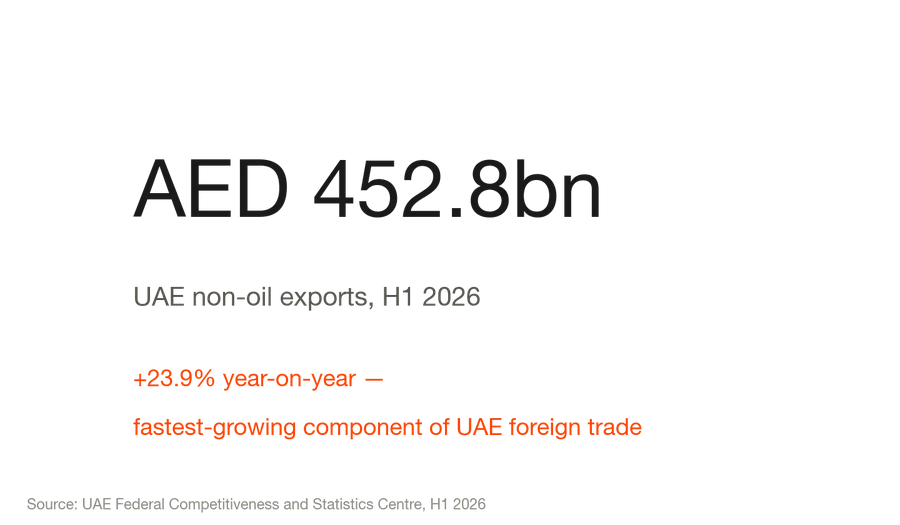
DUBAI (The Thursday Times) — The UAE’s non-oil exports reached a record AED452.8bn in the first half of 2026, growing by nearly a quarter on the same period last year, according to figures from the Federal Competitiveness and Statistics Centre (FCSC) — the strongest evidence yet that the country’s decades-long push to build an economy beyond oil is translating into real trade flows rather than just policy documents.
The 23.9% year-on-year growth in non-oil exports was the fastest-expanding component of UAE foreign trade in the period, outpacing both imports and re-exports, and pushing the UAE further up the list of the Gulf’s most diversified trading economies.
The diversification numbers are catching up to the rhetoric
For years, UAE officials have talked about reducing the country’s reliance on hydrocarbons; the first-half 2026 data gives that talk some hard numbers to lean on. Non-oil activity’s share of real GDP reached 79.4% in the first quarter of 2026, according to WAM, up from already-high prior-year levels, while overall real GDP grew 3% year-on-year to AED485bn in the same quarter.
“Non-oil sectors continue to anchor the UAE’s growth story,” federal officials said, pointing to financial services, trade and manufacturing as the main drivers behind the first-half figures.
Financial and insurance activities were the standout performer, expanding 17.3% year-on-year in the first quarter — the fastest growth of any sector in the economy, and a sign that Dubai and Abu Dhabi’s long campaign to position themselves as regional financial hubs is bearing out in the numbers rather than just in skyline-level ambition.
A bumpier second quarter, but the trend holds
The picture was not uniformly rosy across the full half: second-quarter real GDP contracted 2.1% year-on-year as regional disruptions weighed on tourism, transport and trade, and the IMF has pencilled in slightly slower overall growth for 2026 than in 2025. Officials and economists have largely read the Q2 dip as a temporary drag tied to regional travel disruption rather than a reversal of the underlying diversification trend.
That is also how the non-oil export numbers are being read: as confirmation that the sectors the UAE has spent a decade building — logistics, re-export trade, financial services, advanced manufacturing — are now large and resilient enough to keep growing even in a half-year when the oil-adjacent parts of the economy wobbled. For a country that still derives a meaningful share of government revenue from hydrocarbons, that resilience is the whole point of the strategy.∎