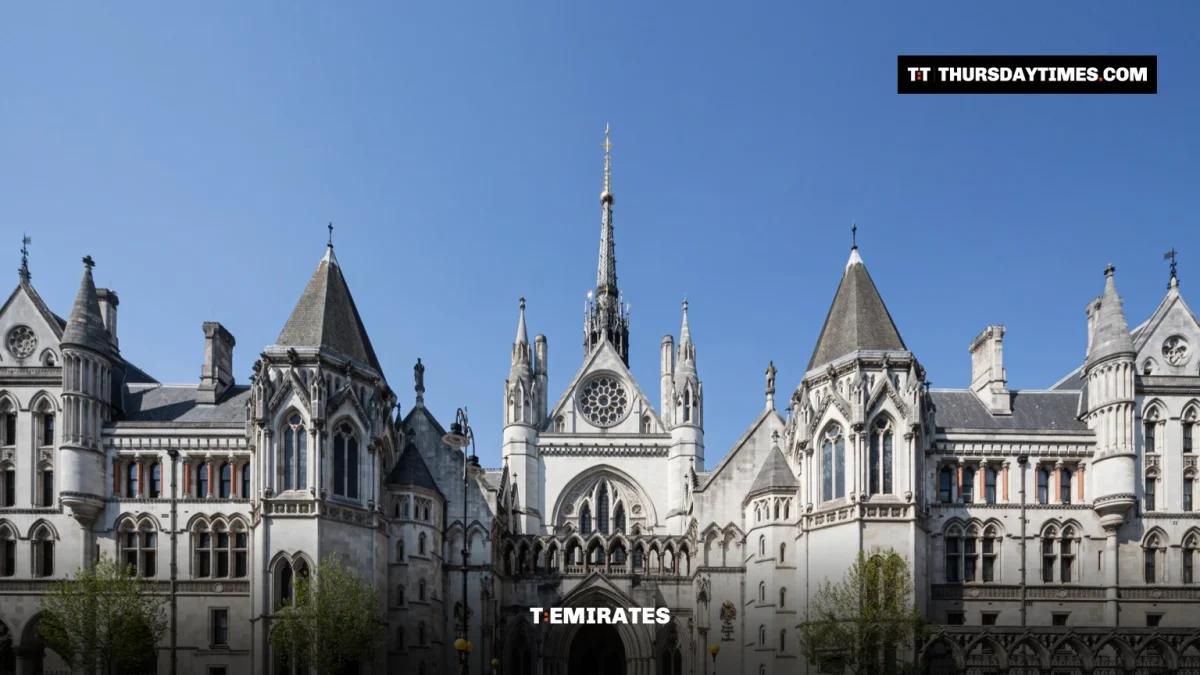
LONDON (The Thursday Times) — India has lost its bid to block a $273 million investment treaty claim brought by the Ras Al Khaimah Investment Authority (RAKIA), after the Court of Appeal of England and Wales ruled that an arbitration tribunal was wrong to say it had no power to hear the case.
Lord Justices Males, Phillips and Miles last week dismissed India’s appeal against a June 2025 High Court ruling by Mr Justice Robin Knowles, who had overturned the tribunal’s decision. The claim now goes back to the tribunal, which will decide whether India breached the India-UAE bilateral investment treaty and owes the emirate’s investment arm compensation.
An aluminium project in Andhra Pradesh
The dispute dates back to a 2007 memorandum of understanding between the governments of Andhra Pradesh and Ras Al Khaimah to build an alumina refinery, an aluminium smelter and a power plant in the Indian state. RAKIA invested about $42.5 million in ANRAK Aluminium, the company set up for the project, although its stake was later diluted to around 12%.
The project depended on bauxite from the state-owned Andhra Pradesh Mineral Development Corporation (APMDC). After public protests, the Andhra Pradesh government withdrew the orders that allowed the supply arrangement in 2015, and APMDC later ended the supply agreement.
RAKIA began arbitration in December 2016, accusing India of failing to give its investment fair and equitable treatment and of unlawful expropriation. In May 2022, a tribunal of Lord Hoffmann, Justice Chandramauli and J William Rowley QC declined jurisdiction, finding that the measures directly affected ANRAK and APMDC but only indirectly affected RAKIA’s shareholding.
What the court decided
India argued that RAKIA’s protected investment was only its shares in ANRAK, so measures aimed at the project or its bauxite supply could not count as measures applied directly to that investment.
The Court of Appeal disagreed. Writing for the court, Lord Justice Phillips said an investment had to be read in its economic context, and that a minority shareholding given in return for capital was “not regarded as just an interest in the company”. He said this reading “makes sense of and gives meaning to the protections given to Investments”, and that India’s reading would weaken those protections.
“I therefore agree with the Judge that the actions of the GoAP in the present case applied directly to RAKIA’s Investment,” Phillips wrote, referring to the government of Andhra Pradesh.
India was represented by Sam Wordsworth KC, Siddharth Dhar KC and Peter Webster, instructed by Dentons. RAKIA was represented by Tim Otty KC, Ben Juratowitch KC and Benedict Tompkins, instructed by Freshfields.