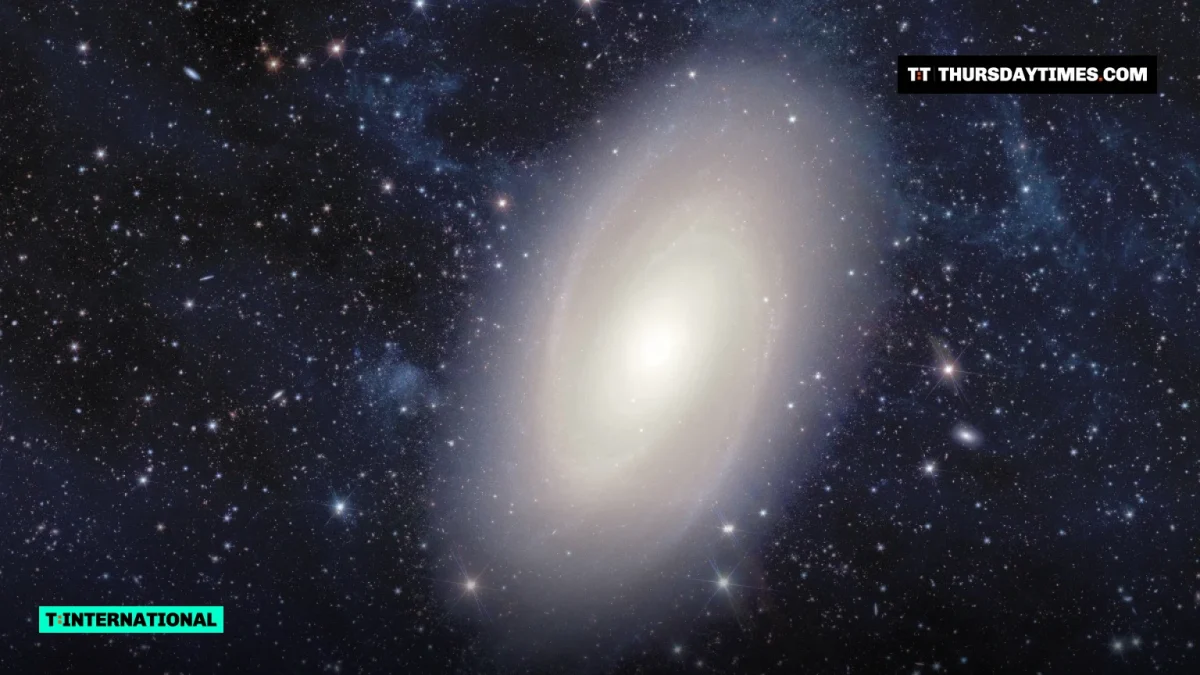
PARIS (The Thursday Times) — The European Space Agency’s Euclid space telescope has released its first major batch of data, cataloguing more than 900 million galaxies as it begins work on the largest three-dimensional map of the universe ever attempted.
The release, called DR1-Foundation and made public on Thursday, draws on about 13 months of observations. It covers 1,900 square degrees of sky, an area about the size of 9,500 full moons, and runs to 1.7 million gigabytes of data, the agency said.
Alongside the galaxies, it contains more than 60 million candidate quasars, the blazing cores of distant galaxies powered by supermassive black holes, spectra from more than 160 million sources, and around 15,000 candidates for strong gravitational lensing.
“These are far more than beautiful pictures; today marks a scientific milestone in our study of the cosmos,” said Carole Mundell, the agency’s director of science. Valeria Pettorino, Euclid’s project scientist, called it “a change in scale” from earlier releases, which covered a few days of observations over about 60 square degrees.
A hunt for the dark universe
Euclid was launched in July 2023 to study dark energy and dark matter, which together are thought to make up about 95% of the universe but cannot be seen directly. Its six-year survey will measure the shapes of billions of galaxies and the distances to millions of them.
Strong gravitational lensing, in which a foreground galaxy bends the light of a more distant one into arcs or rings, is one of its sharpest tools. Because the effect depends on how much mass, including dark matter, the nearer galaxy holds, it lets scientists weigh galaxies they cannot fully see.
Before Euclid, scientists knew of about 1,000 such lenses, said Andy Taylor of the University of Edinburgh, who leads the British science ground segment for the mission. The new catalogue holds about 15,000 probable cases, and around 170,000 are expected by the end of the mission.
Only the beginning
The release covers only about 14% of the sky Euclid will eventually map. The full first data release, due in mid-2027, will add weak lensing, the faint distortions that scientists will use to chart where dark matter sits across the cosmos, and data on how galaxies and clusters fit into the cosmic web.
Euclid is built and operated by the European Space Agency with contributions from NASA. The Euclid Consortium, which provides its instruments and analyses its data, includes more than 2,000 scientists from 300 institutes in Europe, the United States, Canada, and Japan.