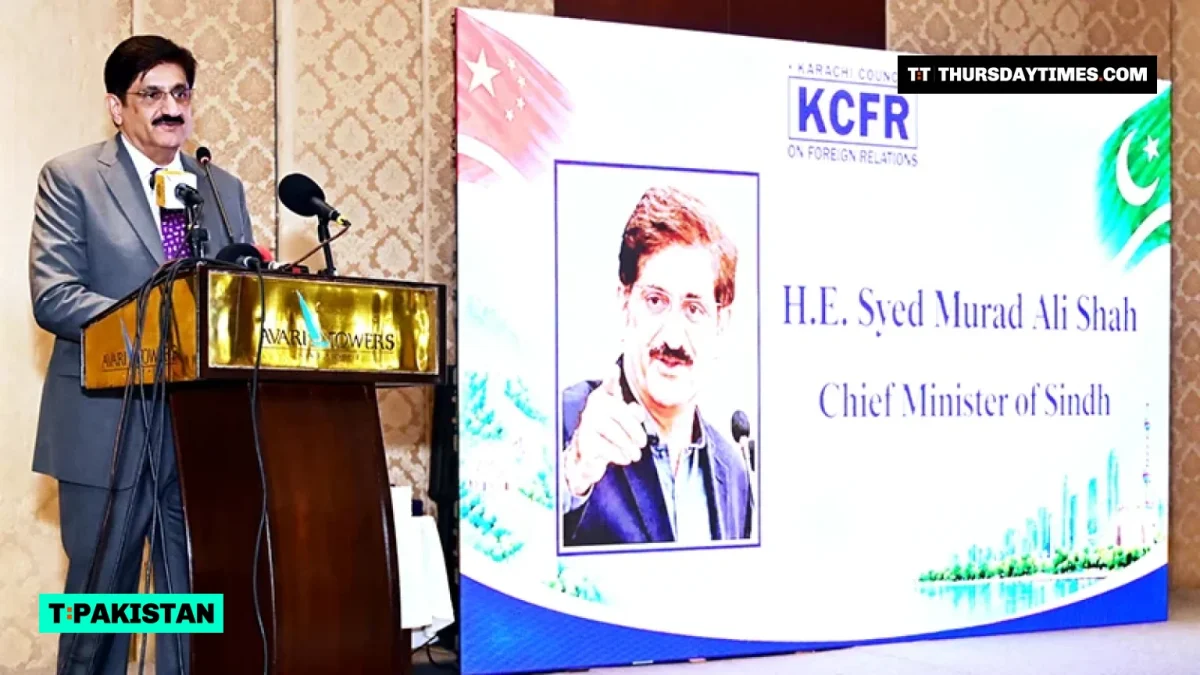
KARACHI (The Thursday Times) — Sindh Chief Minister Syed Murad Ali Shah has proposed a pilot project in one Karachi district modelled on Wuhan’s integrated city management system, starting with everyday problems such as waterlogging and flooded roads.
He was speaking on Wednesday at a seminar on “Understanding China’s Governance and Deepening China-Pakistan Cooperation”, organised by the Karachi Council on Foreign Relations at a local hotel. The event was attended by China’s Acting Consul General, Dr Feng Deheng, the council’s chairperson, Nadira Panjwani, diplomats, officials, and representatives of different sectors.
What the pilot would do
Shah said that during his recent visit to Hubei and Shanghai he saw Wuhan’s City Operation and Management Centre, where different departments work through one system that lets authorities monitor urban problems, spot risks, and respond quickly to public complaints. He proposed a similar mechanism in one Karachi district, with clear responsibility for receiving complaints, mobilising the departments concerned, and ensuring timely responses.
He said Chinese municipal experts, Pakistani officials, engineers, and universities could develop the system together and train local teams. Its success would be judged by faster response times and better public services, he added, before any expansion to other areas.
Three lessons from China
Marking 75 years of diplomatic relations between Pakistan and China, the chief minister named three lessons from China’s development model: continuity of policy, coordination among government departments, and a focus on measurable results for ordinary people. He also pointed to China’s poverty reduction as an example of how farm productivity, industry, jobs, and infrastructure can transform rural communities.
On Thar, where Pakistani and Chinese partners work together under CPEC, he said projects should be judged not only by output but also by jobs created for local youth, the role of local businesses, and better drinking water and public services.
He called for sustained cooperation between Karachi and Shanghai, which have been sister cities since 1984, on water management and urban transport. He also pointed to links between universities, including teacher training with Central China Normal University and farm research on hybrid rice, seed production, and modern farming, and said a proposed Joint Cooperation Council between Sindh and Hubei could give those efforts a regular platform.
Dr Feng said China had lifted more than 700 million people out of poverty over four decades of reform and opening up, and that Beijing respected Pakistan’s independent choice of a development path and was ready to share its governance experience.
Ms Panjwani said Pakistan and China needed to move beyond diplomatic engagement and strengthen connections between institutions, universities, businesses, and people.