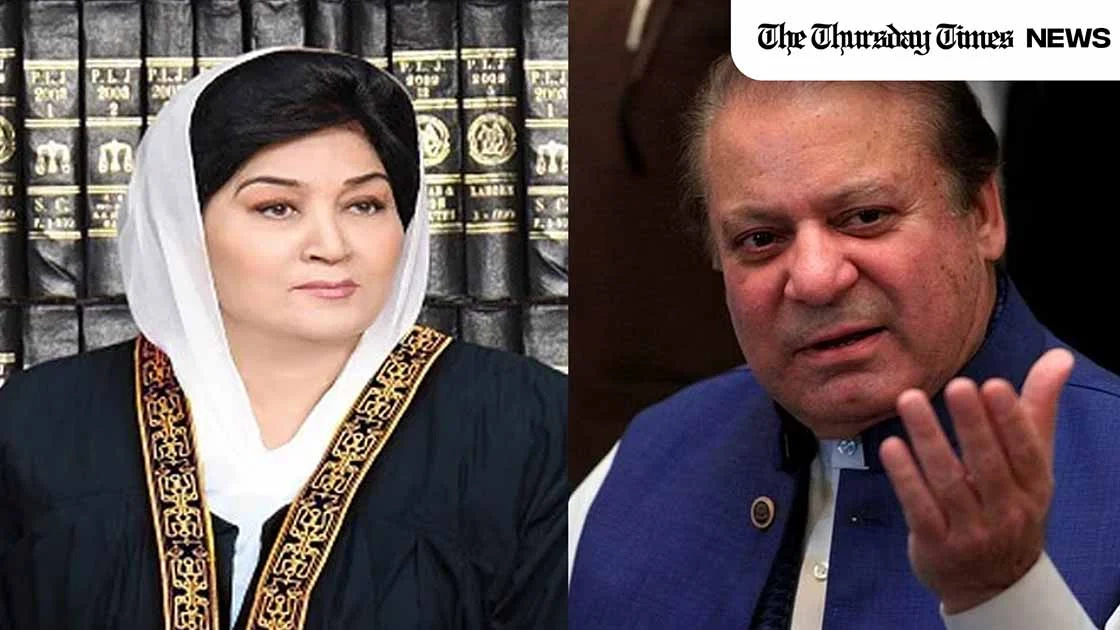
Islamabad (The Thursday Times) — Justice Musarrat Hilali, a member of the Supreme Court's constitutional bench, has said that all the sections in the FIRs of 9 May were from the Anti-Terrorism Act, so how did a military trial take place. In a military court, the officer who conducts the trial does not himself announce the verdict in court; how can an officer who did not hear the trial at all give the verdict? An army chief's aircraft was told, with the airport lights switched off, to leave the country; in that incident all the passengers were put at risk; that one incident led to martial law in the country; even after martial law, that trial was not held in a military court.
Hearing of intra-court appeals against the trial of civilians in military courts
A seven-member constitutional bench of the Supreme Court of Pakistan, headed by Justice Aminuddin Khan, has heard intra-court appeals against the trial of civilians in military courts. The constitutional bench includes Justice Jamal Khan Mandokhail, Justice Muhammad Ali Mazhar, Justice Hasan Rizvi, Justice Musarrat Hilali, Justice Naeem Akhtar Afghan and Justice Shahid Bilal.
During today's hearing, Justice Jamal Khan Mandokhail remarked that the Army Act applies only to the army, and that whether military officers receive fundamental rights and justice or not, we will keep everyone in view.
How can an officer who did not hear the trial at all give the verdict in a military court? Justice Musarrat Hilali
Justice Musarrat Hilali remarked: clarify this point as well, who writes the judgment in a military court? The officer who conducts the trial does not himself announce the verdict in court; the officer who conducts the trial sends the case to another commanding officer, who announces the verdict; how can an officer who did not hear the trial at all give the verdict?
Khawaja Haris, counsel for the Ministry of Defence, replied that the assistance of the JAG Branch is obtained for writing the judgment.
Does the army officer conducting the trial have so much experience and mastery that even death sentences are handed down? Justice Jamal Khan Mandokhail
Justice Jamal Khan Mandokhail remarked: does the army officer conducting the trial have so much experience and command that he can even pronounce a death sentence? Satisfy us on the procedure for trials in military courts. I have been in the legal profession for 34 years and still do not consider myself an expert. Does this army officer have so much experience and command that a death sentence can even be handed down?
Khawaja Haris, counsel for the Ministry of Defence, replied that he would set out the procedure for military trials in full in the second part of his arguments.
Justice Jamal Khan Mandokhail remarked that there is a difference between the Army Act and other laws, that according to the Constitution it protects all fundamental rights, and that a reasonable explanation is given in the law.
Justice Naeem Akhtar Afghan remarked that he too had heard many court martial cases in Balochistan.
The Army Act is a special law, and the evidence and trial procedure under special laws are different: Khawaja Haris
Justice Hasan Azhar Rizvi said that in a field court martial there is a defending counsel but there are no judges, and that the article on fair trial contains fundamental human rights. He asked Khawaja Haris to explain how trials are being conducted in military courts and what their stages are. He said everyone understands that trials in military courts are not like those in civilian courts, and asked for an example of a trial in a military court.
Khawaja Haris, counsel for the Ministry of Defence, argued that the Army Act is a special law, and that the evidence and trial procedure under special laws are different.
Trials in military courts are also like those in ordinary courts: Justice Naeem Akhtar Afghan
Justice Naeem Akhtar Afghan remarked that a court martial also offers the facility of engaging a counsel of one's choice, and that trials in military courts are also just like those in an ordinary court.
Justice Hasan Azhar Rizvi said that he had appeared before a military court as defence counsel, and that an officer is also appointed as a friend of the accused alongside the counsel.
Justice Jamal Khan Mandokhail asked whether the officer sitting in a military court is so perfect that he can determine such a severe sentence.
Only officers sit in courts martial the world over. Justice Muhammad Ali Mazhar
Justice Musarrat Hilali remarked that Khawaja sahib had given an example, saying that military trials had also taken place in America, and asked who the judge is if such a trial is held in another country.
Justice Muhammad Ali Mazhar said that only officers sit in courts martial the world over.
Counsel Khawaja Haris said that the officers who sit in courts martial have experience of conducting trials.
An army chief's aircraft was told to leave the country after the airport lights were switched off. Justice Musarrat Hilali
Justice Muhammad Ali Mazhar said that the lady judge was asking whether these officers also have legal qualifications.
Justice Musarrat Hilali remarked: if permitted, may I ask the question myself? An army chief's aircraft was told to leave the country after the airport lights were switched off, and in that incident all the passengers were put in danger.
How could a man who was not on the aircraft hijack it? Khawaja Haris
Khawaja Haris, counsel for the Ministry of Defence, replied: how could a man who was not on the aircraft hijack it?
Justice Musarrat Hilali remarked that the aircraft had only a little fuel left, yet it was put at risk.
Khawaja Haris submitted that he would not speak about politics here, but that the Supreme Court had later reviewed the matter and had accepted that there was sufficient fuel left in the aircraft.
Justice Musarrat Hilali remarked that martial law was imposed in the country because of that one incident, and that even after martial law that trial was not held in a military court.
Hijacking is not an offence listed in the Army Act. Khawaja Haris
Khawaja Haris, counsel for the Ministry of Defence, said that hijacking is not an offence listed in the Army Act, which is why that trial could not have been held in a military court.
Justice Aminuddin Khan remarked that the difference on this point was now clear, and asked him to move on.
Justice Musarrat Hilali said: wait, one more question arises here. If a warplane or military aircraft is hijacked, where will the trial be held?
Justice Jamal Khan Mandokhail remarked that the government had the majority, and asked who could stop it from putting hijacking and 302 into the Army Act tomorrow as well.
Charges in the 9 May cases were under the Anti-Terrorism Act, so how did a military trial take place? Justice Musarrat Hilali
Justice Musarrat Hilali said that all the sections invoked in the FIRs for 9 May were from the Anti-Terrorism Act, and that she did not know how a military trial had then taken place under those sections.
Additional Attorney General
During the hearing, Additional Attorney General Muhammad Amir Rehman told the court that the military courts took only those 105 accused whose presence at the scene had been established, although the number of accused was more than 5,000.
Hearing adjourned until Monday
The arguments of Khawaja Haris, counsel for the Ministry of Defence, were not completed today either, and the Constitutional Court of the Supreme Court adjourned the hearing of the case until Monday.