
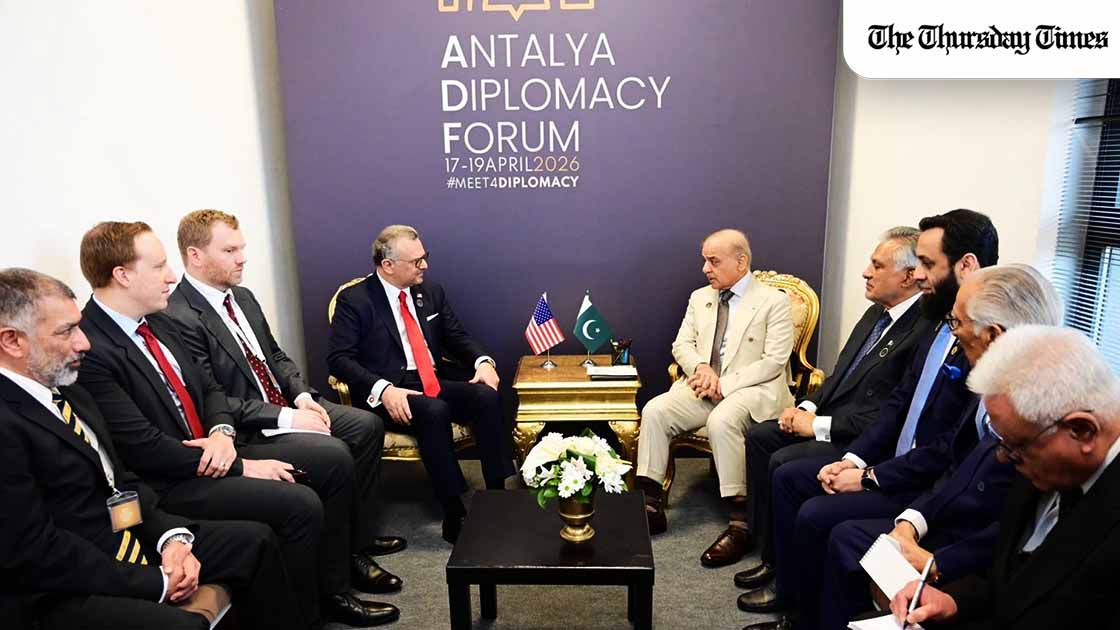
ANTALYA (The Thursday Times) — A senior United States adviser has publicly praised Pakistan’s role in international diplomacy after a high-level meeting with Prime Minister Shehbaz Sharif and Deputy Prime Minister Ishaq Dar at the Antalya Diplomacy Forum, in a signal that Washington continues to view Islamabad as a useful partner in regional peace efforts.
Excellent meeting with the Prime Minister of Pakistan, Muhammad Shehbaz Sharif, and his Deputy Prime Minister and Foreign Minister, Senator Mohammad Ishaq Dar, at the Antalya Diplomacy Forum. I reemphasized our appreciation for the Prime Minister’s tireless efforts and… pic.twitter.com/dVYaHNWMb0
— U.S. Senior Advisor for Arab and African Affairs (@US_SrAdvisorAF) April 22, 2026
In a statement posted after the meeting, the U.S. Senior Advisor for Arab and African Affairs, Massad Boulos, said discussions with Pakistan’s leadership were “excellent” and specifically thanked Mr Sharif for what he described as his “tireless efforts and effectiveness as a facilitator of negotiations.”
The remarks are notable because they place Pakistan once again inside sensitive diplomatic conversations at a time of heightened volatility across the Middle East, the Red Sea corridor and wider South Asia. Public acknowledgements from senior American officials are often carefully worded, and praise for a foreign leader’s role as a negotiator is rarely accidental.
The adviser also thanked Pakistan for its “continued contributions to regional and global stability,” language that suggests Washington sees Islamabad as more than a bilateral security partner. Instead, it points to a broader role in crisis management, message-carrying and behind-the-scenes engagement with multiple capitals.
For Pakistan, the meeting offers another opportunity to reshape its international image. For years, Islamabad was often viewed abroad through the lenses of security turbulence, domestic political instability and economic strain. In recent months, however, Pakistani officials have sought to present the country as a bridge-builder able to maintain dialogue with Western capitals, Gulf powers and key Asian partners simultaneously.
Mr Sharif has increasingly framed diplomacy as central to Pakistan’s foreign policy, emphasising de-escalation, trade connectivity and strategic balance. Mr Dar, who has handled much of the external outreach, has also been active in contacts with regional governments over conflict prevention and diplomatic coordination.
The U.S. adviser’s statement also included praise for Donald Trump, saying Pakistan’s prime minister had commended the American president’s leadership in advancing peace and highlighted the importance of his continued engagement. That portion of the message indicates Pakistan is positioning itself as supportive of renewed U.S.-led diplomatic momentum, particularly where direct communication between rivals remains difficult.
The setting itself was significant. The Antalya Diplomacy Forum has increasingly become a gathering place for states seeking quiet conversations away from more formal summit structures. Held in Antalya, the forum has developed a reputation for hosting parallel meetings where public symbolism and private negotiation often overlap.