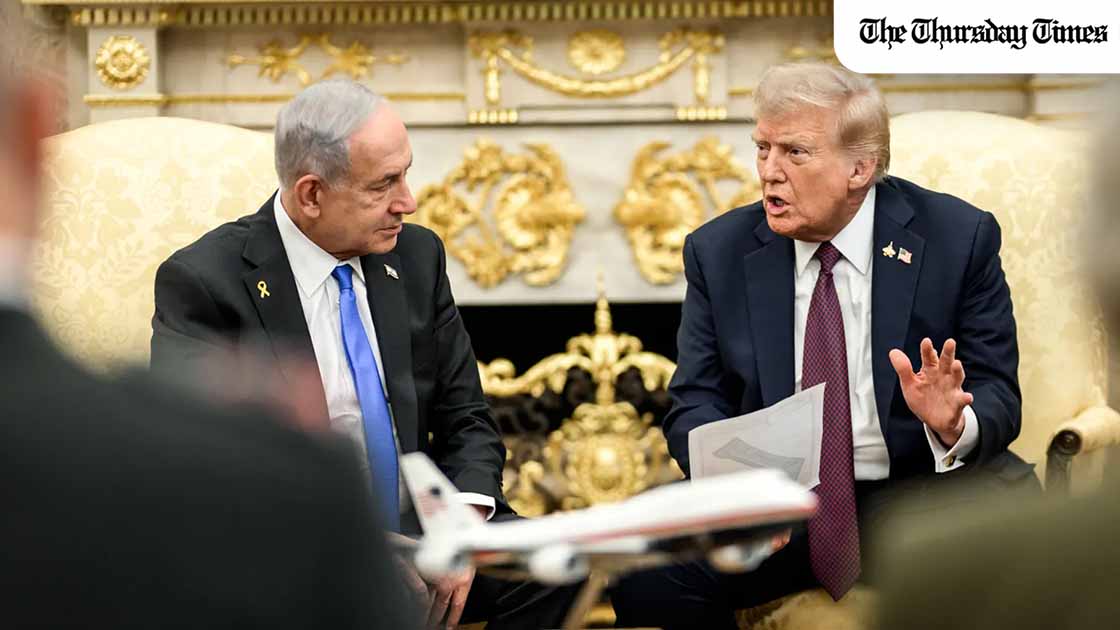
WASHINGTON (The Thursday Times) — US President Donald Trump reportedly pressed Israeli Prime Minister Benjamin Netanyahu to pull back from planned strikes on Beirut during a tense phone call on Monday, after Israel’s military escalation in Lebanon threatened to disrupt ongoing US-Iran diplomacy.
Axios reported, citing two US officials and a third source briefed on the call, that Trump sharply criticised Netanyahu over Israel’s actions in Lebanon and warned that any move to bomb Beirut would further isolate Israel internationally.
The call came as Washington and Tehran were negotiating a memorandum of understanding aimed at ending the fighting in Lebanon and creating a framework for resolving the wider Iran-US conflict, according to Axios. Trump was reportedly angered by the prospect that Israel’s escalation could derail those talks.
A second Axios report said Trump intervened to halt Israel’s plan to bomb Hezbollah positions in Beirut after Iran threatened to pull out of negotiations with the United States. Shortly after the call, an Israeli official told Axios that Israel no longer planned to strike Hezbollah targets in Beirut.
Reuters also reported that Trump said Israeli troops would not go to Beirut following his call with Netanyahu. The agency said Trump had spoken to Netanyahu and, through intermediaries, to Hezbollah, while efforts continued to prevent further escalation in Lebanon.
According to Axios, one US official said Trump told Netanyahu that carrying out strikes on Beirut would deepen Israel’s global isolation. A second source briefed on the call told Axios that Trump was furious and used an expletive while questioning Israel’s actions.
Time magazine separately reported that a US official said Trump told Netanyahu: “You’d be in prison if it weren’t for me. I’m saving your ass. Everybody hates you now. Everybody hates Israel because of this.”
After the call, Trump wrote on Truth Social that he had held a “very productive call” with Netanyahu and that there would be no troops going to Beirut, adding that any troops already on their way had been turned back.
Netanyahu’s office did not respond to Axios’s request for comment. In a separate statement reported by Israeli and international media, Netanyahu indicated that Israel would continue operations in southern Lebanon while maintaining pressure on Hezbollah.
The diplomatic pressure came after Iran warned that Israeli actions in Lebanon could jeopardise talks with Washington. Iran’s Foreign Minister Abbas Araghchi said the US-Iran ceasefire applied across all fronts, including Lebanon, and that a violation on one front would amount to a violation of the broader ceasefire.
Iran’s state-affiliated Tasnim News Agency had earlier reported that Tehran was threatening to abandon negotiations over Israel’s actions in Lebanon. The warning raised the stakes for Washington’s regional diplomacy, which has sought to prevent the Lebanon front from collapsing into a wider confrontation.
According to Axios, a revised peace memorandum was drafted by Qatar and Pakistan, with input from Saudi Arabia, Turkey and Egypt, in an effort to bridge the gaps between Washington and Tehran. A US source briefed on the call told Axios that mediators were working on a “letter of intent” that the United States and Iran would sign to formally end the war and begin a 30-day period of negotiations on issues including Iran’s nuclear programme and the reopening of the Strait of Hormuz.
Pakistan has played a prominent role in the mediation process. Trump said on 27 May that he had given Iran a chance because Pakistan had asked him to, praising Field Marshal Asim Munir and Prime Minister Shehbaz Sharif. On 29 May, Trump posted proposed deal terms from the Situation Room as Pakistan’s Deputy Prime Minister and Foreign Minister Ishaq Dar was in Washington for talks with US Secretary of State Marco Rubio.
The European Union also formally recognised Pakistan’s mediation role in a joint communiqué issued on 1 June, with European Commission Vice-President Kaja Kallas commending Islamabad’s efforts to prevent a return to full-scale war and support a diplomatic opening.
The episode underlines the fragile balance behind Washington’s regional diplomacy. Trump is seeking to preserve a pathway towards a deal with Iran, while Netanyahu has remained sceptical of negotiations and has argued for continued military pressure on Iranian-aligned forces.
According to Axios, Trump’s anger was directed at Israel’s actions in Lebanon and the risk they posed to the diplomatic track, not at the mediators or Iran’s position at the negotiating table.