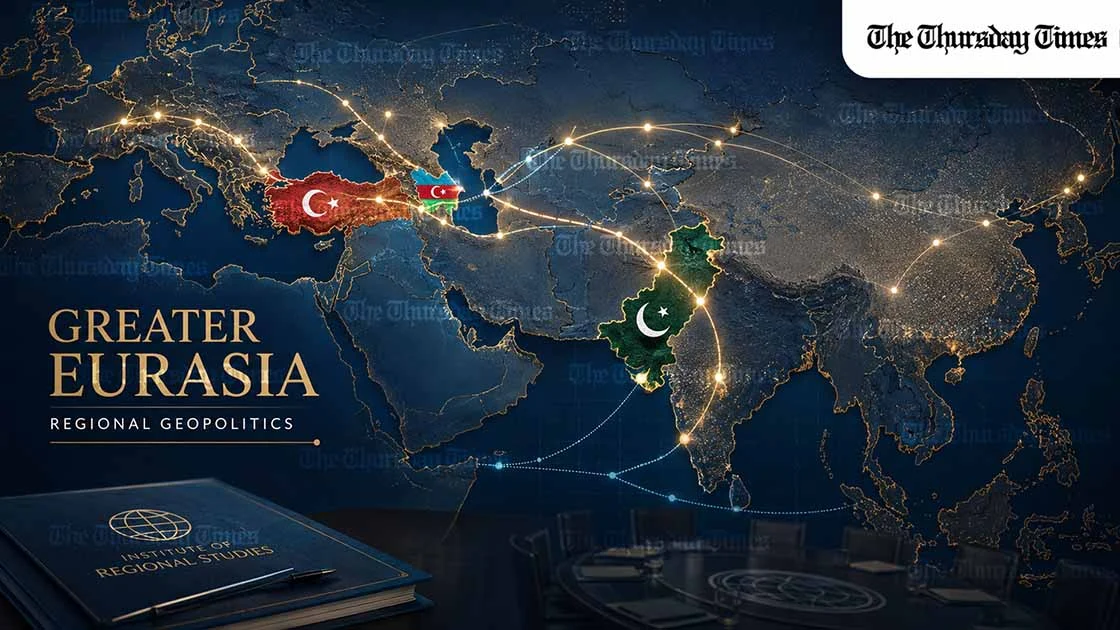
ISLAMABAD (The Thursday Times) — The Institute of Regional Studies convened a high-level seminar in Islamabad on Wednesday under the title “Recalibrating Regional Geopolitics in the Age of Greater Eurasia”, bringing together senior diplomats and scholars from Pakistan, Türkiye and Azerbaijan to examine the shifting strategic landscape across Eurasia.
The discussion placed regional connectivity, economic cooperation and strategic alignment at the centre of Pakistan’s evolving foreign policy outlook, as speakers argued that the emerging Eurasian order is being shaped less by old blocs and more by corridors, partnerships and regional power centres.
The session was chaired by IRS President Ambassador Jauhar Saleem and featured Ambassador Aizaz Ahmad Chaudhry, former Foreign Secretary of Pakistan, Prof. Dr. Ramazan Erdağ, Chairman of the Strategic Research Center in Ankara, Dr. Farid Shafiyev, Chairman of the Center of Analysis of International Relations in Azerbaijan and Prof. Dr. Ismail Numan Telci of Ibn Haldun University in Istanbul.
In his opening remarks, Ambassador Jauhar Saleem said Pakistan, Türkiye and Azerbaijan share deep historical bonds, strategic convergence and growing cooperation across diplomatic and economic fields. He underlined the importance of regional connectivity, particularly projects such as the China Pakistan Economic Corridor, in linking Central Asia with the Caspian region and beyond.
Saleem also referred to the impact of rising tensions between Iran and the United States, noting that instability in West Asia continues to affect the wider strategic environment. His remarks placed Pakistan’s regional diplomacy within a broader geopolitical moment in which Eurasia, the Middle East and South Asia are increasingly connected.
Prof. Dr. Ramazan Erdağ condemned recent terrorist attacks in Pakistan and reaffirmed Türkiye’s solidarity with the Pakistani people. He said regional geopolitics can no longer be understood without examining connectivity corridors, trade routes and the infrastructure that links states across Asia and Europe.
Erdağ identified CPEC and the Middle Corridor as key platforms for expanding Pakistan Türkiye cooperation. He called for deeper bilateral trade, stronger economic collaboration, renewable energy partnerships and closer strategic coordination between Islamabad and Ankara.
Prof. Dr. Ismail Numan Telci focused on Türkiye’s expanding strategic role across Libya, Somalia, Syria and Gaza, arguing that Ankara’s foreign policy has become increasingly active across multiple theatres. He also recognised Pakistan’s diplomatic efforts during recent tensions involving the United States and Iran.
Telci emphasised the importance of Islamic solidarity and stronger cooperation through the Organisation of Islamic Cooperation. He said Pakistan and Türkiye should build deeper partnerships in trade, security and diplomacy, while also noting their shared positions on Palestine and Kashmir.
Dr. Farid Shafiyev highlighted the growing value of trilateral cooperation among Azerbaijan, Türkiye and Pakistan. He said the Caspian region is becoming central to Eurasian connectivity and that new trade corridors could link Central Asia more directly with Pakistan.
Referring to the “One Nation, Two States” relationship between Azerbaijan and Türkiye, Shafiyev called for deeper economic, political and strategic cooperation among like-minded regional partners. He also discussed the normalisation process between Azerbaijan and Armenia, describing it as part of a wider opportunity for regional peace and integration.
Ambassador Aizaz Ahmad Chaudhry described Greater Eurasia as an emerging multipolar space stretching from the Atlantic to the Pacific. He said competition among the United States, China and Russia is intensifying, while confidence in multilateral institutions is declining.
Chaudhry argued that in this changing environment, regional alliances and strategic partnerships are becoming more important. He said Pakistan’s cooperation with Türkiye and Azerbaijan offers Islamabad a meaningful platform in a wider Eurasian order shaped by economic corridors, regional alignments and shifting centres of influence.
The seminar concluded with an interactive question and answer session, followed by closing remarks from Ambassador Jauhar Saleem. The event also included the signing of a memorandum of understanding to enhance strategic cooperation and the distribution of commemorative shields.∎