
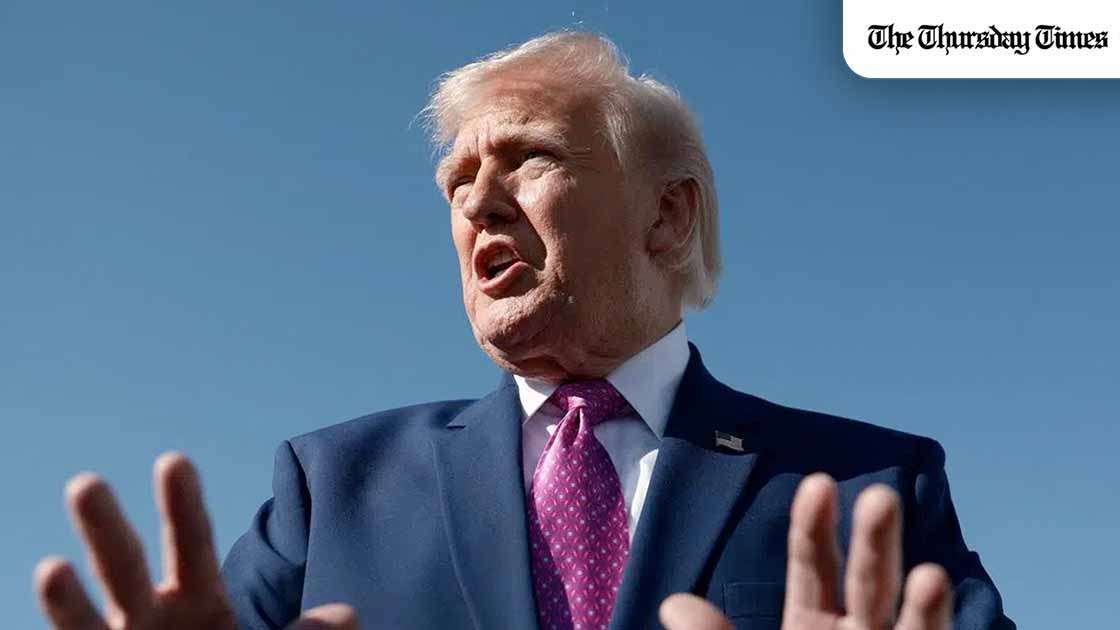
WASHINGTON (The Thursday Times) – President Donald Trump has issued one of his clearest warnings yet against further escalation in Lebanon, saying Israel’s latest attack on Beirut “should not have happened” at a moment when Washington says it is close to securing a peace deal with Iran.
In a post on Truth Social on Sunday, Trump said Israel retained the right to defend itself, but argued that the incident which prompted the Beirut strike was too limited to justify an action that could disrupt a much larger diplomatic breakthrough. His message was direct: Israel should launch no further attacks anywhere in Lebanon, while Hezbollah and all other parties must also halt attacks against Israel.
The statement appeared designed to do two things at once. It reassured Israel that Washington still recognises its security concerns, but it also publicly signalled that those concerns cannot be allowed to overwhelm a peace process that Trump now portrays as entering its final stretch.
That balance matters because the Beirut strike came at a highly sensitive moment. The United States and Iran have been edging towards a framework that could reopen the Strait of Hormuz, reduce the risk of a wider regional war, and begin a longer process over Iran’s nuclear programme. Any fresh fighting in Lebanon risks giving opponents of the deal, in Tehran, Tel Aviv and elsewhere, a reason to harden their positions.
Trump’s language also marked a notable shift in tone. Rather than simply urging restraint in general terms, he named Israel, Hezbollah and other regional actors, placing responsibility on every side not to sabotage what he called the beginning of a “long and beautiful peace”.
For Pakistan, the moment carries diplomatic weight. Prime Minister Shehbaz Sharif and Field Marshal Asim Munir have been associated with Islamabad’s quiet effort to keep channels open between Washington and Tehran, positioning Pakistan not as a spectator to Middle Eastern instability, but as a regional state attempting to reduce it. If the deal holds, it would strengthen Islamabad’s claim that patient diplomacy can still produce results in a region often defined by force.
The challenge now is whether Trump’s public warning can restrain the battlefield long enough for diplomacy to move from announcement to agreement. Iran has already signalled concern that Israeli action in Lebanon raises doubts about whether Washington can control the wider process. Israel, meanwhile, remains under pressure from security hawks who view any accommodation with Tehran as a strategic concession.
That is why the Beirut strike is more than another flashpoint. It is a stress test for the emerging deal. If the violence spreads, the negotiations could be derailed before they are formalised. If the parties stand down, Trump may be able to claim that his pressure helped prevent a local attack from becoming a regional rupture.
For now, the message from Washington is unmistakable: the deal is close, the window is narrow, and nobody is being given permission to blow it.