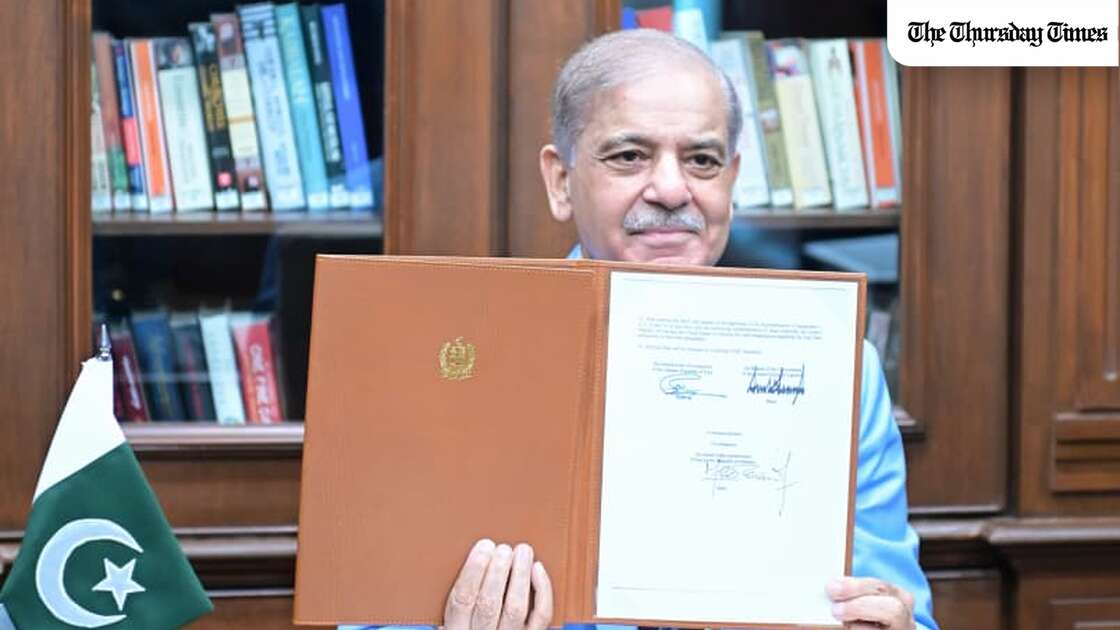
ISLAMABAD (The Thursday Times) — Prime Minister of Pakistan Muhammad Shehbaz Sharif has signed the Islamabad Memorandum of Understanding, known as the Islamabad MoU, in his capacity as mediator, after the agreement was formally signed by US President Donald J Trump and Iranian President Masoud Pezeshkian.
The signing places Pakistan at the centre of the diplomatic breakthrough, with Islamabad acting not merely as a host or facilitator but as the recognised mediator between Washington and Tehran.
The Islamabad MoU is being presented as an interim framework to end hostilities, reopen the Strait of Hormuz and begin a structured process toward a final US-Iran settlement.
According to reports citing US officials, Trump and Pezeshkian completed the signing after an earlier digital process involving senior representatives from both sides. The agreement was initially expected to be finalised at a ceremony in Switzerland, but the signing was accelerated as diplomatic pressure built around the conflict and the closure of one of the world’s most important maritime corridors.
Sharif’s role gives the agreement a distinct Pakistani imprint. The name Islamabad MoU itself reflects the mediation channel through which Pakistan, supported by Qatar and other regional actors, helped move the United States and Iran from indirect engagement toward a written framework.
The memorandum is understood to include an immediate and permanent termination of military operations on all fronts, including Lebanon, while also requiring both sides to refrain from threats or the use of force against each other. It is designed as a ceasefire and negotiation document rather than a final peace treaty.
A central provision concerns the Strait of Hormuz. Iran is expected to restore safe commercial shipping through the strait, while the United States is expected to begin lifting blockade-related measures. The reopening of the strait is one of the most urgent economic elements of the deal because of its importance to global energy supplies.
The agreement also creates a 60-day negotiating window for a final settlement. Those talks are expected to cover sanctions relief, nuclear guarantees, regional security arrangements and the verification mechanisms needed to turn the interim understanding into a binding diplomatic settlement.
On the nuclear issue, the framework reportedly includes Iran’s reaffirmation that it will not seek nuclear weapons, while leaving more detailed questions over enriched uranium and inspection procedures for technical talks. International Atomic Energy Agency supervision is expected to remain central to any credible implementation process.
US Vice President JD Vance has said Pakistani and Qatari negotiators who helped mediate the agreement asked Washington not to release the full text immediately. He said the text would be made public by Friday at the latest, while describing the framework as a deal that Washington wants to explain directly to the American public.
Pakistan’s mediation has also been linked to weeks of quiet diplomacy involving Sharif’s government, senior Pakistani officials and regional partners. Islamabad has presented the deal as a contribution to regional stability rather than a narrow bilateral intervention.
For Sharif, signing the document as mediator is politically significant. It places Pakistan’s civilian leadership in the formal record of the agreement and strengthens Islamabad’s claim that it helped prevent a wider regional escalation at a critical moment.
The accord has already drawn mixed international reaction. Supporters see it as a necessary pause in a dangerous conflict and a possible path back to diplomacy. Critics argue that the framework leaves several major questions unresolved, particularly over sanctions relief, Iranian compliance and the enforcement of nuclear commitments.
The next test will be implementation. The reopening of Hormuz, the lifting of blockade measures, the release of the full text and the start of technical negotiations will determine whether the Islamabad MoU becomes the foundation of a lasting settlement or remains a fragile interim document.
For Pakistan, however, the diplomatic symbolism is already clear. By signing as mediator after Trump and Pezeshkian endorsed the agreement, Shehbaz Sharif has placed Islamabad at the centre of one of the most consequential diplomatic developments between the United States and Iran in years.