

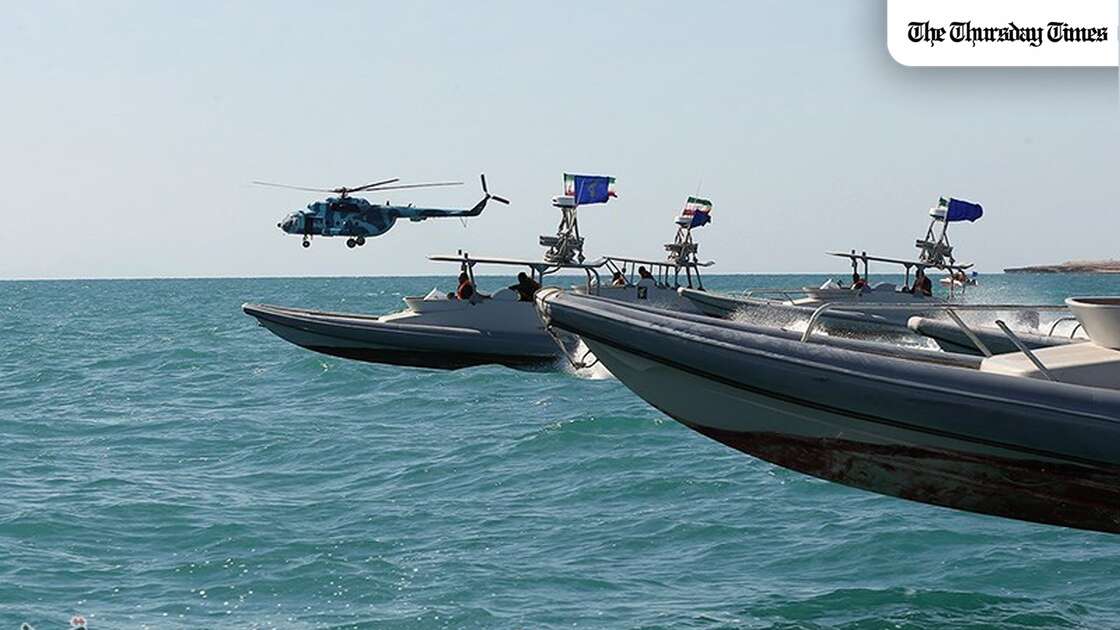
TEHRAN (The Thursday Times) — Iran’s top joint military command has said the Strait of Hormuz will be closed to vessel traffic, citing alleged violations of a ceasefire agreement by the United States and Israel, according to Iranian Tasnim News Agency.
The announcement was attributed to Iran’s Khatam al-Anbiya Central Headquarters, which described the closure as a first step in response to what it called breaches of commitments under the recent understanding between Washington and Tehran.
The development follows mounting warnings from Iranian media outlets, including Tasnim News Agency, that Tehran should keep the strategic waterway closed and cancel further negotiations unless Israel halts its operations in southern Lebanon and withdraws from Lebanese territory.
Tasnim reported on Friday that continued Israeli attacks in southern Lebanon and failure to withdraw from occupied areas amounted to a complete violation of the Islamabad memorandum of understanding between Iran and the United States.
The outlet argued that the Strait of Hormuz should remain closed until the halt of Israeli military activity and withdrawal from Lebanese territory are achieved, adding that reopening the waterway without implementation of the MoU would weaken Iran’s leverage.
The Strait of Hormuz is one of the world’s most sensitive maritime chokepoints, carrying a major share of global seaborne oil and gas traffic from the Gulf. Any sustained disruption would carry immediate consequences for energy markets, shipping insurance and regional security.
Reuters reported that Iran’s high command said the closure was being taken because of alleged US and Israeli truce violations. It also warned that further measures could follow if what Tehran described as aggression continued.
At the same time, the status of the waterway remains contested. US Vice President JD Vance said in a Fox News interview, cited by Reuters, that he saw no evidence the Strait of Hormuz had actually been closed and expressed confidence that the ceasefire framework could still hold.
Axios also reported that a senior US defence official said American forces had not seen Iranian military movements on the ground that reflected a physical closure of the strait, even after Iran’s armed forces announced the move.
The dispute places the newly announced MoU under early pressure. Tasnim previously reported that negotiations over the final text had included disagreements over Article One and provisions related to maritime navigation services in the Strait of Hormuz.
According to Tasnim’s earlier account, Iran and Oman had sought language on the administration of maritime navigation services in Hormuz, while the reopening process was tied to the signing and implementation of the memorandum rather than an immediate unilateral step.
The latest reports suggest that Lebanon has become central to Iran’s interpretation of the MoU. Tasnim said Foreign Minister Abbas Araqchi had linked the first clause of the agreement to Israeli withdrawal from Lebanese territory.
Iran International reported that Tasnim, described as IRGC-affiliated, had urged Iranian authorities to close the Strait of Hormuz and end implementation of the Iran-US MoU, citing Israeli attacks in southern Lebanon.
The closure claim therefore sits at the intersection of three pressure points: the US-Iran understanding, Israel’s military operations in Lebanon and the security of Gulf energy shipping. Each now appears capable of affecting the others.
For global markets, the question is whether Iran’s announcement becomes an enforceable naval blockade or remains a political and strategic warning. Shipping data, US military assessments and future Iranian deployments will be closely watched in the coming hours.
The immediate diplomatic challenge for mediators is to prevent the Hormuz dispute from derailing the broader US-Iran process, particularly if Tehran insists that progress depends on what it views as full implementation of the MoU in Lebanon as well as in the Gulf.