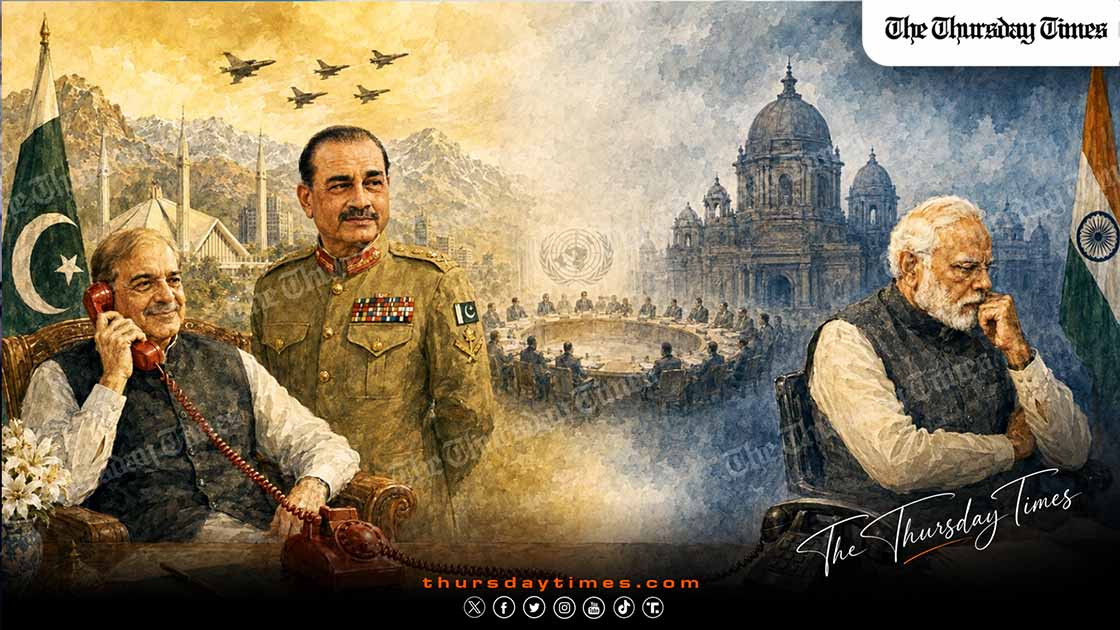
THERE IS A PARTICULAR BRAND of silence that follows an unanswered phone call between capitals, and for much of Donald Trump’s first year back in the White House, that silence sat over Islamabad. Pakistan’s prime minister could not get through. Two years on, the silence belongs to New Delhi instead, and the story of how that reversal happened is, more than anything else, the story of Pakistan’s foreign policy over the past two years.
It began, improbably, in the sky. On May 7, 2025, more than forty Pakistani jets met a larger Indian force, upward of eighty aircraft, in what would become the first jet-era dogfight between two nuclear-armed states. Pakistan’s military briefings called the result “Six-Nil”: six Indian aircraft downed, three of them French-made Rafales, against no Pakistani losses. India has never accepted that tally, and the true cost of those four days may never be settled to both nations’ satisfaction. What is beyond dispute is what happened next in the court of global opinion, because the man who did more than anyone to keep the story alive was not a Pakistani official at all. It was the president of the United States.
“Seven brand-new, beautiful planes were shot down,” Trump told business leaders in Tokyo that October, a full five months after the ceasefire, still marveling at the encounter as though it had happened the week before. He had said five jets earlier that year. By November it was eight. By February 2026, addressing Fox Business, the number had climbed to ten: “Ten planes were shot down,” he said, folding the claim into a boast about the eight wars he believed he had personally ended. He never once specified whose aircraft he meant. It hardly mattered. Each retelling was, in effect, free advertising for the notion that something extraordinary had happened over Kashmir’s skies that May, and that Pakistan had been the one to prove it.
Contrast this with the fate of the country Trump was, by his own account, trying to save. In February 2025, Narendra Modi had been the second foreign leader welcomed to Trump’s White House, a visit thick with warmth and photo opportunities. By August, warmth had curdled into a 50 percent tariff, among the harshest Washington has levied on any trading partner, imposed not long after New Delhi flatly rejected Trump’s claim to have brokered the ceasefire with Pakistan. No return visit to India followed. No Quad summit convened. A long-promised trade deal simply stopped being mentioned. The Diplomat summarized the year in a headline that Pakistani officials have quietly enjoyed ever since: Pakistan had conquered Washington while India lost Trump.
Where India pushed back on the American narrative, Pakistan leaned into it. Islamabad amplified Trump’s mediation claims rather than disputing them and went so far as to nominate him for the Nobel Peace Prize, a piece of flattery that appears to have paid rich dividends. Field Marshal Asim Munir became, through 2025, a familiar face in Washington and at CENTCOM in a way no Pakistani military chief had managed in decades, his presence treated less as a courtesy call than as a fixture of the itinerary.
The warmth translated into something more durable than photographs. In September 2025, Missouri-based US Strategic Metals signed a $500 million framework with Pakistan’s Frontier Works Organization to build a critical minerals refinery, the first tangible outcome of Islamabad’s pitch to become a supplier to American industry rather than merely a recipient of American aid. Five months later, the US Export-Import Bank committed $1.25 billion to the Reko Diq copper-gold project in Balochistan, folding Pakistan into Project Vault, a $10 billion American effort to build mineral supply chains that do not run through Beijing. India spent the same stretch watching its currency slide to record lows against the dollar, its own trade relationship with Washington frozen in place.
If Washington was the year’s most dramatic reversal, the Gulf was its most methodical construction project, and here the comparison to India ceases to be a contrast and becomes something closer to an absence. The Strategic Mutual Defence Agreement Pakistan signed with Saudi Arabia in September 2025, a clause modeled on NATO’s Article 5, treating an attack on either signatory as an attack on both, became the cornerstone of everything that followed. It grew, in August 2026, into the trilateral Makkah Defence Pact, with Saudi Crown Prince Mohammed bin Salman and Turkish President Recep Tayyip Erdoğan joining Prime Minister Shehbaz Sharif at the signing. Kuwait ratified its own bilateral defense agreement with Pakistan the following month, while separately negotiating a far larger one. Libya signed a $4 billion arms deal and has since quietly accepted Pakistan as a mediator between its warring factions. And in August, Syria’s foreign minister made the first visit by a Syrian FM to Islamabad in nearly two decades, telling reporters that Damascus was “studying our options” on joining the Makkah pact outright. India has built no equivalent architecture in this region, in this period, at this pace.
China remains the deepest relationship of all, though it resists a simple story of India’s loss being China’s gain. Islamabad and Beijing marked 75 years of what both governments now call an “Ironclad Friendship” in 2026, a partnership Shehbaz Sharif’s May visit to Beijing deepened further with CPEC 2.0, a new bilateral security partnership, and cooperation reaching into space and artificial intelligence. Pakistan’s arms imports rose 66 percent between 2021 and 2025, almost entirely from Chinese suppliers, and analysts at India’s own Takshashila Institution have concluded that Chinese intelligence support and validated hardware played a real role in Pakistan’s showing during the May 2025 clash, an assessment worth stating plainly even as the underlying battle claims remain disputed. Yet China has hardly abandoned India. “The dragon and the elephant dancing together,” Xi Jinping wrote in a Republic Day message to New Delhi in January 2026, calling the two countries “friends and partners” in the same breath. Beijing, it turns out, can deepen one friendship without ending another. What sets Pakistan apart is not exclusivity but depth: a submarine program, a security pact, an economic corridor that India simply has no counterpart to.
Even inside the United Nations, the ground has moved. Pakistan is currently seated as a non-permanent member of the Security Council for the 2025-2026 term, its eighth turn at the table, elected in June 2024 with 182 of 193 possible votes. India currently holds no seat at all. From that platform, and from the wider 2026 debate over Council reform, Pakistan’s ambassador has warned bluntly against “creating new centres of privilege,” a direct shot at India’s long campaign for permanent membership. Some diplomats have quietly suggested India was among the states that opposed Pakistan’s own candidacy in that secret 2024 ballot, though no government’s vote has been confirmed. Separately, five UN special rapporteurs concluded in a report made public last December that India had not produced what they called credible evidence of Pakistani involvement in the Pahalgam attack before striking Pakistani territory and suspending the Indus Waters Treaty, actions the experts said may have violated international law. India has answered forcefully: its National Investigation Agency has since filed a formal chargesheet naming Pakistan-based militants in the attack, and its diplomats have used the same UN forums to accuse Pakistan of sponsoring terrorism outright. Neither side has moved the other.
Underneath all of it sits a reputation Pakistan has built with unusual deliberateness: that of the region’s trusted broker. Munir has traveled to Tehran at least three times this year alone, most recently as the mediation effort faces its toughest test yet, part of an effort that helped secure an April 8 ceasefire between the United States and Iran and brought both sides together in Islamabad for their highest-level direct talks since 1979. The same instinct has now reached Libya. India, by contrast, ended 2025 the way The Diplomat described it: having “found itself alone in times of crisis,” with no government willing to blame Pakistan even after Pahalgam, and its own military response widely read abroad as the escalatory move.
None of this is guaranteed to last, and it would be dishonest to pretend otherwise. Analysts at the National Interest and the Observer Research Foundation have both cautioned that Washington’s affection is transactional rather than strategic, and that no amount of Gulf diplomacy changes the fact that India’s economic and military weight will remain harder for the United States to walk away from than Pakistan’s goodwill is to keep.
But caution is not the same as refutation. Two years ago Pakistan could not get a phone call returned. Today it holds a Security Council seat, a defense pact stretching from Riyadh to Ankara to Kuwait City, a standing invitation from Damascus, and a mediator’s reputation that runs from Tehran to Tripoli. Whatever 2026 brings, the distance Pakistan has traveled, and the distance India has fallen, will not be easy for anyone to argue away. ∎