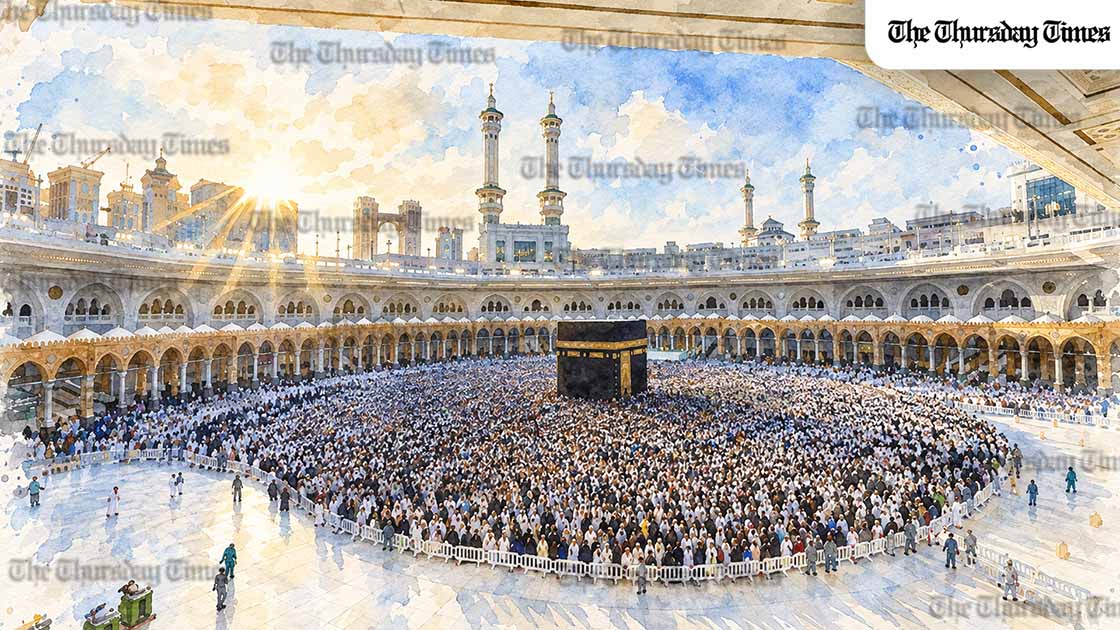
When explosive-laden drones were aimed at the holiest site in Islam this week, the question that mattered most in Islamabad was not whether Pakistan would respond. It was how, and that answer, deliberately, is not one Pakistan intends to give in advance.
Prime Minister Shehbaz Sharif called the attempted strike on Makkah Al-Mukarramah “reprehensible and unforgivable,” a description that will strike most Pakistanis as understatement rather than excess. For a country whose national identity is bound to the Haramain in a way few outside the Muslim world fully grasp, an attack of this kind is not a distant geopolitical event to be monitored from a safe remove. It is personal, and the government’s language, unusually raw for diplomatic communication, reflected that. Saudi forces intercepted and destroyed the drones before they reached the city. That the attempt was made at all is what has changed the calculus.
Pakistan’s answer to what happens next has already been given, if one knows where to listen. Defence Minister Khawaja Asif has said plainly that “if there is unprovoked aggression, or a spillover of whatever is happening in Yemen into Saudi Arabia, definitely the Makkah agreement will become operational,” and that under the trilateral pact signed by Pakistan, Saudi Arabia, and Türkiye on August 7, “an aggression on one country will be considered an aggression on all three countries.” Days later, after this was the second Houthi attempt to reach the city, Asif went further still, past the language of treaties altogether: “Pakistan did not need an agreement to protect the holy sites,” he said. “If Makkah is attacked, there is no need for an agreement to protect it.” That is not a legal position. It is a statement of what Pakistan considers itself bound to regardless of what any document says, and it is worth taking at face value precisely because it costs the speaker nothing to say and everything to mean. Pakistani forces, per the Foreign Office’s own disclosure, are already present in Saudi Arabia for training and logistical purposes under the agreement, with further defence cooperation expected to follow. The pact did not wait for this attack to become real. It was already functioning before Makkah was ever threatened.
What Pakistan will not do is narrate its own next move. DG ISPR Lieutenant General Ahmed Sharif Chaudhry made that explicit when asked directly whether Pakistan would respond to an attack on a fellow signatory: “No country reveals its military operational plans,” he said. “How a response would be mounted in the event of aggression is a matter of operational secrecy, the mechanism is for the three countries to determine jointly and put into practice when the need arises.” Read uncharitably, that sounds like evasion. Read correctly, it is the opposite. A country that has already decided what it will do gains nothing by announcing it, and loses the one advantage, ambiguity, that gives any deterrent its teeth. Pakistan’s silence on specifics is not the absence of a plan. It is the plan.
Türkiye’s own posture reinforces rather than complicates this. President Recep Tayyip Erdoğan has described the pact as sending “a clear message to the entire Islamic world” and spoken of “positive progress” moving “in the right direction,” language that, alongside Ankara’s own condemnation of the drone strikes, signals a partner moving in step with Islamabad rather than hedging beside it. This is not a coalition of convenience assembled after the fact. It is the same trilateral relationship, forged over decades of military, cultural, and governmental ties, that Pakistan’s own officials describe as predating the formal agreement by generations. And Pakistan brings something to this pact that neither of its partners can: it is the only nuclear-armed nation in the Muslim world, a fact rarely stated aloud in Islamabad’s own communications but never far from why its word carries the weight it does when the subject is defending the Haramain.
On who is actually behind the escalation, Pakistan’s own diplomacy has already made its assessment plain without needing to shout it. Islamabad has spent the past several days doing something more consequential than issuing statements: it has gone directly to Tehran. Field Marshal Asim Munir and Saudi Foreign Minister Prince Faisal bin Farhan have both engaged Iran’s foreign minister, and Pakistan has separately delivered a pointed message urging Iran to rein in the Houthis, a message that would have no purpose if Islamabad believed Tehran had no leverage over the group in the first place. Iran’s own public line, that it “does not control the Houthis,” has not stopped Pakistan from treating Tehran as the address where this crisis can actually be resolved. That is itself a judgment, made through action rather than accusation. Tellingly, DG ISPR Lieutenant General Ahmed Sharif Chaudhry was careful to note the Makkah agreement itself “was not directed against any particular country, including Iran,” a distinction that lets Pakistan pursue Tehran as a diplomatic partner in resolving the crisis without ever framing the pact as aimed at it. And separately, at an emergency session of the UN Security Council, Pakistan’s ambassador to the UN, Asim Iftikhar Ahmad, warned that the widening Houthi escalation had brought the region to an “extremely dangerous juncture,” carrying Islamabad’s alarm to the one forum where every implicated party, including Iran, is listening.
Pakistan’s relationship with Saudi Arabia has never needed a treaty to explain itself, but the treaty now exists, and it exists precisely because sentiment alone was never going to be enough in a region this volatile. What Riyadh is being offered is not a promise contingent on paperwork still being finalised. It is a partner that already has boots on Saudi soil, a defence minister who has said outright what triggers action, a military spokesman who has said, just as outright, that the details of that action will not be handed to anyone in advance, and a prime minister whose government treated an attempted strike on Makkah as an attack on something closer to home than geography usually allows. Pakistan does not need to tell the world what comes next for the world to understand that something already has. ■