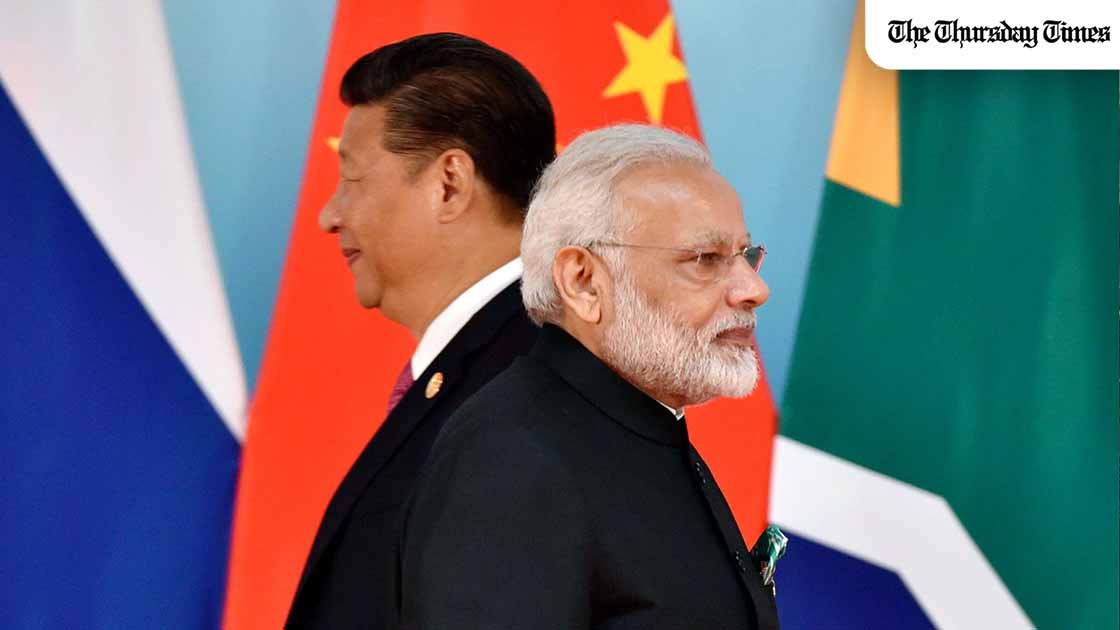
NEW DELHI (The Thursday Times) — India’s turn to chair BRICS was supposed to be a showcase moment, eleven member states and ten partner countries gathered in New Delhi under Narendra Modi’s own hosting, at a summit explicitly framed around the Global South setting its own economic terms. What actually convened this weekend told a more complicated story, one where several of the bloc’s most consequential members either skipped the summit outright or, having shown up, quietly declined to stay for dinner.
Start with Brazil, one of BRICS’s five founding members alongside Russia, India, China, and South Africa. President Luiz Inácio Lula da Silva did not travel to New Delhi at all, citing Brazil’s own approaching elections, and sent Foreign Minister Mauro Vieira in his place. This is not a minor absence to wave away, Brazil is not a peripheral partner state but one of the bloc’s original architects, and its head of state’s decision to sit this one out, only a year after hosting the summit himself in Rio de Janeiro, is a visible downgrade in how seriously Brasília treated India’s turn at the chair.
Saudi Arabia’s absence runs deeper still, because there was no downgrade to speak of, Riyadh never sent its head of state to begin with. The kingdom’s delegation was led throughout by Foreign Minister Prince Faisal bin Farhan Al Saud, notably the last representative scheduled to arrive, on Saturday evening. Saudi Arabia has, in fact, never formally confirmed its BRICS membership to the grouping at all, despite being repeatedly invited to its meetings, a status that leaves Riyadh perpetually hedging rather than committing, and this summit did nothing to change that pattern.
The UAE, similarly, did not send its actual head of state. Abu Dhabi’s delegation was led by Crown Prince Sheikh Khaled bin Mohamed bin Zayed Al Nahyan, standing in for his father, President Sheikh Mohamed bin Zayed Al Nahyan. The Crown Prince did attend the day’s summit sessions, but left for home afterward, skipping the evening’s gala dinner entirely.
Then there is Xi Jinping, and his case may be the most telling of all. China’s president did make the trip, his first visit to India in seven years, attending the full slate of summit sessions and holding a bilateral meeting with Modi beforehand. But when the day’s diplomacy gave way to the evening’s dinner, Xi was gone, reportedly back at his hotel to rest, a deliberate choice about where to draw the line on his presence, not a scheduling casualty. The pattern points the same direction each time: toward Modi specifically, not BRICS generally. When Xi skipped last year’s Rio summit outright, sending his premier instead, reports suggested the real reason was that Brazil’s Lula had also arranged a state dinner in Modi’s honour that same trip, and Xi had no interest in being cast as a “supporting actor” on a stage where India held the seat of honour. Two years before that, in Johannesburg, he abruptly pulled out of delivering prepared remarks he was scheduled to give alongside Modi, sending a commerce minister in his place with no explanation. This time, in New Delhi, on India’s own soil, Xi again found the exit before it mattered least. It reads less like fatigue and more like a message: Beijing will share the summit floor with India, but not the room where India gets to be the host and China merely a guest.
A joint declaration was issued, member states voiced “firm opposition” to the forced displacement of Palestinians, and the bloc continued its now-routine calls for cheaper cross-border payment mechanisms that sidestep the US dollar. But paper outcomes are not what a chairmanship year is actually judged on, optics are, and the optics here undercut the very case BRICS exists to make. This was supposed to be Modi’s moment to prove the Global South could convene as a unified counterweight, on India’s own soil, under India’s own leadership. Instead, a founding member skipped the whole event over its domestic politics, a long-courted Gulf power kept India at arm’s length through a foreign minister rather than its king, and the bloc’s most powerful member showed up only long enough to be seen leaving early. A summit meant to project weight instead projected its limits, and no joint declaration language will quietly undo what the empty chairs already said.