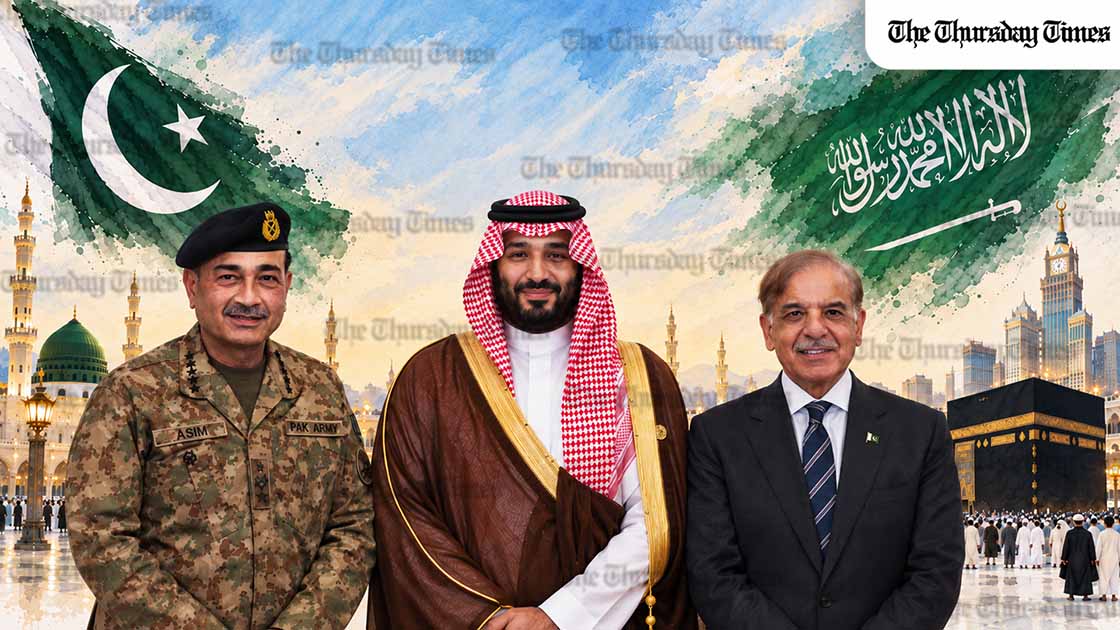
ISLAMABAD (The Thursday Times) — One word did the work in the Pakistan military spokesman’s interview with Arab News this week, and he made sure nobody missed it. Pakistan stands with Saudi Arabia diplomatically and physically, Lieutenant General Ahmed Sharif Chaudhry said, and then paused to underline the second adverb himself. We will go to any extent. In a region where officials have spent months choosing words designed to commit them to as little as possible, that was a departure.
The moment called for plain speaking. Houthi missiles and drones have been arriving over Saudi cities for weeks, and the targets have grown steadily harder to dismiss. The Saudi-led coalition reported destroying a drone heading towards the restricted airspace around Makkah, a line no one in the Muslim world can treat as ordinary. Drones from Iraq struck three pumping stations on the East-West Pipeline, shutting down a route that carries Saudi crude to the Red Sea when Hormuz is unreliable. On Friday the escalation reached the capital, with explosions reported in Riyadh’s Olaya district and the Civil Defence issuing, then lifting, warnings of potential danger across the city. This has stopped being a distant conflict in Yemen.
What gives the spokesman’s words weight is that Pakistan is not offering to arrive. It is already there. Reuters reported in May that Islamabad had deployed roughly eight thousand personnel, a squadron of JF-17 fighters, drones and the HQ-9 air defence system to the Kingdom. Air defence is precisely the capability now under strain. The Associated Press reported this week that Riyadh has approached several allies as its interceptor stocks come under pressure, and Pakistan’s contribution is not a promise awaiting fulfilment but hardware already in position.
The comparison is instructive. According to the same reporting, Saudi Arabia approached Pakistan, Britain, France and Egypt. Of the four, Pakistan is the one whose forces are already stationed in the Kingdom, the one whose commitment is written into a treaty, and the one that has stated its position publicly and without qualification. That combination is not available to the others, and it is not the product of this month. It rests on a presence built over decades and an alliance that was formalised in Makkah before the current wave of attacks began. In alliance politics such things are noticed, and they are remembered in Riyadh long after a crisis has passed.
The architecture behind the commitment is new enough that its edges are still being drawn. The Makkah Joint Defence Agreement holds that an armed attack on Pakistan, Saudi Arabia or Turkey is an attack on all three, building on the 2025 bilateral agreement that says the same of Pakistan and the Kingdom. The operational annexes of neither document are public. What constitutes an armed attack, what response it obliges, and through what mechanism the three decide, are questions that will have to be settled between the signatories. That work is normal for a young alliance. It is also urgent, because the first crisis is a poor place to begin defining terms.
One element of the guarantee has been described differently at different times. Asked whether Pakistan’s nuclear deterrent forms part of what has been extended, Lieutenant General Ahmed Sharif Chaudhry neither confirmed nor denied it. Defence Minister Khawaja Asif said after the 2025 agreement that Pakistan’s nuclear capability could be available to the Kingdom if needed, and later told Reuters that nuclear weapons were not within the agreement’s scope. Ambiguity has a respectable place in deterrence and can be deliberate. It serves its purpose best, though, when it is a single settled formulation that every official uses, rather than a series of individual answers that have to be reconciled afterwards.
What makes Pakistan’s position distinctive is that it is doing something no other party to this can do. It has committed itself to the Kingdom’s defence while remaining the only state both Washington and Tehran have been willing to let mediate between them, a role that produced the Islamabad Memorandum of Understanding in June before the talks stalled. Field Marshal Asim Munir spoke by telephone this week to Iran’s foreign minister during his visit to Beijing. Pakistan has carried a Saudi message to Tehran asking it to use its influence with the Houthis. Guarantor to one party and channel to the other is an unusual combination, and holding both will take more effort as each becomes more credible.
Ankara has been alive to the same difficulty. Turkish Foreign Minister Hakan Fidan said this week that Iran is not the target of the Makkah arrangement, and that no state which refrains from aggression against the three has anything to fear from it. That is the right message and there is no reason to doubt it is meant. Whether it is accepted in Tehran will be determined by what the alliance does rather than by what its members say about it.
It would be a mistake to read any of this as a country pulled into someone else’s war by a treaty signed a fortnight ago. The relationship with Saudi Arabia is eight decades old, carried by governments and by the millions of Pakistanis who work in the Kingdom and send home the remittances that hold up the external account. Pakistani troops have been stationed there before. The Makkah agreement wrote down an arrangement that already existed, and the spokesman this week described it in plainer language than officials usually permit themselves.