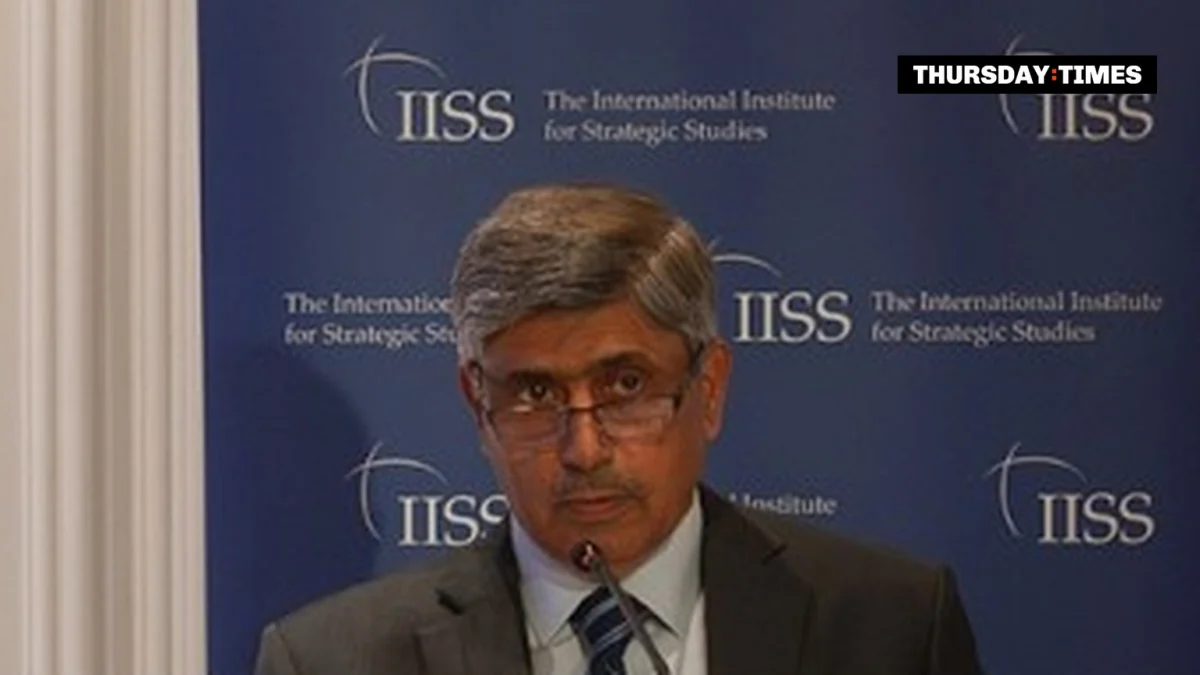
LONDON (The Thursday Times) — A senior adviser to Pakistan’s National Command Authority (NCA) delivered a rare keynote address on nuclear deterrence in South Asia at the International Institute for Strategic Studies (IISS) in London on Tuesday, the first time a former chief of the Strategic Plans Division (SPD) has spoken at the institute’s London headquarters since 2020.
Lieutenant General (Retd) Mazhar Jamil, who serves as adviser to the NCA and was Director-General of the SPD — the secretariat that oversees Pakistan’s nuclear arsenal — from 2015 to 2017, delivered the keynote at the 11th IISS–Centre for International Strategic Studies (CISS) “track 1.5” workshop on “Nuclear Deterrence and Strategic Stability in South Asia.” The event was last held at IISS London in February 2020, when it was addressed by Lieutenant General (Retd) Khalid Kidwai, also a former SPD chief and NCA adviser.
In his address, Jamil said strategic stability in South Asia could not be assessed through a “Cold War lens” and argued that the region’s political leadership needed to prioritise dialogue over “military adventurism,” which he called “highly risky and unaffordable” given the region’s nuclear status. He described Kashmir as the “core dispute” between Pakistan and India and said it remained a “nuclear flashpoint,” accusing India of avoiding a political resolution and instead pursuing what he called a revisionist, Hindu-nationalist political project reflected in the country’s dual constitutional naming as India and Bharat.
Jamil was sharply critical of India’s declared No-First-Use (NFU) nuclear policy, calling it a “diplomatic ruse” that Pakistan had “never believed,” and cited a 2019 campaign-trail remark by Prime Minister Narendra Modi — in which Modi referred to the night of 27 February 2019 as “Qatal Ki Raat,” or “Night of Slaughter” — as evidence of what he described as reckless nuclear rhetoric from India’s top leadership.
On the May 2025 crisis between the two countries, Jamil said India had blamed Pakistan for the 22 April Pahalgam attack within an hour, without evidence, and had then launched a military offensive that breached Pakistani sovereignty. He said Pakistan’s response was “calibrated” and targeted at military assets under a doctrine he described as “Quid Pro Quo Plus,” underpinned by Pakistan’s policy of “Full Spectrum Deterrence,” and credited Pakistan’s restraint — not Indian escalation — with averting a wider conflict. He said Pakistan had agreed to a ceasefire at India’s request and that, in his view, “India owes a thanks to President Trump” for the role Washington played in reaching it.
Jamil also referenced a 2022 incident in which an Indian BrahMos missile struck Pakistani territory, saying it took India 48 hours to notify Islamabad and that the episode raised questions about the reliability of India’s nuclear command-and-control systems. He cited an assessment by the Stockholm International Peace Research Institute (SIPRI) that India had mated nuclear warheads with submarine-launched ballistic missiles and conducted sea-based deterrence patrols, calling it further evidence that India was moving toward a first-strike posture despite its official NFU stance. He urged the international community to reconsider the Nuclear Suppliers Group (NSG) waiver granted to India in 2008, arguing that India’s nuclear conduct did not meet the standard of a “responsible nuclear state.”
He criticised India’s decision to hold the Indus Waters Treaty in abeyance following the May 2025 conflict, calling it a threat to Pakistan’s “water lifeline,” and accused India of expanding support to militant groups including the Tehrik-e-Taliban Pakistan (TTP) and the Balochistan Liberation Army (BLA), which he linked to what he described as India’s publicly acknowledged “Doval Doctrine.” He said Pakistan had presented evidence of Indian state support for such groups to the United Nations Security Council.
During a discussion session moderated by Sir Philip Barton, a former British High Commissioner to Pakistan and India, Jamil fielded questions from IISS researchers and journalists, including on the recently announced defence pact between Pakistan, Saudi Arabia and Turkey — which he described as the “Makkah Joint Defence Pact” and said was defensive in nature, built on decades-old bilateral ties, and not directed against any country. Asked by the Financial Times’ foreign editor what the pact would mean in the event of renewed hostilities with India, Jamil said he hoped for no further conflict and that any response would be a matter for political leaders at the time.
Jamil closed by saying Pakistan remained open to dialogue, including on Kashmir, and had offered to establish a crisis-management mechanism with India, while warning that Pakistan’s restraint “has its own thresholds.”∎