ANKARA (The Thursday Times) — The full text of the Makkah Joint Defence Agreement between Türkiye, Pakistan and Saudi Arabia has been made public for the first time. It shows an open-ended pact that no member can leave for ten years, a secretariat in Saudi Arabia to be led first by a Pakistani, and a pledge to come to one another’s aid that leaves each government to decide the scale of its help.
Turkish state broadcaster TRT Haber published the 16-article text after the government submitted the agreement to parliament for ratification on Tuesday, and Pakistan’s Dawn newspaper reproduced it on Wednesday. Crown Prince Mohammed bin Salman, President Recep Tayyip Erdoğan and Prime Minister Shehbaz Sharif signed the pact in Makkah on August 7.
An attack on one
The core of the agreement is Article 2. An armed attack from outside against any of the three is to be treated as an attack on all of them, and the others must “immediately assist” the country attacked, “making full use of all means of mutual assistance” they can provide. The clause ties this to the right of self-defence under Article 51 of the UN Charter.
Article 2
“An externally originating armed attack against any of the ‘parties’ shall be considered an attack against all the ‘parties.’”
The same article sets out how help is to be measured. The parties will decide “the scope and nature of the support to be provided following an objective assessment of the assistance required”, and will cooperate “within the limits of their available resources, including military means and capabilities.” Article 1 adds a wider duty: if any member’s sovereignty, territorial integrity or internationally recognised borders are threatened, the parties “shall use all necessary means to eliminate such threat(s) or danger(s).”
Who runs it
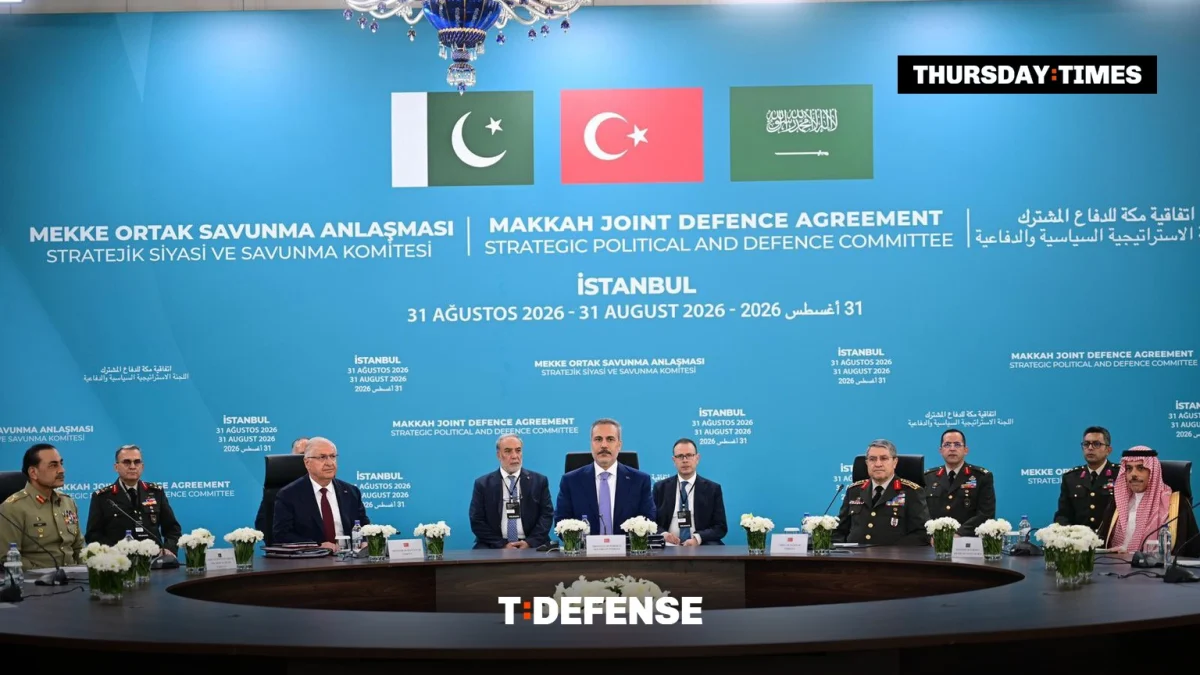
Article 8 creates the Strategic Political and Defence Committee, made up of the three countries’ foreign ministers, defence ministers and chiefs of general staff. It is to meet twice a year, with hosting rotating among the members, and the three leaders may meet once a year if needed. The committee first met in Istanbul on August 31.
A secretariat headquartered in Saudi Arabia will serve the committee. It will be led by a secretary-general appointed for three years, rotating among the three founding members, and the text specifies that the first secretary-general “shall be a citizen of the Islamic Republic of Pakistan.” The committee also holds the key to expansion: by consensus of the three founding members, it decides the rules under which other countries may join.
Troops, arms and intelligence
Beyond the mutual-defence pledge, the agreement builds a working military relationship. Article 6 commits the members, in war and in peace, to personnel exchanges, joint training and exercises, and “deployments and activities” to make their forces work together, the kind of step Türkiye is now preparing to seek parliamentary approval for. Article 10 obliges them to supply one another with weapons, ammunition, fuel, spare parts and other equipment in peacetime, wartime and emergencies, subject to availability.
Article 9 provides for intelligence sharing through agreed secure channels, and Article 5 for operational cooperation against terrorism. Article 7 covers the defence industry: joint production, joint research and development, training and the sharing of expertise, the same ground covered by the Badr memorandum that Türkiye and Pakistan signed with Qatar and Indonesia in Doha on Wednesday.
Ten years before any exit
Under Article 16, the agreement enters into force once the last of the three ratifications is deposited with the committee’s secretariat, and it has no end date. A member may withdraw only after ten years, giving at least three months’ written notice through diplomatic channels. Projects already agreed survive a withdrawal, and duties to protect classified information continue after it.
Article 12 says the pact does not affect the members’ obligations under earlier international agreements. The text names none, but Türkiye is a member of NATO and Pakistan signed a separate mutual defence agreement with Saudi Arabia in September 2025. Amendments need the unanimous agreement of the three founders, disputes are to be settled through consultation, and of the three equally authentic versions, in Turkish, Arabic and English, the English text prevails if they differ.
The 16 articles at a glance
Sovereignty. All necessary means against threats to any member’s borders.
Attack on one. Immediate help, scaled to need and resources.
Cooperation. Defence, defence industry and security ties.
Consultation. Regular talks and joint measures on threats.
Terrorism. Joint efforts, including at operational level.
Forces. Exchanges, exercises and deployments.
Industry. Joint production, R&D and training.
Committee. Secretariat in Saudi Arabia; first chief a Pakistani.
Intelligence. Shared through secure channels.
Logistics. Weapons, ammunition, fuel and spares.
Legal basis. The pact itself, within each country’s law.
Prior treaties. Earlier obligations are unaffected.
Secrecy. No classified material to outsiders.
Disputes. Settled by consultation.
Amendments. Unanimity among the founders.
Duration. Indefinite; no withdrawal for ten years.
Ratification is still pending in Türkiye. A lawmaker from the ruling AK Party has said that once parliament approves the agreement, the government will ask it for a separate mandate to send military personnel to Saudi Arabia.∎