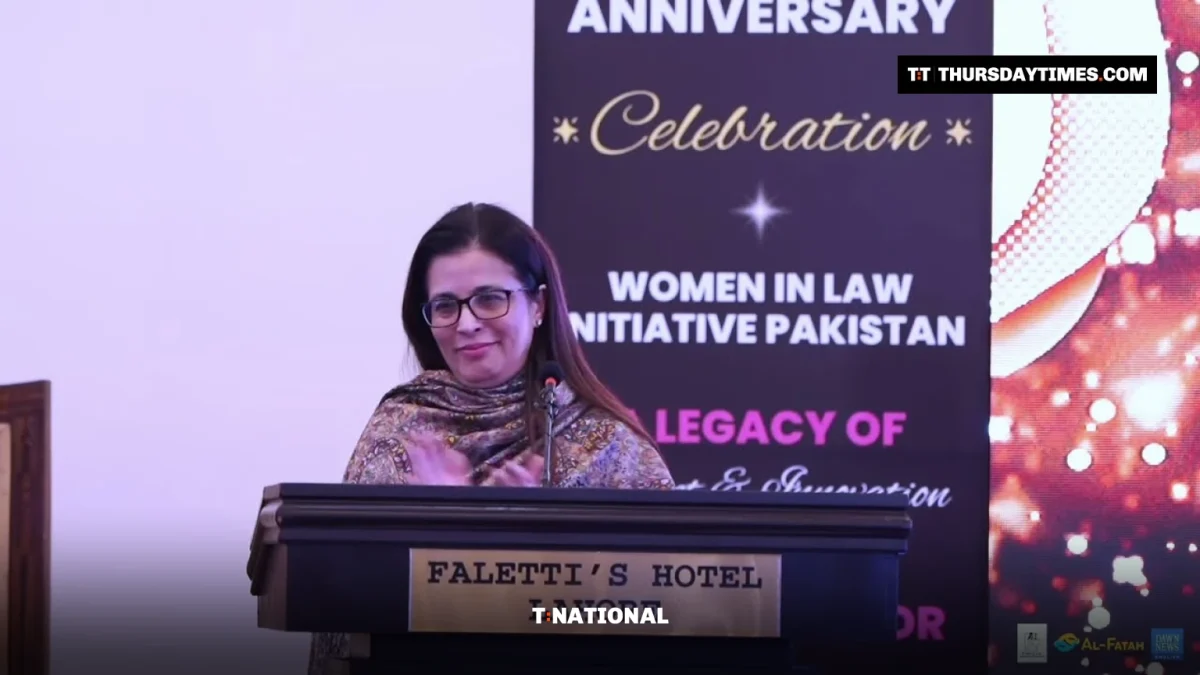
ISLAMABAD (The Thursday Times) — Supreme Court judge Justice Ayesha Malik on Tuesday challenged the assumption that women “invite” rape, and warned that sexual violence had become so routine in Pakistan that it no longer caused enough outrage.
Justice Malik was giving the keynote address at the launch of a bench book on deciding rape cases, written for judges of the country’s gender-based violence courts. She called for a fundamental re-examination of the attitudes towards women that allow victim-blaming to persist.
The bench book, produced by the Ministry of Human Rights with the Legal Aid Society and the United Nations Population Fund, sets out the law and the guidance of the superior courts in 10 chapters that follow the order of a trial. It was launched alongside a national study, prepared with the Senate’s Functional Committee on Human Rights, on why so few gender-based violence cases end in convictions, tracing where they falter from the first police report through investigation, medical examination, prosecution and trial.
‘Not yet converged’
“The bench book takes what Parliament enacted, together with what the superior courts have held, and places it within reach of the judge who has to apply it,” said Senator Ayesha Raza Farooq, who chairs the special committee on the Anti-Rape (Investigation and Trial) Act 2021. Human Rights Secretary Abdul Khalique Shaikh was blunter: “The honest position is that the word on paper and the practice on the ground have not yet converged.”
Legal Aid Society chief executive Barrister Haya Emaan Zahid said judges needed to weigh delayed reporting, gaps in medical evidence and family power dynamics in their proper context. UNFPA’s representative in Pakistan, Dr Luay Shabaneh, said: “A judgment that is correctly reasoned protects everybody in and outside the courtroom.”
The child rights group Sahil recorded 3,172 cases of gender-based violence across Pakistan in the first half of 2026, including 644 murders, 280 rapes and 132 so-called honour killings. Earlier on Tuesday, Punjab Chief Minister Maryam Nawaz said she had told assault victims to hit back and vowed that no party would shield offenders.