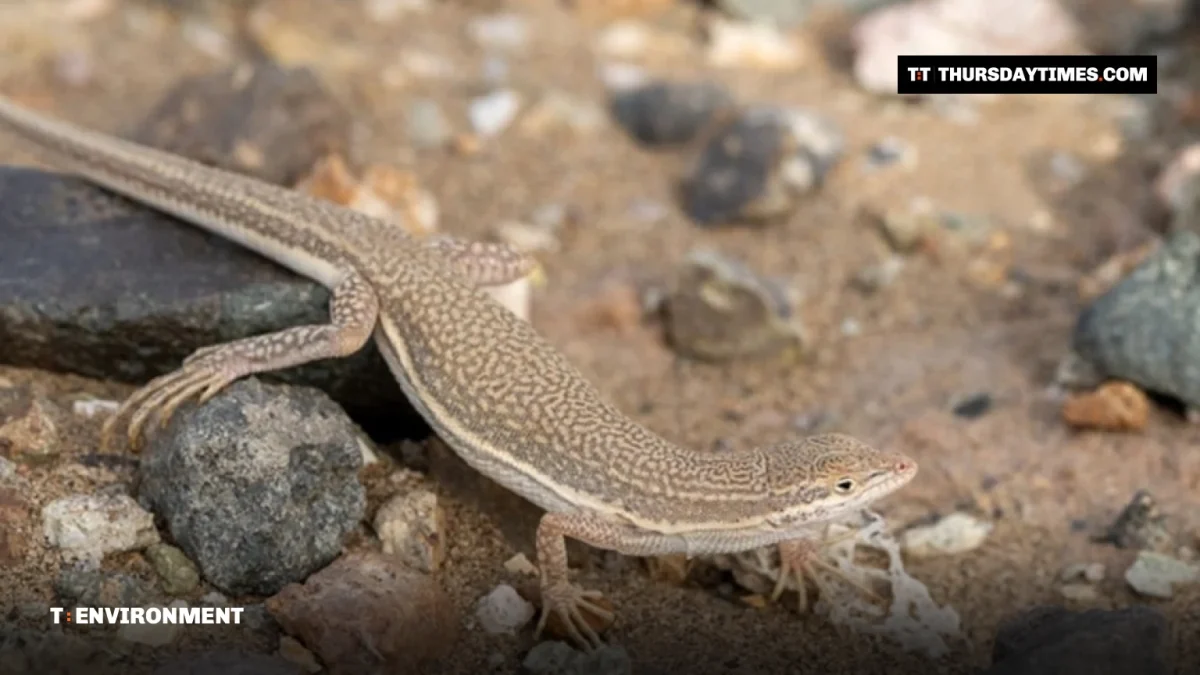
QUETTA (The Thursday Times) — Scientists have identified a lizard new to science on the sand dunes of Chagai in northwestern Balochistan, and named it after the district. It is marked with winding, maze-like brown patterns across its back.
The species, Eremias chagaiensis, is described in a paper published on Tuesday in the journal Zootaxa by Rafaqat Masroor of the Pakistan Museum of Natural History, Muhammad Danish and Daniel Jablonski of Comenius University in Bratislava, Slovakia.
“Balochistan’s deserts are among the least explored places in South Asia. Finding a new lizard here tells us how much is still undocumented,” said Masroor, who led the work.
The team recorded the animal at four sites during field surveys between 2022 and 2025, on low, shifting dunes at the southeastern edge of the Registan Desert, close to Pakistan’s borders with Afghanistan and Iran. Its body grows to 5.7 centimetres, and its tail can be more than twice that length.
It belongs to the racerunners, a group of fast desert lizards. Most of its closest relatives have stripes running down the body. This one keeps its maze pattern from juvenile to adult.
That pattern first made it look like Eremias graphica, a species described from Iran in 2023. DNA and detailed comparisons of body proportions and scales showed otherwise. Its nearest relative in the mitochondrial genes studied turned out to be a striped species, Eremias fasciata, from which it differs by about 10.6 per cent.
“Appearances can be deceptive,” said Jablonski, who is also with the Natural History Museum in Vienna. “The sand doesn’t stop at the border. Surveys in Afghanistan are needed to learn how far this species really lives.”
The two lizards keep to different ground. The new species burrows in loose sand, especially low dunes and sandy patches near desert shrubs, and was not found on the neighbouring gravel plains, where E. fasciata lives.
The study also settles an old question. E. fasciata was reported from Pakistan more than a century ago, but the record was long disputed. The new specimens and DNA provide the first definitive confirmation that it lives in the country.
The findings bring the number of Eremias species recorded in Pakistan to eight. Masroor and Jablonski, who have worked together for almost a decade, have already described other racerunners from northwestern Balochistan.
Chagai is better known for other things. It is the site of Pakistan’s 1998 nuclear tests and home to the Reko Diq copper and gold deposit. The researchers say its sands may still hold more that has never been recorded.