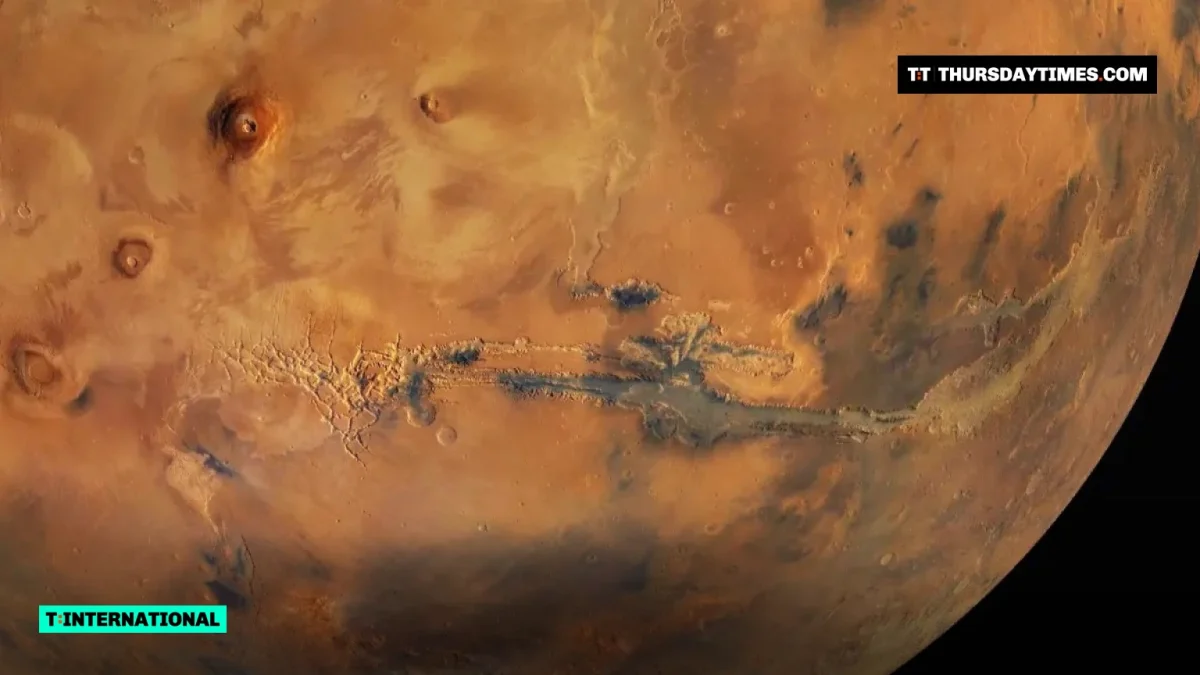
PARIS (The Thursday Times) — A European spacecraft orbiting Mars has found gas seeping from fresh cracks on the flanks of one of the planet’s great volcanoes, a sign, scientists say, that Mars may not be geologically dead but only dormant, with magma still stirring beneath its surface.
The European Space Agency said its ExoMars Trace Gas Orbiter had picked up unusual spikes of hydrogen chloride above fissures around Alba Mons, a vast volcano in the planet’s northern hemisphere. On Earth, the gas commonly escapes from vents linked to magma. “Our findings suggest that Mars has retained enough internal heat to support volcanic activity until recently, and possibly still does,” said Daniel Mège, a professor at the Space Research Centre of the Polish Academy of Sciences and a co-lead author of the study.
The wrong season: hydrogen chloride in the Martian air normally peaks in northern winter and mostly disappears in summer, a pattern tied to the planet’s dust and water cycles. But the orbiter’s infrared spectrometers kept finding one exception, always in the same place and the same season: above the Alba Mons fissures in early northern summer, just after the winter frost turns to vapour. A closer look with the orbiter’s CaSSIS camera then showed fresh, narrow fissures, some hundreds of metres long, with changes in colour on the ground around them.
The team, led by Alexander Trokhimovskiy, suggests that gases from a dormant magma chamber rise through the cracks much like fumaroles, the volcanic gas vents found on Earth. In winter, when temperatures fall as low as minus 120°C, ice would seal the fissures; when it turns to vapour in early summer, the gas escapes. The discoloured ground may be deposits left by the escaping gas. The findings were published in the journal Science Advances on November 4.
Why it matters: Mars has the largest volcanoes in the Solar System, and orbital images suggest some were active within the last few million years. Seismometers have recorded marsquakes. But no new lava flow or eruption has ever been seen. If magma is still close enough to the surface to release gas, and meets water underground, it could create warm pockets where microbes might survive. “Looking for martian life in the seeping fissures of the Alba Mons region would make a lot of sense,” Mège said.
The orbiter first detected hydrogen chloride on Mars in 2021. Colin Wilson, the agency’s project scientist for the mission, said: “These findings may prove to be TGO’s greatest success yet.”