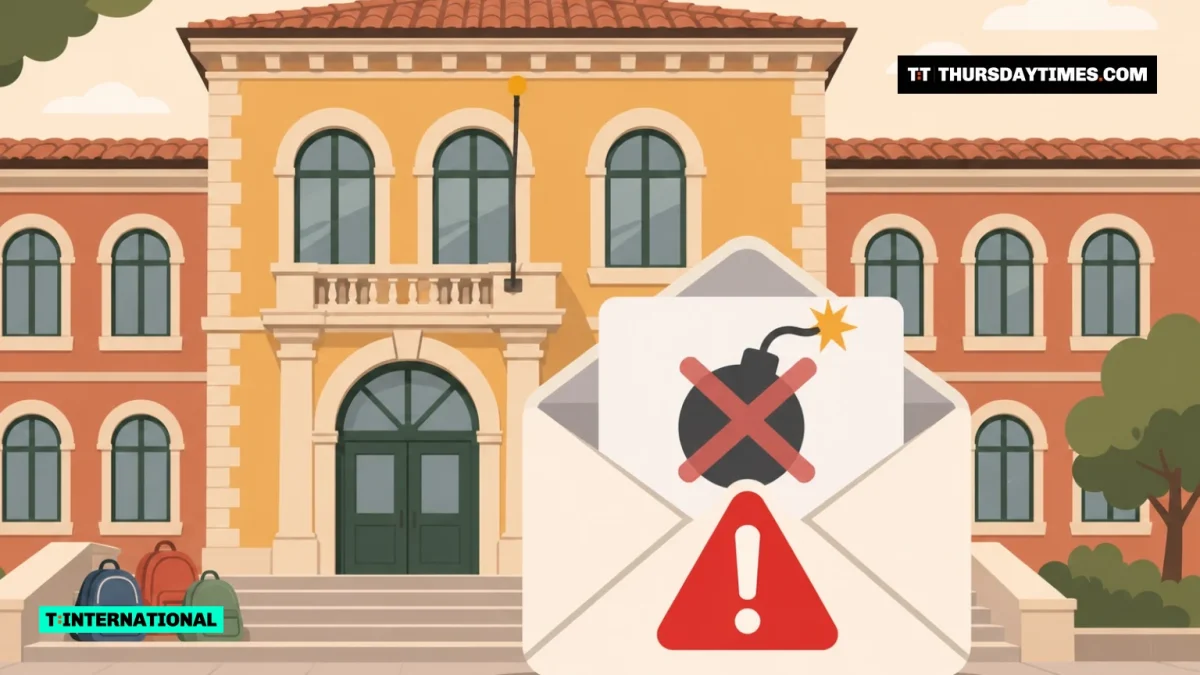
ROME (The Thursday Times) — More than 1,800 schools in Italy received emailed bomb threats on Thursday, the government said, a day after about 6,300 schools were sent similar messages, as authorities across Europe treated a wave of alerts as hoaxes meant to spread fear.
Many schools closed as soon as the latest warnings arrived, and parents rushed to collect their children. Police in Rome said there was nothing to substantiate the threats.
Officials said Wednesday’s email reached about 6,300 of Italy’s 7,476 state schools; private schools were not affected. Like that message, Thursday’s emails were reportedly signed by a “Mikhail Andropov”, who described himself as the leader of a self-styled “Vilayat of Misoginistan”. The same name was linked to emailed threats that forced newsrooms in Ireland and Bulgaria to evacuate last week.
Rome changes its advice
Prime Minister Giorgia Meloni summoned opposition leaders for talks on how to respond. Her office said buildings should not be evacuated on the strength of a mass email alone, without concrete signs of a real danger, and that schools would be instructed accordingly.
On Wednesday, Meloni said checks had found no evidence of concrete danger and that the messages appeared to be part of a strategy to cause alarm. Education Minister Giuseppe Valditara called the incidents probably a cyber-attack rather than a genuine risk.
Opposition parties accused the government of neglecting cyber defences. Elly Schlein, leader of the Democratic Party, called for stronger coordination among cyber-security bodies and more money for defending against such attacks.
Scotland and Ireland too
Schools in Scotland, Northern Ireland, and the Republic of Ireland received similar emails from abroad on Wednesday. More than 700 schools in Scotland and Northern Ireland were targeted, local authorities said. Officials there classified the messages as hoaxes, and most classes went ahead. Police Scotland said there was no need to evacuate schools or keep children at home because of the emails alone.
The alerts come amid wider concern in Europe about so-called hybrid attacks on airports, supermarkets, hospitals, and broadcasters. Some European officials suspect Russia of being behind the campaign in countries that support Ukraine. Moscow denies this and calls the accusations a smear.