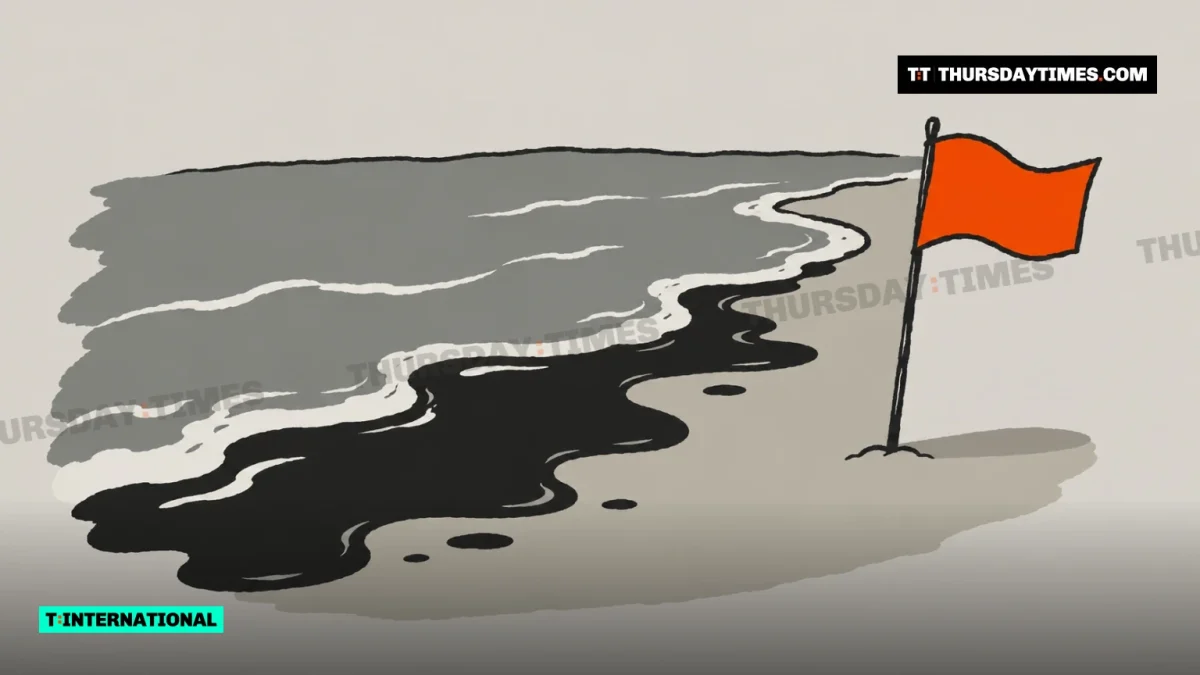
RAS AL KHAIMAH (The Thursday Times) — Ras Al Khaimah has reopened seven beaches after a clean-up following an oil spill from a supertanker struck near the Strait of Hormuz, the emirate’s government media office said, as a fresh spill closed a beach on the UAE’s east coast.
The reopened sites are Flamingo Beach, Dahan Beach, Al Mairid Beach, and the Al Rams Corniche, along with the beaches of the Anantara, InterContinental, and Cove Rotana resorts. Officials said more beaches would reopen once they were ready.
A long stretch of coastline from Sharjah to Ras Al Khaimah had been closed for nearly three weeks.
A tanker hit in October
The oil came from the supertanker Gem No.2, which was hit in what was described as a suspected Iranian drone attack in early October. Its crew was rescued, but crude leaked into the Gulf for weeks, leaving a slick more than 35km long off the UAE coast.
The UAE’s Ministry of Climate Change and Environment confirmed the spill on October 22 after residents reported a strong smell of fuel. The authorities closed beaches, launched a clean-up, and monitored the country’s desalination plants, which supply much of its drinking water. They said on October 30 that the leak had been stopped.
On Monday, Al Luluyah Beach in Khor Fakkan, on the Gulf of Oman, was closed because of an oil spill, the first confirmed on the UAE’s east coast. The authorities did not say where that oil had come from.
Hundreds of spills since February
Greenpeace says it has identified more than 500 oil spills through satellite monitoring across the Gulf, the Strait of Hormuz, and the Arabian Sea since the war with Iran began on February 28. Added together, their daily footprints cover about 20,000 square kilometres, the group says, and it counts more than 133 attacks on oil tankers in that time.
The Gulf is shallow and already under heavy pressure from rising sea temperatures, and its coral reefs, mangroves, and seagrass beds shelter dolphins, sea turtles, and fish. Bernhard Riegl, a marine biologist at Nova Southeastern University in Florida who has studied the Gulf for more than 30 years, warned that the pollution could cause lasting damage. “There is no such thing as a ‘clean war’,” he said.
Tanker attacks around Hormuz have continued into November, including the strike on an ADNOC ship inside UAE waters and Iran’s reported attack on navigation aids on Oman’s Didamar island.