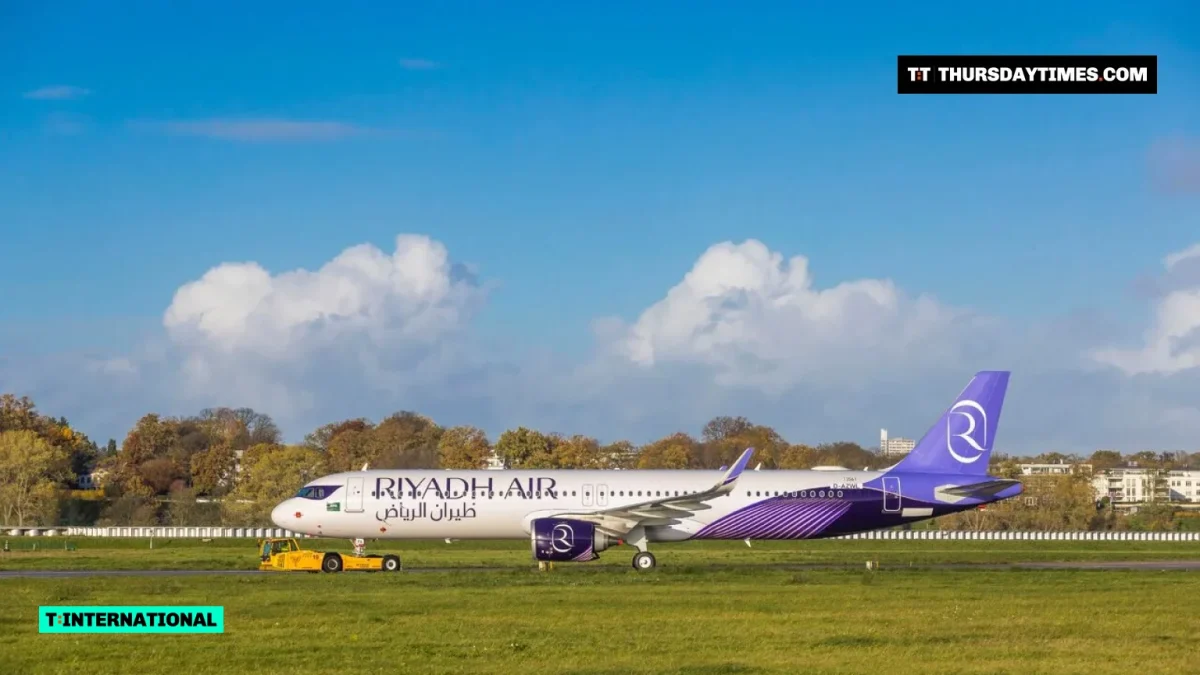
RIYADH (The Thursday Times) — Riyadh Air’s first Airbus A321neo has rolled out of Airbus’s paint facility in Hamburg, Germany, in the Saudi carrier’s pearl livery, the airline said, as it adds narrow-body jets to a fleet built so far around Boeing’s 787 Dreamliner.
The aircraft, which will be registered as HZ-RXFA, left the paint shop on Friday and will now go through a series of test flights before it is delivered and flown to Riyadh, the airline’s operating base. Riyadh Air said details of the cabin, the onboard service, and the routes its narrow-body fleet will fly would be announced in the coming weeks.
The livery draws on Saudi heritage, the airline said, with flowing lines modelled on the curves of traditional Bedouin tents and on Arabic calligraphy. It uses shades of indigo and lavender, with feather-like patterns on the rear of the fuselage and a dark frame around the cockpit windows. The airline’s name is painted in both Arabic and English.
Two fleets for one network
The A321neo will fly alongside the 787s that form the core of Riyadh Air’s long-haul plans. In July, the airline and Boeing announced an agreement covering 28 more Dreamliners, including the switch of 20 aircraft to the larger 787-10 and a previously undisclosed purchase of 11 jets. Once the remaining 17 aircraft are finalised, its firm order is expected to reach 67 Dreamliners, according to the announcement at the time.
Riyadh Air, wholly owned by the Public Investment Fund, began flying with a service to London Heathrow and has since added Manchester and Bangkok. It raised Heathrow to nine flights a week from November 2 and moved Bangkok to daily flights from November 9. Bookings are open for Milan, where flights begin on December 16, four times a week, making it the 15th destination on sale.
In October, the airline said it was flying eight aircraft to 14 destinations in Europe, the Middle East, and Asia, and aimed to have nearly 30 destinations on sale by the end of 2026. Its target is more than 100 destinations by 2030, part of the Vision 2030 plan to diversify the economy away from oil. The airline expects to support more than 200,000 direct and indirect jobs and add more than SR75 billion ($20 billion) to non-oil GDP by then.
The expansion comes as Gulf aviation recovers from weeks of disruption. Riyadh’s King Khalid International Airport has been a target of Houthi drone and missile attacks, and Qatar Airways resumed flights to Riyadh and Dammam only this week after a month-long halt.