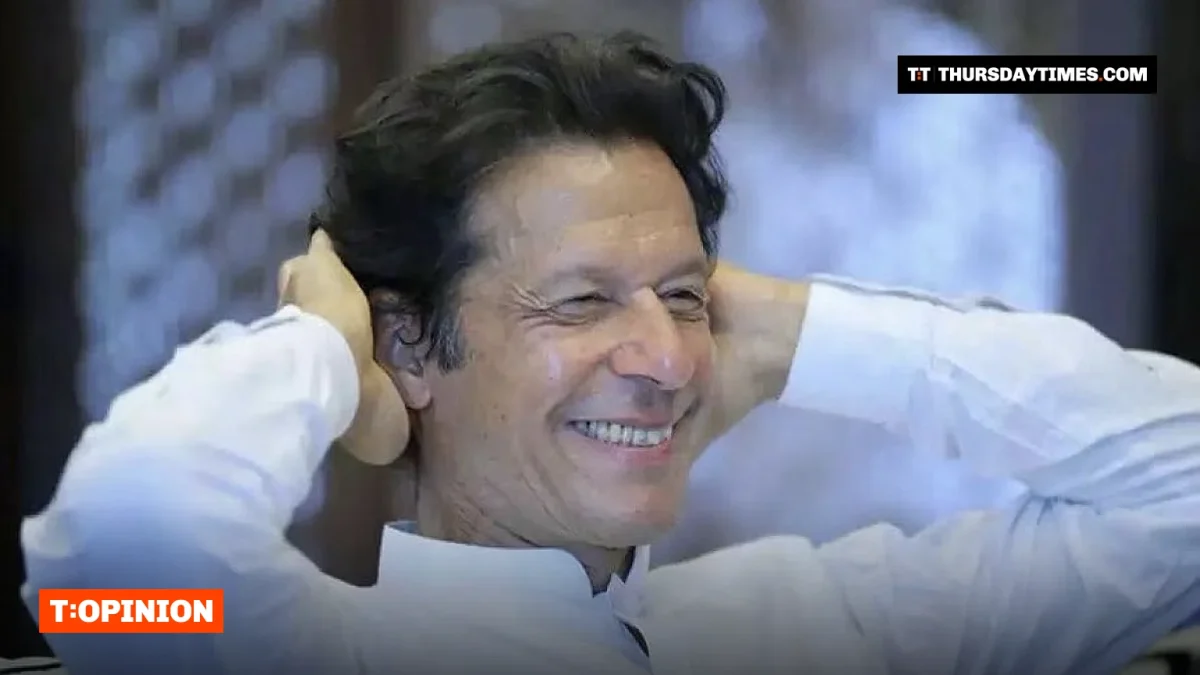
These days, X is crammed with posts from Pakistanis, at home and abroad, asking for the release of the former prime minister Imran Khan from Adiala jail, where he has been held for more than three years.
Much of the conversation seems to revolve around one man, Imran Khan. Psychology has a name for such a fixation: an idée fixeA fixed idea that dominates the mind and crowds out everything else., a fixed idea that crowds out everything else.
In this connection, I posted this:
My message to my friend, the eminent Pakistani journalist Moeed Pirzada:
Forgive me, Moeed, for saying so, but do Pakistani journalists have nothing else to talk about except Imran Khan? There are 24 or 25 crore people living in Pakistan. Do they not matter?
You Pakistani journalists rarely talk of the hard socio-economic realities facing most Pakistanis: poverty, unemployment, high levels of child malnutrition, the lack of proper healthcare and good education for the masses, and the soaring prices of essentials like food and fuel.
But perhaps such dry and mundane topics do not increase readership, circulation, and TRPTelevision rating point: the measure of how many people watch a TV channel or programme. ratings, and do not have much mirch masalaLiterally “chilli and spice”: sensational content served up to draw an audience. to help the media make money. For that, what alone seems relevant is what is happening to one man, Imran Khan.
I could understand it if that man were a George Washington, an Abraham Lincoln, or a Lenin. But Imran Khan came to power on the plank of restoring honesty in public life. And yet, to get power, he abandoned his principles by giving the PTI’s tickets to tainted ‘electablesCandidates with their own vote banks, who tend to win whichever party they stand for.’ in the 2018 National Assembly elections, and hobnobbed with religious reactionaries.
While posing as modern and liberal, soon after becoming prime minister, Imran Khan removed the internationally renowned economist Atif Mian from the Economic Advisory Council because of his faith.
Instead of facing the no-confidence motion in parliament, he tried to scuttle it through the then deputy speaker, Qasim Khan Suri.
I also gave an interview to the Pakistani journalist Ameer Abbas, in which I said this (from 8:40 in the video).
In response to my post, many Pakistanis criticised me, some with abuse, though some agreed with me.
No doubt Moeed Pirzada often speaks on topics other than Imran Khan, but rarely, in my view, on Pakistan’s real problems: poverty, unemployment, child malnutrition, the lack of healthcare and good education for the masses, and other socio-economic ills. An example is his recent vlog.
Moeed replied:
Dear Justice Katju, Lincoln and Lenin were not perceived as “Super Heroes” in their times! They are products of historian’s imagination & romance! Imran too will become bigger & bigger with every passing year! … This story is not over! It’s unraveling like an Art film! … Real tragedy is this that the Indian intelligentsia, like yourself, has not grasped the changed Pakistan … This new Pakistan carries the seeds of a healthy South Asia, provided there is a vision across the border!
I found most of this to be empty rhetoric. Nowhere does Moeed answer my basic point: a person who abandons his principles just to come to power is not fit to lead a nation.
Nor does he respond to my view that much of the media serves mirch masala to the public to increase readership, circulation, and TRP ratings, which is why it rarely addresses the huge socio-economic issues facing Pakistan and other developing countries.
The test of every political activity and political system is one, and only one: does it raise the standard of living of the people?
Many of Imran Khan’s supporters say all their problems will be solved if he is released and fresh elections are held.
Suppose Imran Khan is released, fresh elections are held, and, as his supporters expect, the PTI wins and he becomes prime minister again.
But the question is: is this relevant?
The test of every political activity and political system is one, and only one: does it raise the standard of living of the people? Does it give them better lives?
From that viewpoint, Imran Khan’s return as prime minister would not by itself change the lives of ordinary Pakistanis. The poverty, the unemployment, the lack of healthcare (one Shaukat Khanum hospital cannot cater to the needs of an entire population), the lack of good education, and the soaring prices of food, electricity, and other essentials would remain.
In my opinion, Imran Khan has no real programme to solve these problems. When he was prime minister, from 2018 to 2022, he relied heavily on religious appeals. He spoke often of Riyasat-e-MadinaThe “state of Madina”: Imran Khan’s model for a welfare state, drawn from the early Islamic state at Madina., and hosted meetings of the Organisation of Islamic Cooperation.
Such appeals may divert attention for a while, but, as the saying goes, you can fool all the people some of the time, and some of the people all the time, but not all the people all the time. In the end, the bread-and-butter issues come back. Unemployment, the lack of healthcare, and rising prices cannot be solved by slogans.
Rome’s rulers were said to keep the people quiet with bread and circuses. Marie Antoinette is supposed to have said that if the people have no bread, let them eat cake. Slogans, too, cannot fill empty stomachs.
Too many people in our subcontinent, in Pakistan as in India, are swayed by personalities rather than programmes. Unless that changes, Imran Khan, even if he is released and returns to power, risks becoming the Pied Piper of HamelinThe piper of the German folk tale who, when the town refused to pay him, led its children away with his music., leading his followers towards disillusionment and a rude awakening.