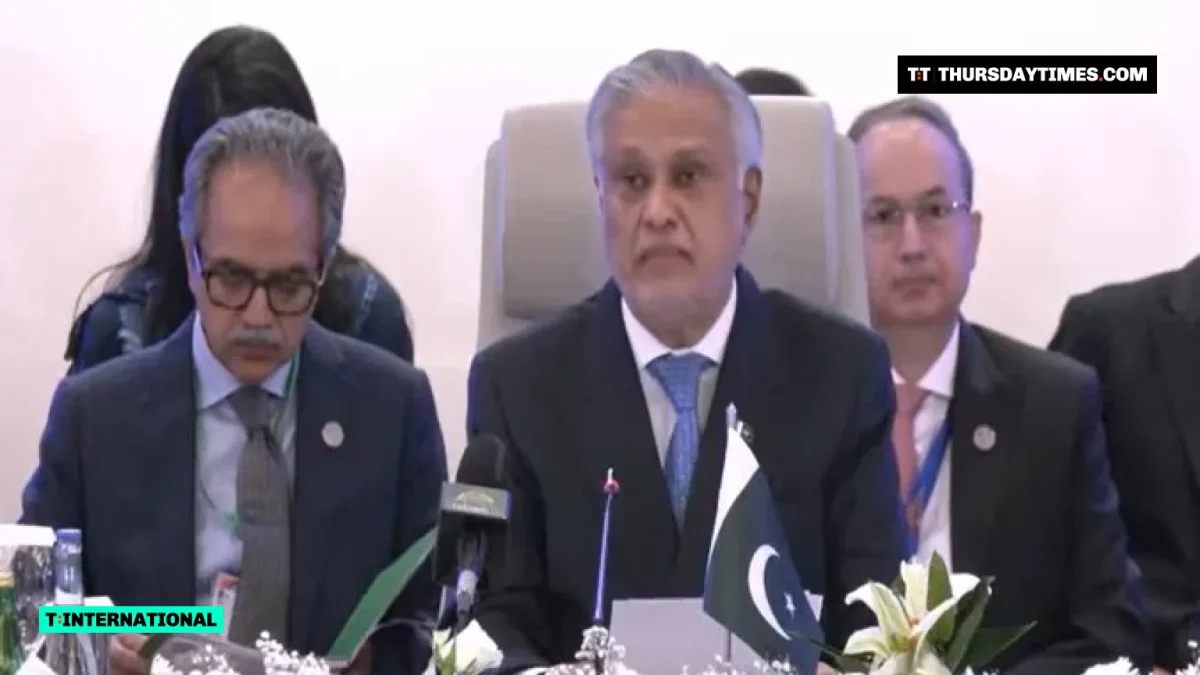
ISLAMABAD (The Thursday Times) — Deputy Prime Minister and Foreign Minister Ishaq Dar opened the 30th meeting of the Economic Cooperation Organisation’s Council of Ministers in Islamabad on Monday, naming five priorities for Pakistan’s 2026-27 chairmanship. The session, held under the theme “Reviving Regionalism for a Resilient ECO”, followed a senior officials’ meeting that finalised the agenda and a draft Islamabad Communiqué. At the time of writing, the final communiqué had not been released.
Dar’s opening address
In his welcome address, Dar said regional cooperation had to rest on practical initiatives that build economic links and deliver lasting benefits, amid geopolitical uncertainty, economic pressure, and rapid technological change. Closer cooperation among businesses and communities, he said, could open new markets, lower trading costs, attract investment, and create jobs.
He thanked the senior officials, the preparatory committee, the ECO Secretariat, and Secretary General Asad Majeed Khan, and praised Kazakhstan for its 2025 chairmanship, which focused on regional transport connectivity and sustainable development. Pakistan, he said, was honoured to hold the chair for 2026-27, and reviving regionalism did not mean reinventing the wheel but building on the foundations already laid.
The five priorities he listed were wider market access, stronger regional value chains, and greater private-sector participation, particularly by small and medium enterprises; better transport and transit links between Central Asia, South Asia, and Pakistan’s Arabian Sea ports; work towards a more effective, inclusive, and digitally enabled regional trade framework, based on the negotiating strategy agreed in November 2025; cooperation on disaster preparedness, early warning, sustainable water management, and climate-resilient infrastructure; and skills for the region’s youth through education, research, innovation, and vocational training.
Dar said peace and development reinforced each other, and voiced concern about conflict and instability that disrupt trade routes, energy supplies, and investment. He said Pakistan favoured resolving disputes through dialogue and diplomacy under international law and the UN Charter. He urged members to turn proximity into connectivity, connectivity into commerce, and commerce into lasting prosperity. “The true measure of our success will lie not merely in the commitments we make, but in the progress they bring to the lives of our people in the region,” he said. Dar also set out Pakistan’s position on Afghanistan, as The Thursday Times reported.
Who was there
The meeting brought together foreign ministers and heads of delegations from ECO member states, along with the secretariat and its subsidiary bodies. The Foreign Office has not yet published a full list of delegations. Among those confirmed so far, Iran’s foreign minister, Abbas Araghchi, travelled from Tehran and was received at the airport by Additional Foreign Secretary Muhammad Tariq Wazir. Turkmenistan was represented by Foreign Minister Rashid Meredov, Türkiye by Deputy Foreign Minister Musa Kulaklikaya, Azerbaijan by Deputy Foreign Minister Elnur Mammadov, and Kazakhstan by Deputy Foreign Minister Arman Issagaliyev. Turkish Republic of Northern Cyprus Foreign Minister Tahsin Ertugruloglu was also reported among the arrivals.
The Organisation of Islamic Cooperation’s secretary general, Ismail Ould Cheikh Ahmed, the Shanghai Cooperation Organisation’s deputy secretary general, Ahmad Saidmurodzoda, and the secretary general of the Conference on Interaction and Confidence Building Measures in Asia, Sultan Hajiyev, were also in Islamabad, as Dar’s meetings with them showed.
Iran’s address
According to Iranian state media, Araghchi told the session that trade, transport, and energy were the three strategic pillars of ECO cooperation, and that stronger connectivity and energy cooperation would reduce members’ vulnerability to outside shocks. He welcomed the creation of a technical committee to renegotiate the ECO Trade Agreement and urged current parties to push the process and bring in other members. Iranian media said he was also expected to hold bilateral meetings in Islamabad. None had been announced by the Foreign Office at the time of writing, and no meeting with Prime Minister Shehbaz Sharif has been reported.
What happens next
Ministers were expected to consider draft outcome documents, including the long-term ECO Vision 2035, reports said. Their decisions will be reported once the communiqué is out. Dar has told the ECO secretary general that Pakistan will host the 2027 summit. Reports also say the ECO leaders’ summit is due in Tehran on December 3 and 4. The ministers’ session opened on Sunday with the delegates’ arrival and a welcome dinner hosted by Dar.