WASHINGTON (The Thursday Times) — NASA has released four new sonifications that turn X-ray, optical, and infrared observations of star-forming regions into sound, adding a new album of “baby star” audio from its Chandra X-ray Observatory.
The pieces cover the starburst galaxy Messier 82, the Orion Nebula, part of the Carina Nebula, and the Rho Ophiuchi cloud. Each uses Chandra data alongside observations from other NASA telescopes. NASA says that studying places where stars are being born helps astronomers understand the life cycle of all stars, including the Sun.
What the sounds represent
Messier 82 forms stars at a rate tens or even hundreds of times higher than the Milky Way, possibly because of a collision with another galaxy in the past. Its sonification combines Chandra X-rays with optical data from Hubble and infrared views from Webb and the retired Spitzer telescope. It opens with a radar-like scan that grows louder where sources are brighter. X-rays are mapped to the highest frequencies, infrared is heard as a low drone with plucked sounds, and optical light becomes a range of pitches and textures.
In the Orion Nebula, Chandra sees more than a thousand energetic young stars. In the sonification they become twinkling sounds, while diffuse X-ray emission is mapped to pure high tones. Infrared data from Webb, which reveals the dust and gas used to build new stars, is heard as lower tones, distorted strings, and a digital harp.
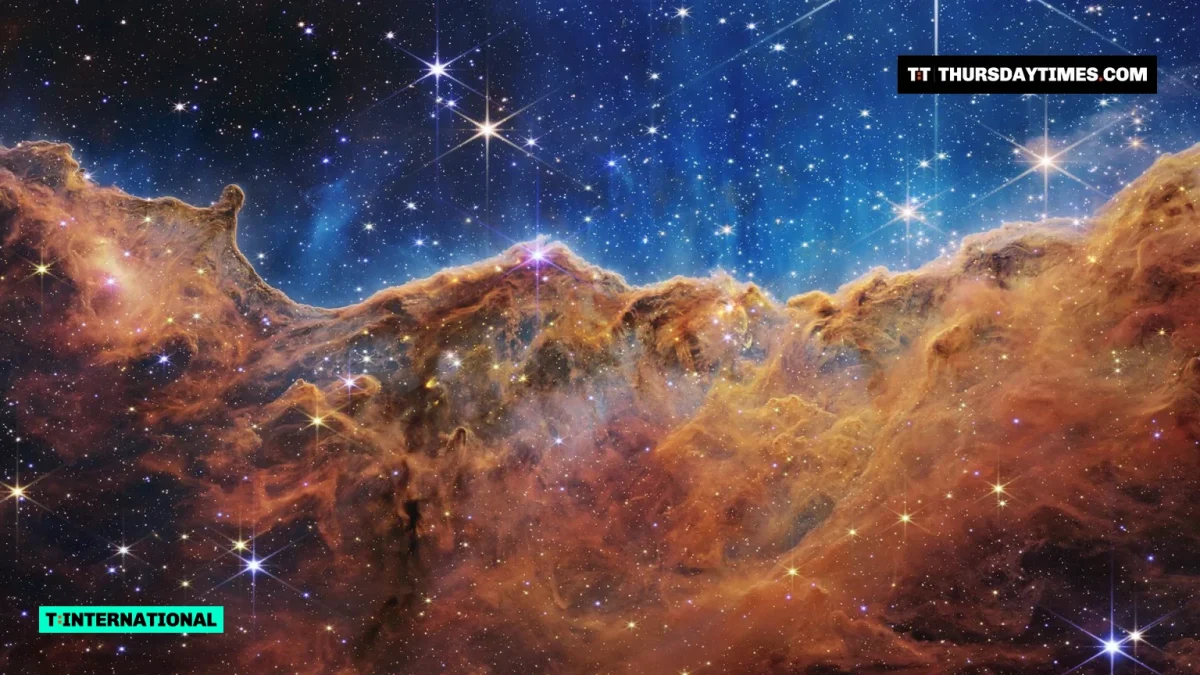
The Carina piece covers a region nicknamed the “Cosmic Cliffs”, shown in the photo above. Chandra sees through the dust and gas to individual baby stars, which are turned into short string sounds, while the diffuse X-ray glow gets longer string notes. Webb’s view of the nebula becomes a sustained sound, punctuated by other instruments for features such as stars and ridges.
In Rho Ophiuchi, Chandra reveals infant stars that flare violently and produce X-rays, heard as high-pitched, glassy tones. Webb’s infrared clouds are mapped to differently pitched sounds, and the stars are played as metallic plucks. A gap in the middle of the piece reflects dark dust clouds that emit very little light.
Who made them
The sonification programme is led by the Chandra X-ray Center. The collaboration was driven by visualisation scientist Kimberly Arcand, astrophysicist Matt Russo, and musician Andrew Santaguida of SYSTEM Sounds, with consultant Christine Malec. NASA’s Marshall Space Flight Center in Huntsville, Alabama, manages the Chandra programme.