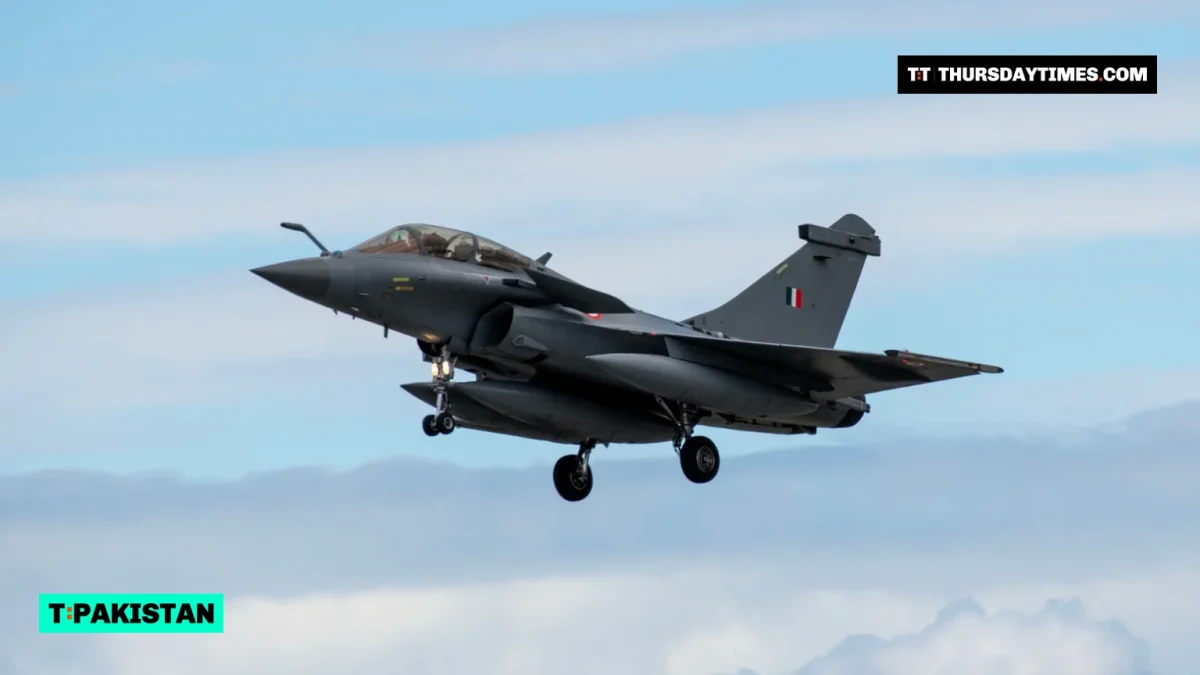
ISLAMABAD (The Thursday Times) — Pakistan says its Air Force shot down Indian Rafales in May 2025, and a published directory now lists India’s fleet at 32, four short of the 36 ordered in 2016. India has not said how many jets it lost. What it has done is order more of the same aircraft. One order is signed. A far larger one is not, and the listing sits awkwardly beside both.
The 26 that are signed
On 28 April 2025, India and France signed an inter-governmental agreement for 26 Rafale aircraft for the Indian Navy: 22 single-seaters and four twin-seaters, according to the Indian defence ministry. The package includes training, a simulator, associated equipment, weapons and performance-based logistics. Defence Minister Rajnath Singh signed for India and his French counterpart, Sébastien Lecornu, for France. Indian media put the value at about 64,000 crore rupees.
The ministry said delivery would be completed by 2030, with crews trained in France and India. The deal also includes an Indian production facility for Rafale fuselages and maintenance facilities for the aircraft’s engines, sensors and weapons. The naval version is a carrier-borne aircraft that the ministry says shares commonality with the Air Force’s Rafales.
One line of the announcement matters for the fleet question. The agreement also covers “additional equipment for the existing Rafale fleet of the Indian Air Force”, the ministry said. It did not say what that equipment is.
The 114 that are not
The Air Force’s larger requirement is for 114 multi-role fighters, and the Rafale is the leading candidate. India’s Defence Acquisition Council granted an Acceptance of Necessity for 114 Rafales in February 2026. That is a first approval in principle. The proposal still has to go to the Cabinet Committee on Security, and no contract has been signed.
Reports say about 96 of the 114 would be built in India and 18 bought directly from Dassault, with a cost estimated at around 3.25 lakh crore rupees. The directory’s own table for the Indian Air Force also shows 114 Rafales in its ordered column, with an asterisk marking the planned further fighter purchase. Reports in April described a dispute over access to the aircraft’s software and source code; the outcome has not been publicly confirmed. Dassault has said it wants the contract signed this year.
What a bigger fleet does not fix
If both orders went through and the 36 original jets stayed in service, India would have up to 176 Rafales. On paper that is a large force. In practice, the 26 naval jets will fly from carriers, the 114 would take years to build and deliver, and neither answers the near-term question raised by the directory: why the Air Force’s two operational Rafale squadrons are listed at 32 jets, not 36. Our look at the fleet sets out the squadron arithmetic.
India has not confirmed any Rafale losses by number, and the directory does not say why its count differs. What the orders show is that New Delhi is committing to the aircraft for the long term, whatever happened in May 2025. Pakistan’s record of that month is laid out in our explainer.
The contest between the two air forces is also being fought in the export market. Bangladesh has said it is drafting a purchase of Chinese J-10CE fighters, the export version of the aircraft Pakistan flies, and cited Pakistan’s own combat record as a reason, as we reported in August.