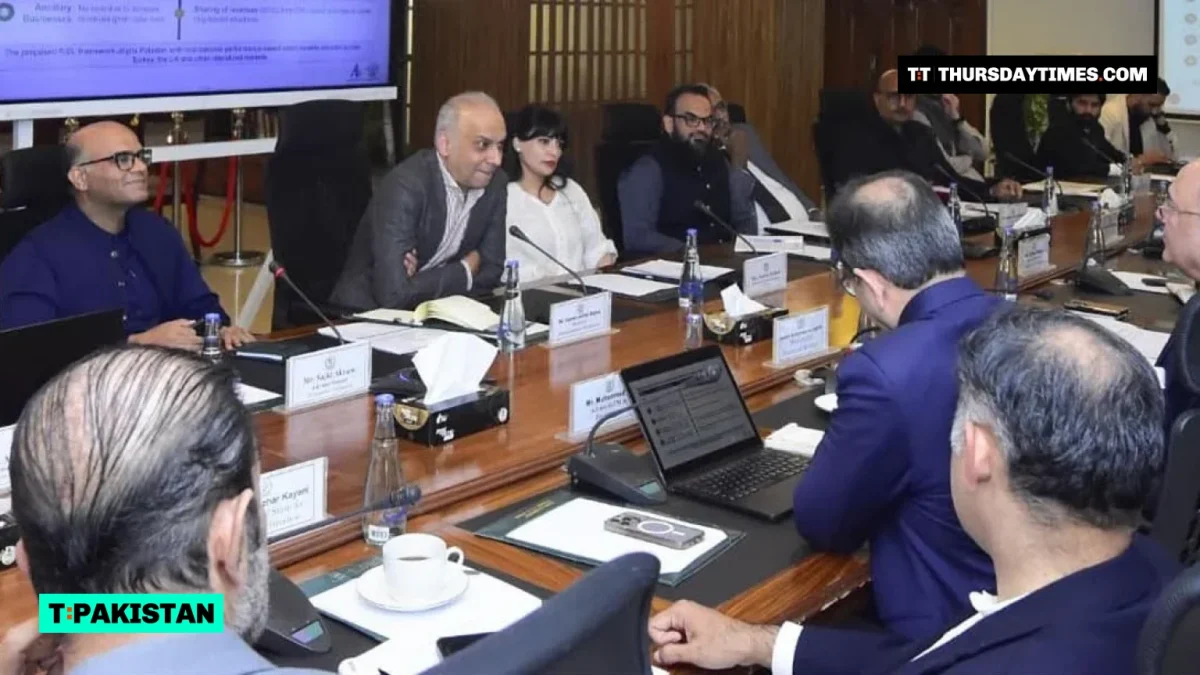
ISLAMABAD (The Thursday Times) — Finance Minister Muhammad Aurangzeb on Friday reaffirmed the government’s commitment to advancing power-sector reforms within clear timelines, chairing a meeting of the Steering Committee on the Power Sector Regulatory Regime in Islamabad, according to an official statement.
The committee reviewed progress on the proposed reforms and the recommendations of a Technical Working Group (TWG), which is drawing up a regulatory and market framework meant to improve efficiency, promote competition, and attract private investment. The group’s work covers tariff methodology, regulatory certainty, investment incentives, performance benchmarks, and the future structure of the electricity market.
What the committee examined
Participants discussed transparent and predictable rules for distribution network operators and competitive suppliers, including investment approvals, performance standards, transmission and distribution losses, conflict-of-interest safeguards, and ancillary commercial activities. The meeting also stressed the need to define the roles of the National Electric Power Regulatory Authority (NEPRA) and the Competition Commission of Pakistan clearly, to avoid overlap.
The committee looked at proposals to strengthen incentives under the Multi-Year Tariff framework, including rewards for operational efficiency, better service quality, and lower distribution losses. It also discussed the treatment of returns on equity, inflation-related adjustments, and how efficiency gains are shared, so that improvements translate into benefits for consumers.
Rapid solarisation, battery storage, and changing consumption patterns also came under discussion. Participants examined the pressures created by excess generation capacity, declining grid demand, and mounting capacity-payment obligations, all of which weigh on electricity tariffs.
Against that background, the committee considered adapting the design of the Competitive Trading Bilateral Contract Market to Pakistan’s changing energy landscape. One option is to align existing supply obligations and consumer demand with distribution companies that are being privatised, which could give competitive suppliers more flexibility in setting tariffs and improve the use of existing generation capacity. The statement said the implications for existing power purchase agreements, capacity-payment obligations, and uniform tariffs need further examination, to avoid placing extra costs on consumers connected to the grid.
The committee also discussed the pace and sequencing of the move towards a competitive retail electricity market, with an emphasis on a realistic roadmap that reflects regulatory and institutional readiness, consumer protection, and investor confidence. It reviewed the residual assets and liabilities of distribution companies in the context of privatisation, including land, receivables, pension obligations, and litigation.
No decisions yet
Aurangzeb called for a pragmatic and cost-effective institutional arrangement that avoids unnecessary duplication. He said that lower electricity costs, better service delivery, and the sector’s financial sustainability must remain the overriding objectives of the reform process.
The committee agreed that further technical and policy work is needed. The finance minister directed the relevant teams to identify outstanding issues, including areas of divergent views, and to submit considered recommendations for further deliberation, in continued coordination with NEPRA and other stakeholders.
The meeting was attended by Power Minister Sardar Awais Ahmad Khan Leghari, the prime minister’s special assistant on energy, Lt Gen Muhammad Zafar Iqbal, Minister of State for Finance and Railways Bilal Azhar Kayani, the prime minister’s adviser on privatisation, Muhammad Ali, the NEPRA chairman, and senior Finance Division officials.