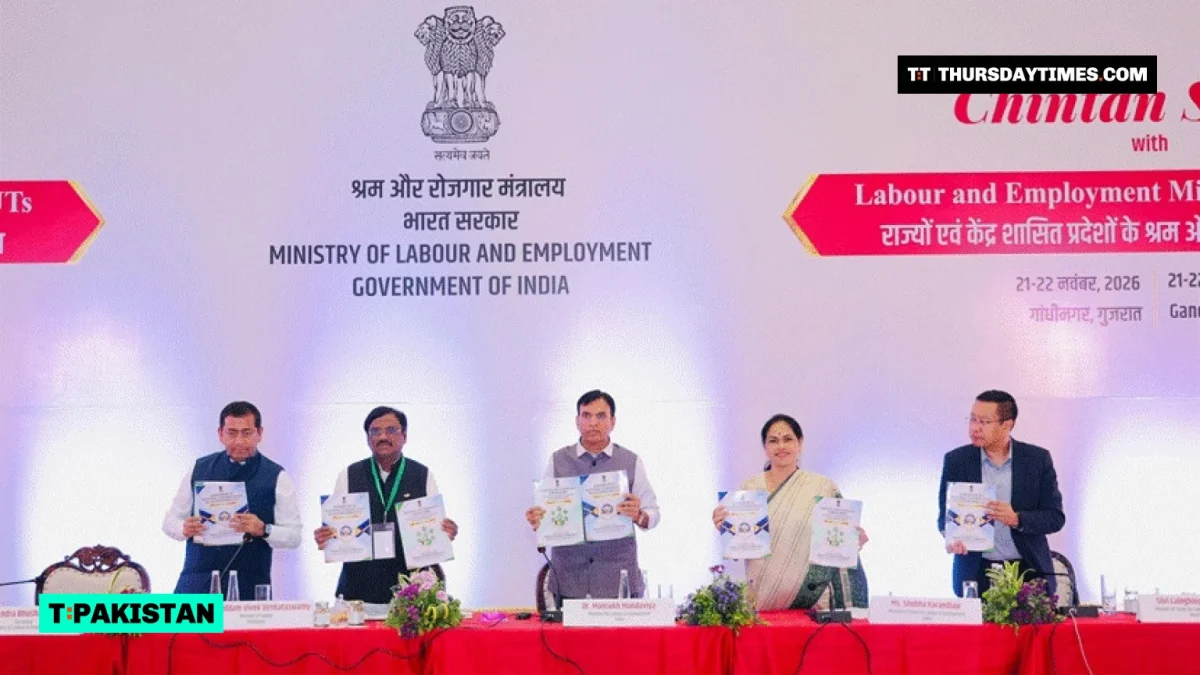
GANDHINAGAR (The Thursday Times) — India’s labour ministry on Sunday launched a revamped National Career Service portal that links jobseekers with employers, state job portals and private platforms, along with an index meant to show where labour-market shortages lie.
Labour and Employment Minister Mansukh Mandaviya unveiled the NCS Open Network for Employment, or NCS ONE, on the second and final day of a two-day brainstorming session of state and Union territory labour ministers held on 21–22 November in Gandhinagar, Gujarat. Minister of State Shobha Karandlaje also attended, according to the ministry.
The portal and the index
The ministry said NCS ONE connects jobseeker and employer apps, state employment portals, private job platforms and campuses, and adds a voice bot and a chat bot. A new Occupational Shortage Index is meant to be a data-driven tool that measures gaps between demand and supply in the labour market. The ministry said it would help jobseekers make career choices, employers spot shortage areas and plan hiring, training institutions align skilling with industry demand, and policymakers target employment and skilling schemes. The statement does not say what data the index draws on or how often it will be updated.
Mandaviya also released the e-Shram livelihood profile module, which records a worker’s livelihood details alongside five social-security protections: food, health, life insurance, accident and disability cover, and pensions.
Career lounges and publications
The minister virtually opened eight career lounges, in Jaipur, Ludhiana, Bhubaneswar, Kanpur, Bengaluru, Varanasi, Hyderabad and Guwahati. The ministry plans 200 such centres, mostly in tier-two and tier-three cities, at employment offices, universities and colleges, in partnership with industry. The lounges are to offer career guidance, skill assessment, internships, apprenticeships and placement help, along with information on overseas jobs, global labour trends and language and cultural preparation.
Two publications were also released: an addendum to the National Classification of Occupations 2015 and a compilation of existing and emerging green occupations.
Mandaviya said the suggestions and field experience shared by states would help implement the labour codes more effectively on the ground and protect workers’ interests. The meeting marked one year since the labour codes came into force on 21 November 2025, and states shared their best practices. Karandlaje stressed coordination between the Centre and states and urged resolving grievances early, before they reach the courts.