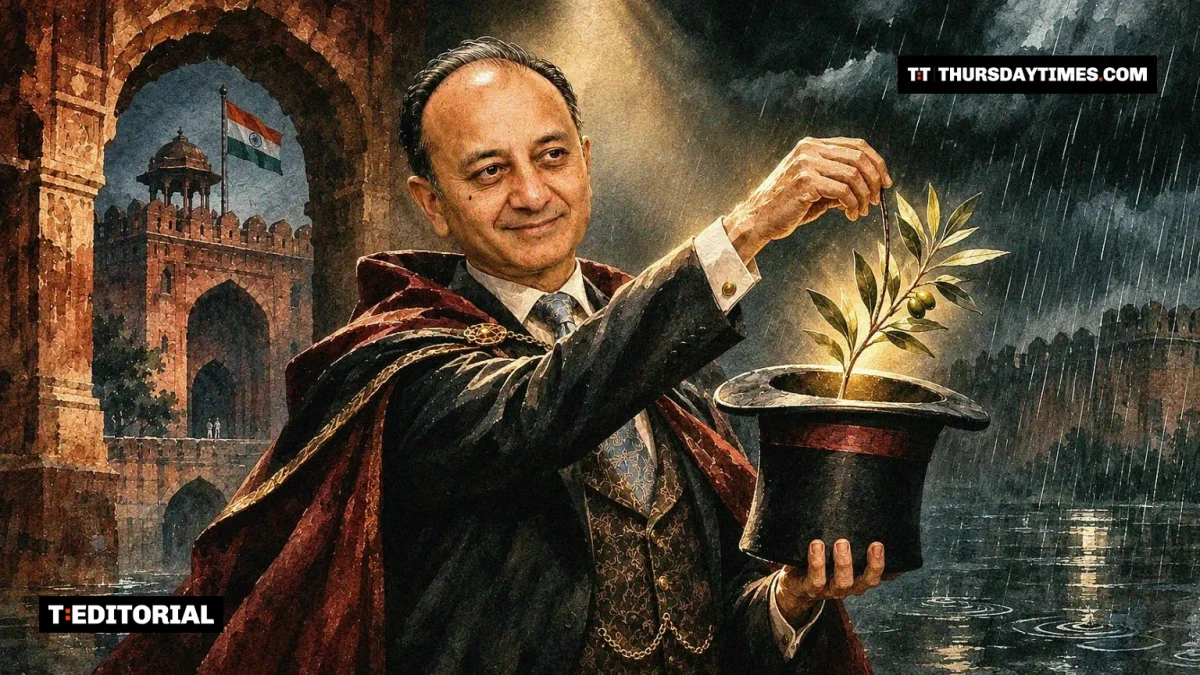
Some envoys arrive with a briefcase. Musadik Malik arrived in Delhi with a sentence, and by Saturday evening the sentence had grown into an argument: that the enemy of a civilisation is seldom the one across the border. It is the weather. Pakistan sent the right man to the right room, and he spoke as if the room had been waiting for him.
The right man for the room
The occasion was the first Civilisational Dialogue Forum of the Shanghai Cooperation Organisation, held at Delhi’s Purana QilaThe 16th-century fort in Delhi, begun under Humayun and completed under Sher Shah Suri, where the forum was held., an old fort that has watched empires come and go and has learned to be patient. It was the first visit to India by a Pakistani federal minister since 2023. Whoever stepped through those gates would carry more than a name card. He would carry the weight of three years of silence.
Pakistan chose a man who understands that silence is not broken by shouting. Musadik Malik is known at home as a minister who can hold a television studio, who can argue without raising his voice and explain without condescension. Those are not small gifts in a region where most arguments are conducted at full volume. In Delhi he put them to better use than any speech could have.
A sentence that opened the window
“I think it’s wonderful that we’re speaking across,” he said on the sidelines on Friday. “We are having a dialogue across civilizations, across cultures.” He called the forum “a very welcome sign”. Then, as a good magician does, he turned the audience’s attention away from the hand that held the trick and towards the thing that mattered. “The entire region is in flux, the geopolitics is in flux,” he said, “and I think the easiest thing to do is to speak about things that affect us all.”
There is a whole philosophy of statecraft in that one line. When the ground is moving, the sensible traveller does not argue about whose land it is. He looks for the rope everyone can hold. Malik found it, and he offered it to the room without a flourish.
The conjuror’s line
That was his finest moment, and it was almost a poem. “Dialogue is between distinct entities,” he said. “Singularity does not require dialogue; it requires a monologue. Dialogue is about diversity.” In two sentences he answered the oldest complaint of the subcontinent, that to talk is to concede. It is the reverse. Only a confident people can afford a conversation with someone who is not like them. A monologue is the refuge of those who fear to be answered.
“Singularity does not require dialogue; it requires a monologue. Dialogue is about diversity.”
A bouquet, and a city of layers
On Saturday, on the forum’s second day, he stood inside the fort itself and did something rarer than a speech. He read the walls. Delhi, he reminded his hosts, was made by people who came from outside as well as by those who were always here. Humayun, who rode in from Central Asia, laid the foundations of this very fort, and Sher Shah Suri, the rival who drove him out, left his own mark on it. Archaeologists, Malik said, are reading the city layer by layer, and no single layer deserves to be called the only authentic one.
It was a kind courtesy to the host, and it was also a thesis about home. Pakistan, he said, is a bouquet of many flowers, and its history cannot be understood from one viewpoint. Its roots reach north to Bukhara and Samarkand and west to Persia and Arabia. It holds the Indus Valley and Gandhara, and Taxila, where students once came from far away to learn. It is the land whose Buddhist art travelled the Silk Road towards China, and whose languages and poetry still carry the accent of Central Asia and Persia. A country made like that, he argued, should stay open to people and ideas, and nobody should have to give up who they are in order to take part.
The mound of the dead
Then he turned the lamp towards the real enemy, and the room grew quiet. The danger to civilisation, he said, is not another civilisation. It is climate change. He spoke of the floods in Nepal that killed more than 1,400 people, and of Pakistan’s own floods of 2022, which killed about 1,700 and put a third of the country under water. And he spoke of Mohenjo-Daro, the city that outlasted every army sent against it.
“Do you know what is the meaning of Mohenjo-Daro? It means mound of the dead.”
Four days of rain, he said, brought down walls that no one had been able to break for 4,500 years. In the same floods the ruins gave shelter to the families the water had driven from their homes. It is hard to think of an image that makes the case for dialogue more plainly. A heritage that survived conquerors and centuries can be undone in a week, and no border will stop the next storm. Those who share a river, a monsoon and a past have more reason than anyone to share a plan.
Hope, plainly stated
Asked about relations between the two countries, he did not retreat into the careful fog that diplomats prefer. “I think all of our relationships will improve,” he said, and he spoke of a “macro view” that would take in political and social questions together. It is the language of a man who believes that the quarrel is real and also that it is not the whole story. Pakistan has always held that the two can be true at once.
When journalists pressed him on terrorism, he declined to let a forum on civilisations be turned into a bilateral courtroom. “I have come here on a multilateral forum and I want a good multilateral forum to be held,” he said. But he did not look away from the subject. “Many incidents have occurred in your country as well,” he reminded them, and then, of his own: “every day, we have to carry their coffins on our shoulders.” Thousands of Pakistanis have been martyred, he said, and what the region needs is a transparent mechanism, resting on evidence and open to both sides, that can restore trust. It is a proposal Pakistan has put forward more than once. Restraint of that kind is not evasion. It is craft.
“Restraint of that kind is not evasion. It is craft.”
Why he was the best choice
A cultural forum asks for a particular sort of envoy. A blunt instrument would have turned it into a quarrel. A cipher would have turned it into a photograph. Pakistan needed a man who could be warm without being weak, who could speak of shared heritage without surrendering a single argument, and who could make the other side feel, for an afternoon, that listening was not a defeat. That is a rare combination, and Musadik Malik has it.
He used the margins well, too. On the sidelines he met Tajikistan’s culture minister, Sattoriyon Amonzoda, and Mohammad Mahdi Imanipour, who heads Iran’s Islamic Culture and Relations Organisation, and spoke with both of cultural ties and wider cooperation. They were the very neighbours his speech had just sketched, Central Asia to the north and Persia to the west, and it was a pleasing symmetry to see the map he described sitting down to talk.
There is also the matter of what comes next. Pakistan chairs the SCOThe Shanghai Cooperation Organisation, the Eurasian bloc whose council of heads of state Pakistan chairs in 2026–27. council of heads of state for 2026–27, and the next leaders’ summit is due in Islamabad in August 2027. A country that expects to host guests does well to show, a few months earlier, that it knows how to be one. In Delhi, Pakistan was a guest of grace. It spoke of culture and climate and left the bluster at home, and it is the visitor who behaves like that who is remembered when the host’s own speeches are forgotten.
Magicians do not explain their tricks, and neither should we. What can be said is this: a room that came expecting a stalemate left having heard the word “dialogue” spoken as if it meant something, and having been shown, in the cracked walls of a 4,500-year-old city, why it must. Whether Delhi answers in kind is for Delhi to decide.
On the days that mattered, Pakistan’s voice was clear, its tone was generous, and its minister was the right one for the work.