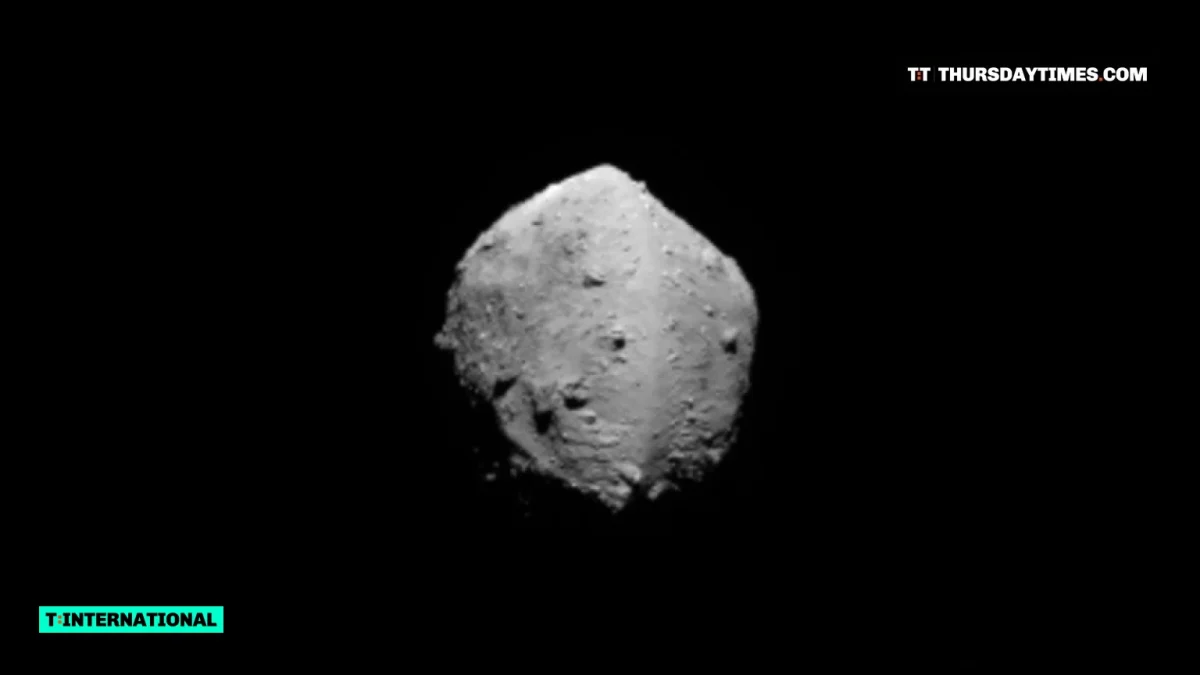
PARIS (The Thursday Times) — The European Space Agency’s Hera spacecraft is studying the asteroid pair that NASA’s DART probe struck in 2022, and detailed images of the system are due for release on Wednesday.
Hera reached the Didymos system in early November after more than two years in transit. Didymos is about 730 metres wide and is orbited by a smaller asteroid, Dimorphos, about 150 metres across. DART hit Dimorphos on 26 September 2022 in the first test of whether a spacecraft impact could change an asteroid’s path, and shortened its orbit around Didymos by about 33 minutes, from 11 hours 55 minutes. The asteroids pose no threat to Earth.
What the first images show
The first images, taken by the Asteroid Framing Camera from about 60 kilometres away, show boulders, craters and a sharp equatorial ridge on Didymos, while Dimorphos is largely hidden in shadow. They reveal a side of Didymos that DART’s camera did not see before the impact. A later set, taken from about 28.5 kilometres, included thermal infrared and multispectral views, according to the German Aerospace Center, DLR, which leads the camera science.
The work ahead
Hera will spend at least six months examining the crash site. Its team wants to learn whether the impact left a crater or reshaped Dimorphos, and to measure the asteroid’s mass, which is key to judging how effective DART’s push was. Two shoebox-sized CubeSats on board will study the system more closely and may later attempt a landing.
The results are meant to make asteroid deflection a predictable technique. Other planetary-defence missions are lined up, including a NASA space telescope, NEO Surveyor, due to launch in 2027. In 2029 the asteroid Apophis will pass about 32,000 kilometres above Earth, and two spacecraft, NASA’s OSIRIS-APEX and the ESA-JAXA mission Ramses, are planned to visit it.