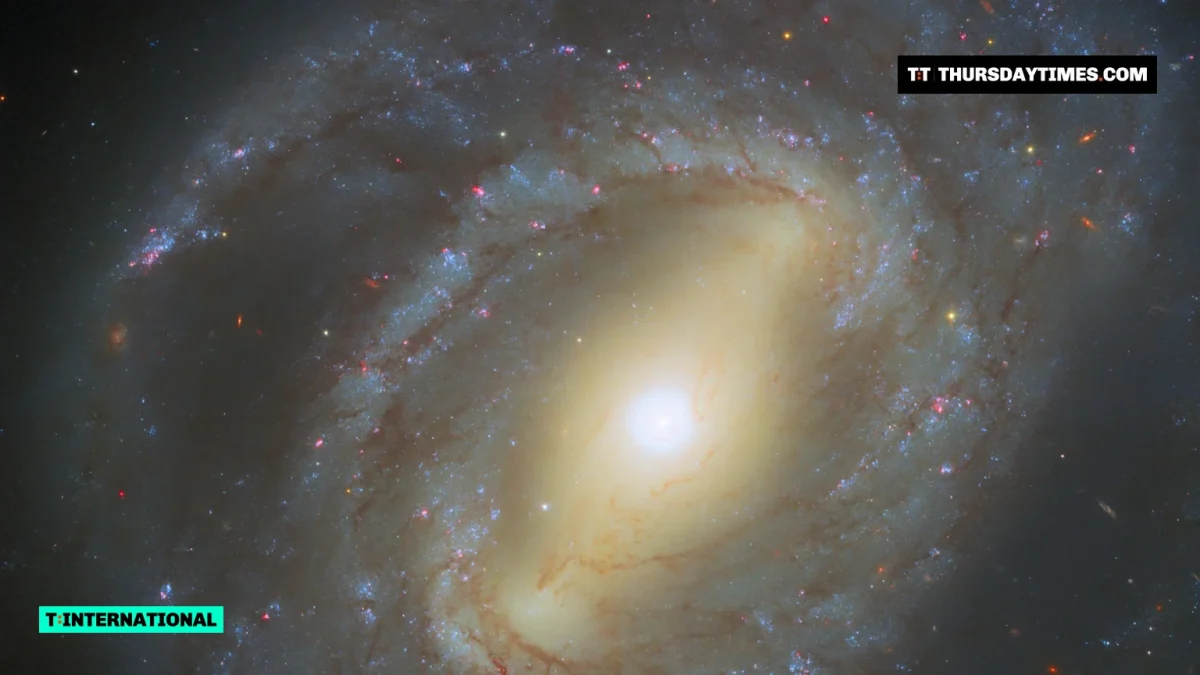
GREENBELT, Maryland (The Thursday Times) — A new image from the NASA/ESA Hubble Space Telescope shows the barred spiral galaxy NGC 4394 in sharp detail, with its graceful spiral arms and a distinct straight bar of stars across its centre. NASA published the picture on Tuesday.
The galaxy lies in the constellation Coma Berenices, about 55 million light-years away, which makes it relatively nearby. It is one of more than 1,000 galaxies in the Virgo Cluster, the galaxy cluster closest to the Milky Way.
NASA said NGC 4394 closely resembles what astronomers think our own galaxy would look like if it could be seen face-on. Galactic bars are common, with an estimated 65 per cent of nearby spiral galaxies having one, and Hubble has imaged many others, including NGC 5728, NGC 685, and NGC 613.
Explanations for how bars form tend to centre on a galaxy’s disc of stars becoming unstable, which could be triggered by the gravitational nudges of passing galaxies, interactions between stars, or other forces. The circular orbits of stars then stretch into the elongated shape seen in NGC 4394. Observations show bars are more common in galaxies today than they were several billion years ago, though research suggests the trend may be temporary, because bars can themselves become unstable as they grow more massive.
The Milky Way and NGC 4394 may share another feature: both could contain a LINER, or low-ionisation nuclear emission-line region, an area near a galaxy’s centre whose light shows particular ionised or neutral elements. Researchers do not yet know exactly how LINERs form, though hungry supermassive black holes or intense star formation are likely to play a role.
Hubble has looked at this patch of sky before. An earlier image of NGC 4394 was released a decade ago, taken as a by-product of a programme led by Eric Peng that focused on the neighbouring galaxy Messier 85. The new picture also draws on a recent programme led by David Thilker, which uses Hubble’s Wide Field Camera 3 to study how star formation comes to an end in galaxies in dense clusters, and how that differs from isolated galaxies. NGC 4394 is one of 40 galaxies studied in that way.