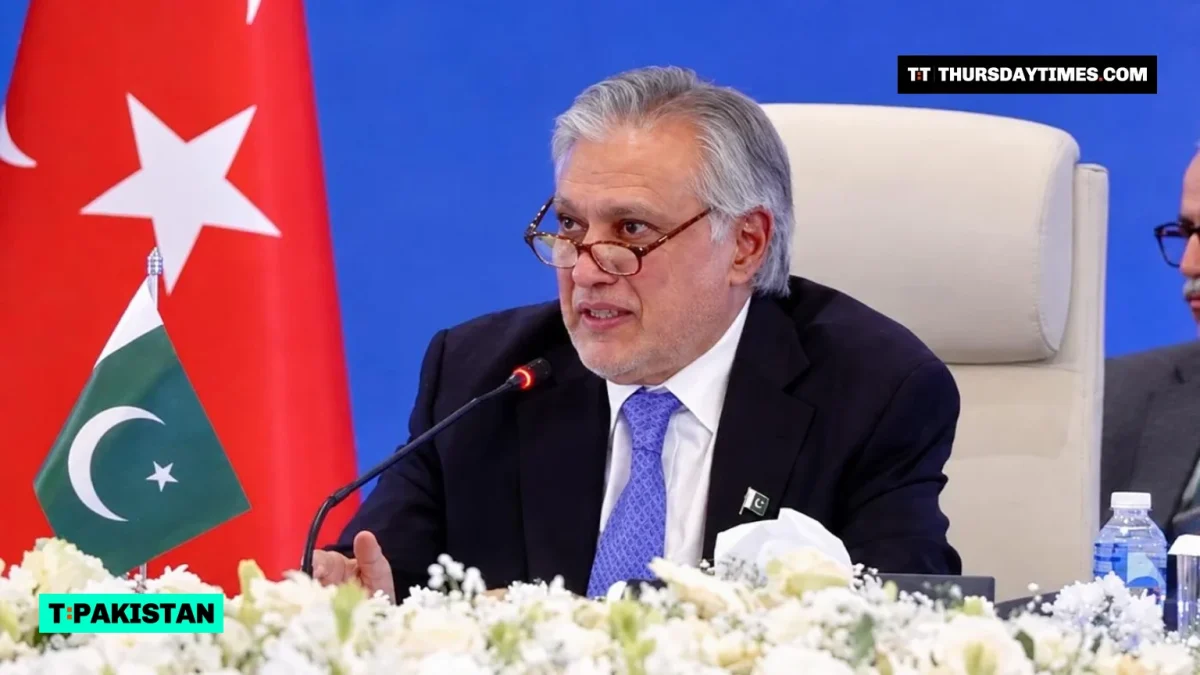
ISLAMABAD (The Thursday Times) — The second meeting of the Makkah Alliance for Defence’s Strategic Political and Defence Committee ran for about two and a half hours in Islamabad on Friday and ended with a joint statement that renewed the three countries’ commitments and reviewed progress on building the alliance’s institutions, but set no dates, numbers, or timetable.
Pakistan hosted Saudi Arabia and Türkiye at the committee, which brings together each country’s foreign minister, defence minister, and chiefs of defence forces and general staff, Deputy Prime Minister and Foreign Minister Ishaq Dar said afterwards. Dar delivered the welcome remarks. Islamabad was given a public holiday for the day, the Red Zone was sealed off, and government buildings were lit in the three countries’ colours.
Pakistan was represented by Dar, Defence Minister Khawaja Asif, and Field Marshal Asim Munir, the Chief of Defence Forces and Chief of Army Staff. The Saudi delegation was led by Defence Minister Prince Khalid bin Salman, with Foreign Minister Prince Faisal bin Farhan and General Fayyadh bin Hamed Al-Ruwaili, chief of the general staff. Türkiye sent Foreign Minister Hakan Fidan, National Defence Minister Yaşar Güler, and General Selçuk Bayraktaroğlu, chief of the general staff.
On the sidelines, the Saudi and Turkish delegations called on Prime Minister Shehbaz Sharif, according to a statement from his office. He reaffirmed Pakistan’s commitment to the alliance, welcomed the “strong unity and determination” of the three countries to defend their security, sovereignty, and territorial integrity, and expressed satisfaction with the outcome of the committee meeting. Dar separately met Fidan. Our news report covers the committee’s condemnation of Houthi attacks on Saudi Arabia, Dar’s briefing, and that bilateral meeting.
What the committee agreed
The joint statement, issued in the names of all three countries, is mostly a review. The committee recalled the inaugural meeting in Istanbul on 31 August and the emergency session in Riyadh on 5 October, and went over progress on both, particularly on “the institutionalisation of the Alliance and the practical implementation of collective defence commitments in line with their national legislation”.
It praised the “pace of progress” towards setting up and operationalising the alliance secretariat in Saudi Arabia, agreed to continue political and military consultations, and committed to cooperation in defence industries, joint technological development, training, and capacity-building, “with a view to enhancing the collective capabilities and cohesion of their armed forces”. It also renewed its condemnation of Houthi attacks and resolved to accelerate support for Saudi security under the pact’s collective defence provisions. Dar called the meeting a sign of Pakistan’s “growing and robust diplomatic footprint”.
How the alliance got here
President Recep Tayyip Erdoğan, Saudi Crown Prince Mohammed bin Salman, and Shehbaz Sharif signed the Makkah Joint Defence Agreement in Makkah on 7 August. Under its text, as reported, an armed attack from outside on any one of the three is treated as an attack on all of them. The Istanbul meeting on 31 August agreed to institutionalise the cooperation, set up a secretariat in Saudi Arabia headed by a secretary-general, and have Pakistan supply the first holder of the post for an initial three years.
At the emergency meeting in Riyadh on 5 October, held after attacks on Saudi cities, the committee appointed Lieutenant General (retd) Nauman Mahmood of Pakistan as the first secretary-general. It also resolved to move immediately to implement collective defence commitments, including providing agreed military forces and capabilities and deploying them rapidly in the Kingdom. Friday’s meeting was the second regular session, which is why it carries that number despite coming after the Riyadh meeting. The agreement provides for the committee to normally meet twice a year, according to our earlier report on its terms.
On ratification, the Turkish parliament approved the pact on 5 November by 279 votes to 119, and the law was published in the Official Gazette on 14 November. On Friday, the Gazette carried Erdoğan’s approval of the agreement, which reports described as completing Türkiye’s ratification.
Dar said on 16 November that Pakistan had offered at the Istanbul meeting to host the next formal session and that a working committee had been formed to carry the implementation work forward. He described the pact as one of self-defence and said it does not breach the UN Charter, whose Article 51 recognises the right of individual and collective self-defence. He added that it should not be read as an attempt at confrontation with other countries. “This region should have its own security architecture. Maybe this is a beginning,” he said, as we reported in his briefing. A Foreign Office spokesperson said on 20 November that the agreement is “defensive in nature” and “not directed against any country”, as noted in our preview of this meeting.
What has not been made public
None of the three joint statements, from Istanbul, Riyadh, and Islamabad, sets out the alliance’s doctrine, the size or make-up of any joint force, who would command it, or the procedures for responding to an attack. The Riyadh statement spoke of rapid deployment in the Kingdom without describing the nature or scale of the forces. Pakistan’s military spokesman said in an interview this month that military alliances do not disclose troop numbers, deployment locations, or operational specifics.
The agreement’s text, as reported, says help for a member under attack is given at its request, with the nature and scope decided by consensus, and that sending Turkish troops abroad would still need separate parliamentary approval. It also provides for intelligence sharing through secure channels. Some previews expected intelligence sharing and joint planning to feature in Friday’s talks, but the joint statement mentions neither.
What comes next
The statement gave no date or venue for the next session and said only that consultations will continue. The near-term work it points to is getting the secretariat in Saudi Arabia fully operational under Mahmood, the defence-industry, joint technology, and training tracks, and the continued effort to support Saudi security against Houthi attacks.