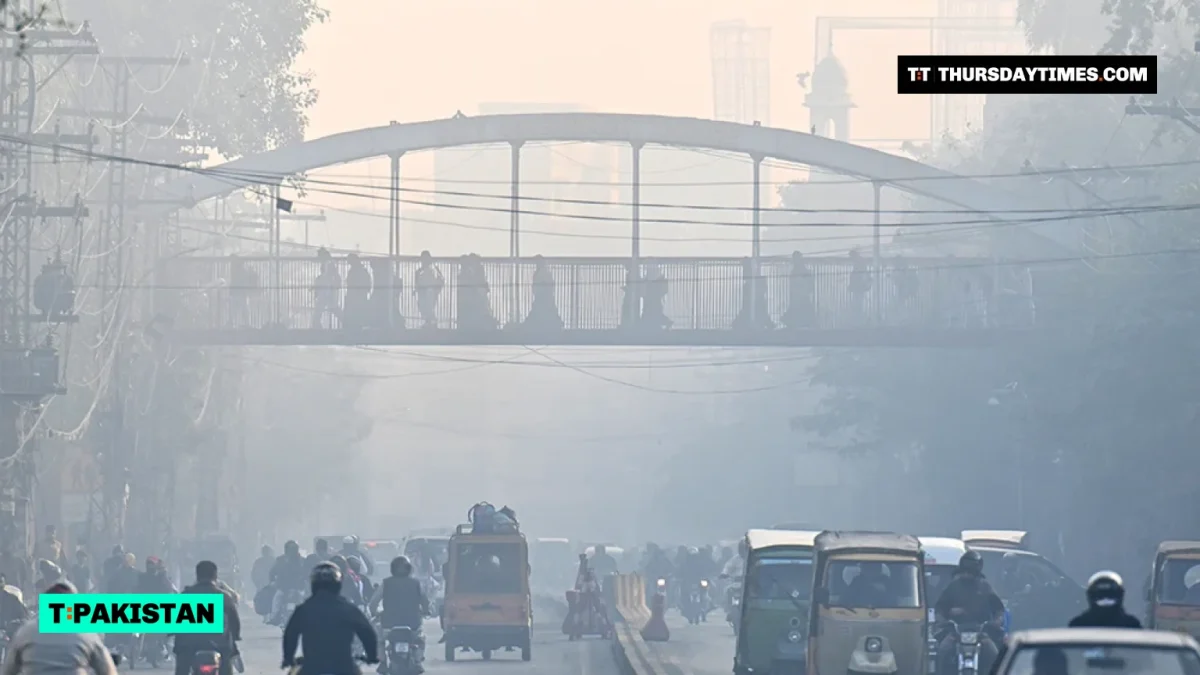
LAHORE (The Thursday Times) — Lahore was ranked the most polluted major city in the world on Sunday morning, with an air quality index (AQI) of 443 recorded between 9am and 10am by the Swiss monitoring firm IQAir, while dense fog forced motorway police to close part of the M4 in Punjab.
Readings above 300 are classed as hazardous. IQAir placed Karachi fifth among major cities with a reading of 175, which is classed as unhealthy. Cairo, Delhi, and Baghdad held second, third, and fourth place.
Fog on the motorways
Motorway police said a section of the M4 between Faisalabad and Pindi Bhattian was closed early on Sunday because of dense fog, and heavy traffic was restricted between Abdul Hakeem and Faisalabad.
“The motorways are being closed to protect people’s lives and property,” said Syed Imran Ahmed, a spokesperson for the motorway police’s central region. “Avoid unnecessary travel in fog.” He advised motorists to travel in daylight, preferably between 10am and 6pm, to reduce speed, and to keep a safe distance from other vehicles.
The Pakistan Meteorological Department had forecast dense fog on Sunday morning between Kot Momin, Pindi Bhattian, Sheikhupura, and Lahore, on the M3 between Lahore and Abdul Hakeem, and on the N5 between Gujranwala and Lahore and between Lahore and Okara. It expected patchy smog or fog across the plains of Punjab and Khyber Pakhtunkhwa.
Readings across Punjab
Readings differ by monitor and time of day. On Saturday evening, Lahore recorded a US AQI of 270 between 5pm and 6pm, in the “very unhealthy” range. The Punjab Environmental Protection Agency’s dashboard showed higher figures elsewhere in the province, with Gujranwala at 470, Vehari at 429, Sialkot at 383, and Wazirabad at 369, all in the hazardous range. The Lahore dashboard put the Multan Road station at 500, Shahdara at 372, and Egerton Road at 346.
Why winter is worse
Air pollution in Pakistan typically worsens in winter, when cooler temperatures and stagnant air trap emissions from vehicles, factories, brick kilns, and crop burning close to the ground. Poor visibility also disrupts road travel across the agricultural plains of Punjab.
Punjab has brought in a range of anti-smog measures in recent years, including curbs on industrial and vehicle emissions and support for farm machinery to discourage crop burning. The government says more than 95 percent of brick kilns in the province have adopted zigzag technology and that crop residue burning fell by a third in the first year of its programme.
The Pakistan Air Quality Initiative found that Lahore’s average PM2.5 concentration from 2 to 31 October was 100.5 micrograms per cubic metre, about 21 percent lower than the 127.4 recorded a year earlier, but still above Pakistan’s standards on all 30 days. The city had 16 consecutive days of unhealthy air between 16 and 31 October.
Fine particulate matter can raise the risk of respiratory and cardiovascular disease, because the tiny particles penetrate deep into the lungs and enter the bloodstream.