BAGHDAD (The Thursday Times) — An Iraqi government committee investigating alleged oil smuggling entered Jurf al-Sakhar, a fortified district south of Baghdad widely regarded as controlled by the Iran-aligned armed group Kataib Hezbollah, under a large military escort on Friday, and agreed on how its inquiry would proceed after meeting faction leaders inside.
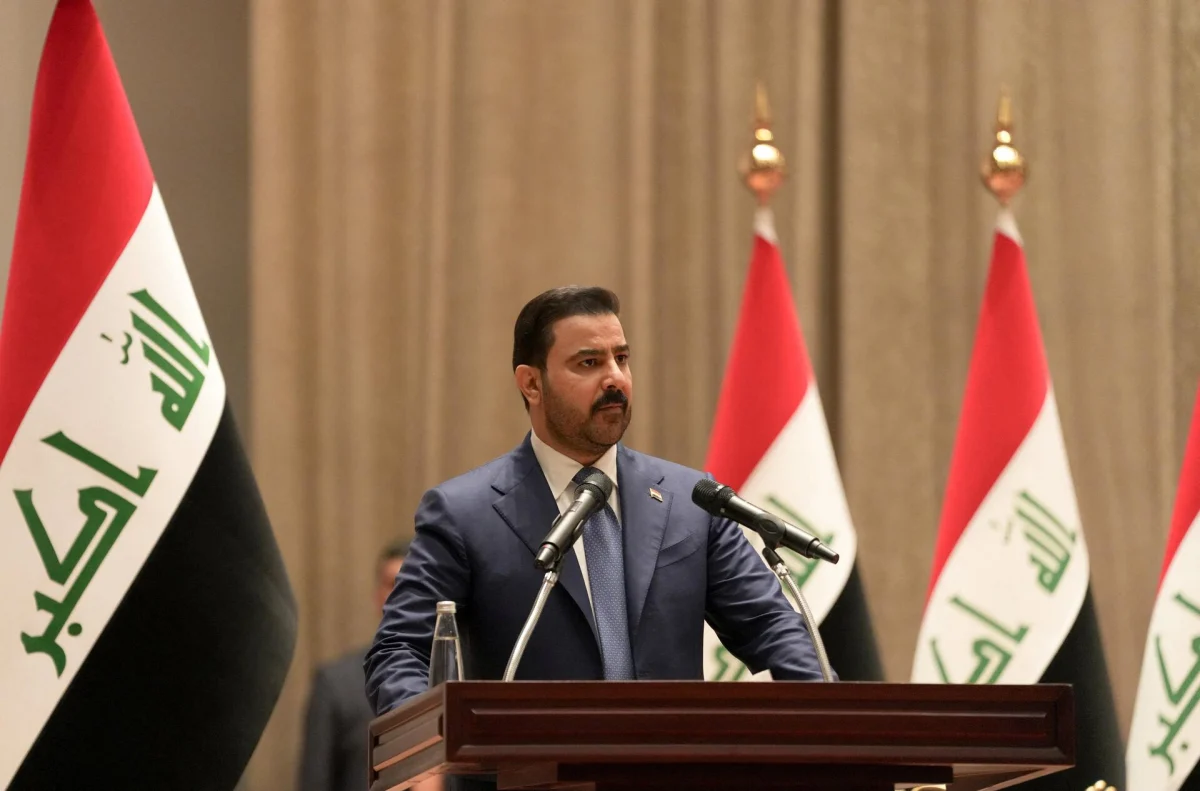
Prime Minister Ali al-Zaidi formed the 11-member committee on Thursday and placed it under the Popular Mobilization Forces, the state-sanctioned umbrella of mostly Shiite armed groups formed in 2014 to fight the Islamic State group. It is chaired by the director general of discipline and security at the Popular Mobilization Commission, and its members include Muayad al-Saadi, an adviser to the prime minister, the director of integrity investigations, and senior officials from the Oil Ministry, the Federal Police, the Counter-Terrorism Service, and the Interior Ministry, among them the head of the Energy Police.
The committee met faction leaders at a security headquarters inside Jurf al-Sakhar and agreed on investigative procedures and a schedule of field visits before starting work, a source with knowledge of the matter said. Footage from the area showed commanders believed to be from Kataib Hezbollah addressing Interior Ministry officers. Saad Maan, who heads the government’s Security Media Cell, denied that political groups or armed factions had seats on the committee itself.
The inquiry follows an intelligence report, circulating since Monday, which alleges that oil is being drawn from a pipeline in the area through an unauthorised opening and carried away in tanker trucks. The report has not been independently verified, and it is not clear which agency prepared it.
The order setting up the committee, dated Thursday and signed by Lt Gen Abdul Amir al-Shammari, director of the commander-in-chief’s office, tasks it with investigating “the smuggling of oil products within the Jurf al-Nasr area” and reporting its findings. Jurf al-Nasr is the name the district was officially given after Iraqi forces and allied armed groups recaptured it from the Islamic State group in 2014.
A test of state control
Before the committee set out, al-Zaidi met Badr Organization leader Hadi al-Amiri, Popular Mobilization Commission chairman Falih al-Fayyadh, and the force’s chief of staff, Abdul Aziz al-Muhammadawi, known as Abu Fadak. According to accounts of the meeting, the prime minister demanded that the law be enforced against offenders, while al-Amiri and al-Fayyadh proposed giving the groups concerned time to reorganise and resume talks over their weapons.
The United States designated Kataib Hezbollah a terrorist organisation in 2009 and designated al-Muhammadawi, a former secretary-general of the group, a terrorist in 2021.
“The state is not merely confronting forces that possess weapons; these forces have also become capable of influencing political decision-making,” a government adviser said, adding that Baghdad wanted to restore its sovereignty without confronting communities.
The case has also shaken Babil’s provincial government. Governor Ali Turki, who was elected in January as the candidate of Sadiqoun, the political wing of the Iran-aligned group Asaib Ahl al-Haq, rejected the smuggling allegations on Tuesday after visiting the site, saying it was an old fuel station used by Federal Police and Popular Mobilization Forces vehicles. On Thursday he said he had resigned over the case, but hours later he and the governorate’s official page published a post suggesting he was still in office. His status remained unclear on Saturday.
Parliament Speaker Haibat al-Halbousi ordered a separate committee of lawmakers to investigate the report on Wednesday. Neither committee has announced any findings.
Jurf al-Sakhar has been under tight security restrictions since 2014, and many of its displaced residents still cannot return. It is believed to contain military camps, weapons depots, and rocket and drone workshops, and many believe it also serves as an operations centre for Iran’s Islamic Revolutionary Guard Corps, an allegation faction representatives deny. Al-Zaidi made his first visit to post-Assad Syria last month as Baghdad looked for new oil export routes.