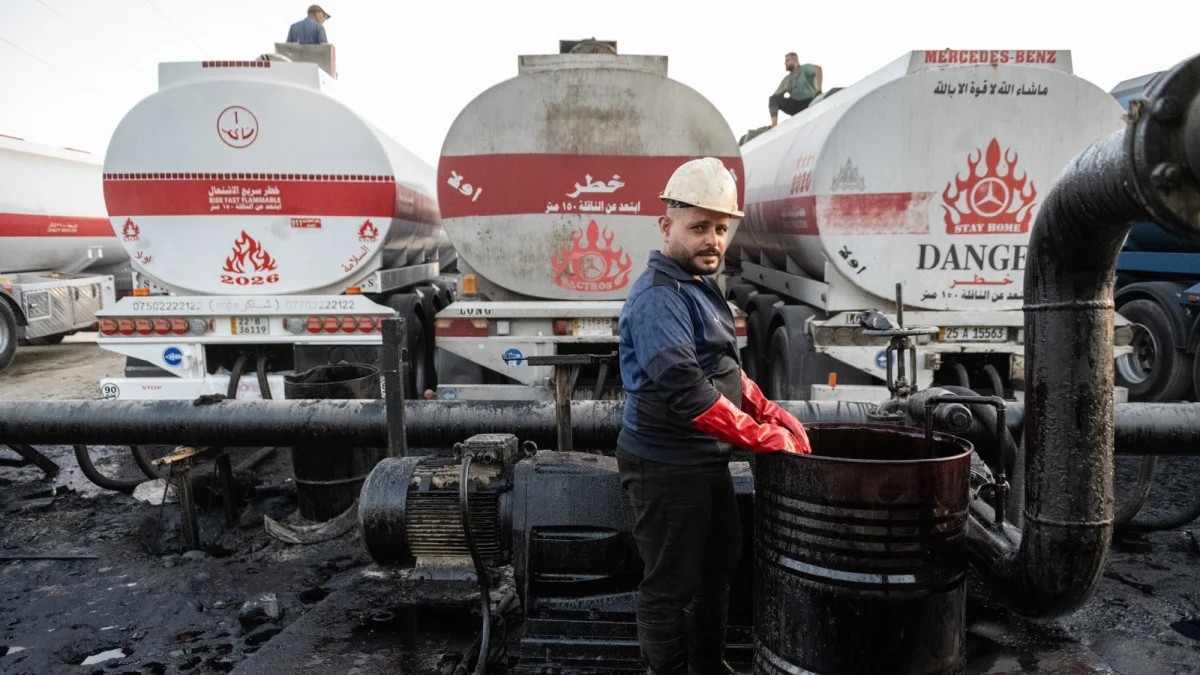
BASRA (The Thursday Times) — Iraq is trucking up to 150,000 barrels of crude a day across the desert to Syria’s Mediterranean port of Baniyas, reviving an overland export route that had lain largely unused for decades as shipping through the Strait of Hormuz remains disrupted.
Since last month, the Qatari energy group UCC Holding has been moving Iraqi crude to Baniyas under a contract with the state oil marketer SOMO, shipping 120,000 to 150,000 barrels per day depending on how many trucks are available, said Bassem Abdul Karim, director general of the Basra Oil Company.
Hundreds of tankers have been queuing outside the Tuba storage depot near Basra to load. UCC has loaded about 1.6 million barrels since the deal took effect on October 26, said Luay Jawad, the facility’s manager. “We load crude oil at the Tuba storage facility and transport it to Baniyas, Syria. The round trip, including the return journey to Tuba, takes up to five days,” said Ishaq Mohammed, one of the drivers.
A costly road west
The route is more expensive than shipping from the Gulf, but it has become workable again because years of war in Syria have ended, people close to the arrangement said. A document describing the deal shows UCC plans to load 5 million to 14 million barrels of heavy crude over three months from October 14 at a discount of $38 a barrel, with about $12 a barrel going on trucking and transit through Syria.
UCC runs a fleet of 6,000 trucks and is expanding it to 10,000 for the route, a person familiar with the deal said, adding that the crude is shipped on from Baniyas to refineries in Greece, Italy, Türkiye, and elsewhere in the Mediterranean. Volumes are unlikely to grow soon because of a shortage of trucks, the person said.
Iraq, OPEC’s second-largest producer, pumped nearly 4.5 million barrels a day in October, about half a million more than in September, according to OPEC’s secondary sources. Iraqi officials said exports rose to about 3.5 million barrels a day in October from 2.65 million in September.
Pipeline plans
Prime Minister Ali al-Zaidi and Syrian President Ahmad al-Sharaa recently discussed in Damascus exporting Iraqi oil through a pipeline to Baniyas with a capacity of up to 2 million barrels a day, Zaidi’s office said, without giving details of cost, technology, or timing. Zaidi called Iraqis and Syrians “one people in two countries”.
The two governments signed a memorandum in July to rehabilitate the pipeline from Haditha in western Iraq to Baniyas, with the US company Chevron expected to carry out the work. Baghdad has also approved studies for two export routes, one from Basra through Haditha to Baniyas, and another from Basra through Haditha and Kirkuk to the Turkish port of Ceyhan. On Saturday, the oil ministry reviewed negotiations on the Basra–Haditha–Baniyas pipeline.
Foreign Minister Fuad Hussein said in an interview that Iraq had reached understandings with the United States to export oil through Hormuz via a shipping lane near Oman, and that the war had cost the country $60 billion in losses. The war began on February 28 with US and Israeli strikes on Iran, and Iranian forces have since attacked vessels that cross the strait without Tehran’s permission.