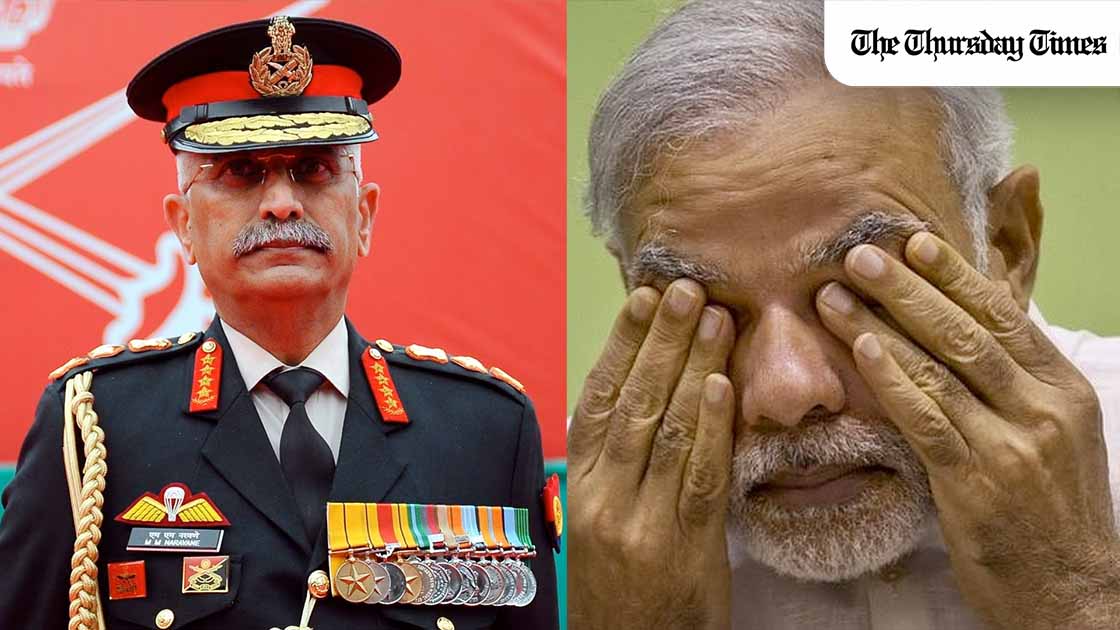
NEW DELHI (The Thursday Times) — The most damaging revelations about a government rarely come from its critics. They come from its own institutions, spoken quietly, without slogans. That is what makes the account attributed to Manoj Mukund Naravane, India’s former Chief of Army Staff, so unsettling. In describing the night of 31 August 2020 during the Ladakh crisis, Naravane is not making a political argument. He is documenting a vacuum.
According to Naravane’s description, four Chinese tanks supported by infantry advanced toward Rechin La in eastern Ladakh, closing to within a few hundred metres of Indian positions. The terrain allowed little margin for delay. In such conditions, military professionalism demands restraint until civilian authority clarifies intent. Naravane did exactly that. He sought instructions.
The calls he made were not routine. They went to the core of India’s security architecture: Defence Minister Rajnath Singh, National Security Adviser Ajit Doval, Chief of Defence Staff Bipin Rawat, and External Affairs Minister S Jaishankar. The question Naravane posed was deceptively simple. What are my orders?
The absence of a clear answer mattered more than the answer itself. Standing instructions prohibited opening fire without clearance from the highest political level. This reflected proper civilian control. Yet civilian control is meaningful only when it culminates in decision. Authority that delays indefinitely ceases to function as authority.
When the instruction finally arrived, relayed after a conversation with Narendra Modi, it consisted of a single sentence. “Jo uchit samjho, woh karo.” Do what you think appropriate. In international security terms, this was not empowerment. It was displacement.
In crises involving nuclear-armed peers, discretion is not the same as freedom. Delegation without parameters transfers risk downward while preserving deniability upward. The military is left to bear not only the tactical consequences of action, but also the strategic and moral weight of escalation.
Naravane’s account is especially revealing because it contrasts sharply with India’s public security narrative. Since 2014, political messaging has emphasised centralisation, decisiveness, and personal command. The Balakot air strikes were repeatedly framed as having been personally cleared at the highest level. The image projected was one of control and certainty.
The Ladakh episode suggests something different. When faced with China rather than Pakistan, with structural escalation rather than symbolic retaliation, the political system hesitated. The result was not restraint by design, but restraint by indecision.
This distinction matters. Deterrence depends on predictability. An adversary must believe that red lines exist and that crossing them produces known consequences. Ambiguity at the moment of confrontation weakens deterrence even if no shots are fired.
China, unlike Pakistan, is not a signalling adversary. It is a systemic competitor. Its leadership studies process as carefully as posture. What it learns from hesitation is not moderation but opportunity.
The significance of this episode lies not in what happened, but in what was revealed. A state that centralises narrative but diffuses responsibility creates a dangerous asymmetry. Power is claimed publicly but avoided privately when costs rise.
The discomfort reportedly surrounding Naravane’s unpublished chapters reflects this tension. The account is not inflammatory. It is procedural. That is precisely why it is destabilising. It frames leadership not as intent, but as action taken when action is hardest.
One sentence from the episode captures the problem with devastating economy. “Do what you think appropriate.” In foreign policy, that is not leadership. It is absence.
The Ladakh crisis passed without escalation. That outcome may be welcome. But outcomes do not erase processes. States that wish to be taken seriously by peers must demonstrate not only capability, but willingness to decide. The lesson of Ladakh is that power unused by choice is strength. Power unused by hesitation is exposure.
The instruction “Jo uchit samjho, woh karo” is therefore legally significant. It does not constitute a decision to escalate. It does not constitute a decision to restrain. It constitutes a transfer of judgment to a military officer operating under time pressure and uncertainty.
From a constitutional perspective, this creates a problem. Delegation of execution is lawful. Delegation of political judgment is not. The choice between escalation and restraint is a political act that must be owned by the civilian executive, precisely because it implicates Parliament, international law, and the lives of citizens.
Indian constitutional practice during past conflicts supports this view. In 1971, the decision to go to war was taken collectively and explicitly by the political leadership. In 1999, the Cabinet Committee on Security retained control over escalation despite intense military pressure. In both cases, the military executed policy rather than improvised it.
The Ladakh episode suggests a departure from this norm. Authority was centralised in theory but avoided in practice. The military was constrained until the final moment, then suddenly released without legal or political cover.
Such a structure exposes commanders to legal and moral risk. If force had been used, responsibility would have been diffuse. If force had not been used and deterrence failed, accountability would have been equally unclear. Constitutional governance requires clarity precisely to prevent such ambiguity.
The principle of civilian control is not satisfied merely by withholding permission. It is satisfied by issuing clear, reasoned directives that reflect political judgment. Silence or vagueness at moments of crisis undermines rather than reinforces civilian supremacy.
There is also a parliamentary dimension. Decisions that risk war engage legislative oversight, even if retrospectively. When political leadership declines to decide, Parliament is denied the opportunity to scrutinise that decision. Democratic accountability is weakened not by secrecy alone, but by evasion.
The government’s apparent sensitivity to the publication of these accounts underscores the constitutional stakes. The concern is not operational security. The events described are historical. The concern is institutional exposure.
Naravane does not accuse the executive of illegality. He does something more consequential. He documents a moment where constitutional responsibility was blurred. In constitutional law, blurred responsibility is itself a failure.
A single sentence encapsulates the legal flaw. Discretion without direction is not authority. It is abdication.
The durability of democratic control over the military depends not on rhetoric, but on practice. When leaders decide, they assume risk. When they hesitate, they transfer it unlawfully to those not constitutionally empowered to bear it.
The Ladakh crisis therefore deserves attention not as a partisan controversy, but as a constitutional warning. Power that is claimed but not exercised corrodes the very structures it seeks to dominate.
If India aspires to strategic credibility, it must reconcile centralised authority with accountable decision-making. Otherwise, future crises will expose the same fault line. And next time, the cost of hesitation may not be theoretical.