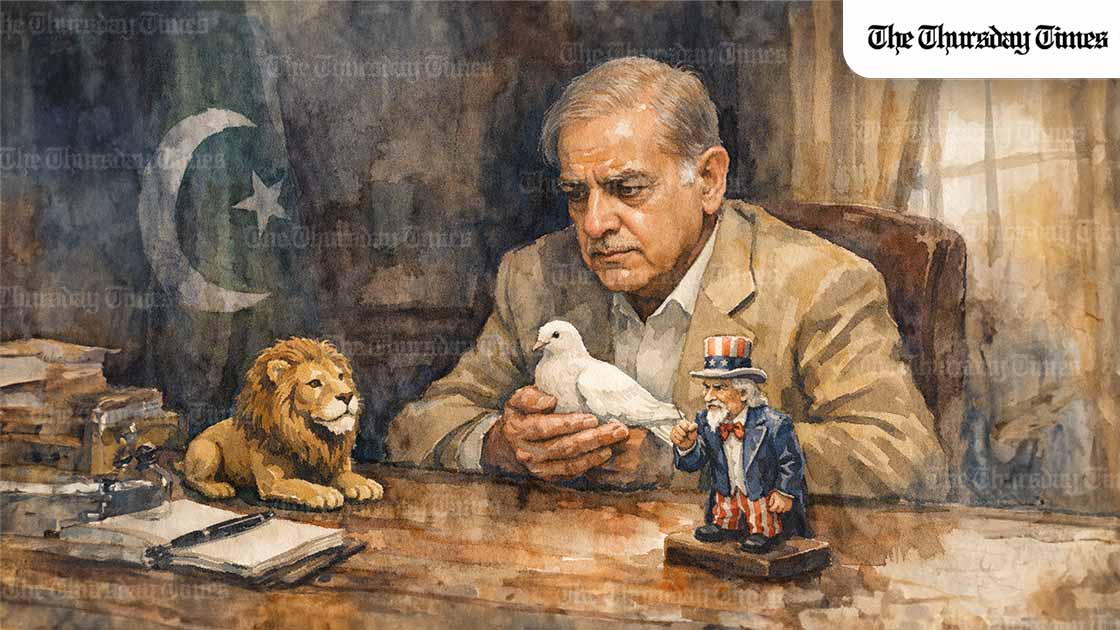
ISLAMABAD (The Thursday Times) — Pakistan has not just issued general calls for calm. It has taken on an active mediator role: pushing for a ceasefire, building a regional diplomatic coalition, coordinating with China, the UN and Gulf capitals, talking directly to Iranian leaders, hosting the first senior direct U.S.-Iran talks in decades in Islamabad, physically mediating those talks through Ishaq Dar and Field Marshal Asim Munir, continuing to pass messages after the talks stalled, and now trying to organise a second round in Islamabad later this week or early next week. That much is clearly supported by a mix of Reuters reporting and Pakistani official statements.
What Pakistan has done, step by step
In late March, Pakistan publicly moved onto a mediation track. According to Pakistan’s Foreign Ministry briefing of 2 April, Prime Minister Shehbaz Sharif and Deputy Prime Minister/Foreign Minister Ishaq Dar had already been engaged in “active diplomatic efforts” for an end to hostilities in West Asia, including Iran, through multiple calls and meetings. Pakistan says this included direct outreach by the Prime Minister to Kuwait and to Iranian President Masoud Pezeshkian on 27–28 March, with Sharif briefing Pezeshkian on Pakistan’s peace initiative and Pezeshkian praising Pakistan’s supportive role.
At the same time, Pakistan used the foreign-minister level to build a supporting bloc. The 2 April Foreign Ministry briefing says Pakistan hosted the second consultations among the foreign ministers of Pakistan, Saudi Arabia, Türkiye and Egypt in Islamabad after a first round in Riyadh on 19 March. Pakistan’s spokesperson said Dar briefed them on the prospects for possible U.S.-Iran talks in Islamabad and that the visiting ministers “expressed their full support to the initiative.”
Pakistan also widened that diplomacy beyond the four-state format. The same official briefing says Dar spoke with China’s Wang Yi, Egypt’s Badr Abdelatty, Türkiye’s Hakan Fidan, UN Secretary-General António Guterres, Qatar’s Prime Minister/Foreign Minister Mohammed bin Abdulrahman Al Thani, Indonesia’s foreign minister, and Iran’s Abbas Araghchi between 27 and 29 March. In those contacts, Pakistan pressed de-escalation and diplomacy, while China and the UN expressed support for Pakistan’s efforts.
One of Pakistan’s clearest concrete confidence-building moves was around shipping. Pakistan’s Foreign Ministry said Iran agreed to allow 20 more Pakistani-flagged ships to pass through the Strait of Hormuz, two per day, and Pakistani officials described that as a constructive gesture and a “meaningful step toward peace.” This was framed by Islamabad as both an economic and de-escalatory measure.
Pakistan also coordinated closely with China at a more formal level. On 31 March in Beijing, China and Pakistan announced a five-point initiative calling for an immediate cessation of hostilities, the start of peace talks as soon as possible, protection of civilians and infrastructure, restoration of safe commercial shipping through Hormuz, and a comprehensive peace framework rooted in the UN Charter and international law. That is one of the clearest documentary signs that Pakistan was trying to shape not just a ceasefire but a wider peace process.
By early April, Pakistan’s role had become more openly acknowledged in international reporting. Reuters reported on 2 April that Pakistan had been in frequent contact with Washington and that JD Vance had communicated with Pakistani intermediaries over the Iran conflict, while Pakistani officials and analysts described an intense pattern of meetings and near-daily calls with world leaders. Reuters also reported that Sharif had repeated contacts with Donald Trump, Saudi Crown Prince Mohammed bin Salman and Masoud Pezeshkian.
The most consequential step came with the ceasefire and the Islamabad talks themselves. Reuters reports that the U.S.-Iran talks in Islamabad were held four days after a Pakistan-brokered ceasefire paused six weeks of war. Pakistan’s Foreign Ministry states that Iran and the United States accepted Sharif’s invitation for peace talks in Islamabad. The U.S. delegation, led by Vice President JD Vance, and the Iranian delegation, led by Speaker Mohammad Baqer Qalibaf and including Foreign Minister Abbas Araghchi, arrived in Islamabad on 11 April. Pakistan says both delegations were formally received by Ishaq Dar and Field Marshal Asim Munir.
Pakistan did not merely host the delegations. According to Dar’s official remarks, he and Munir “helped mediate several rounds of intense and constructive negotiations” over roughly 24 hours. Reuters’ reconstruction of the meeting says the talks were conducted across separate hotel wings with trilateral meetings involving Pakistani mediators; when the atmosphere became tense, Munir and Dar called a tea break and moved the two sides back into separate rooms. Reuters also says Pakistan tried to soften the mood and has continued passing messages between Tehran and Washington after the meeting ended.
Pakistan also eased the mechanics of the process. Its Foreign Ministry issued visa-free travel for delegates and journalists from Iran and the United States for the duration of “Islamabad Talks 2026.” That is a smaller point, but it shows Islamabad was not improvising casually; it was building an actual negotiation platform.
After the talks ended without agreement, Pakistan publicly worked to keep the diplomatic track alive rather than letting the process collapse. Dar said it was imperative that both sides uphold the ceasefire and that Pakistan would continue facilitating engagement in the days ahead. Sharif said on 13 April that the ceasefire was still intact and that vigorous efforts were under way to remove bottlenecks and secure lasting peace. Reuters separately quoted Sharif saying that a “full effort” was still on to resolve the issues.
Pakistan is now trying to get both sides back into the room. Reuters reported on 14 April that Pakistani and Iranian officials said Islamabad had reached out to Iran and received a positive response about a second round, that Pakistani officials were in communication with both sides on timing, and that another meeting could happen as early as this coming weekend. AP likewise reported that Pakistan had proposed a new round of U.S.-Iran talks in Islamabad.
What seems to have been Pakistan’s strategy
Taken together, Pakistan’s approach appears to have had six moving parts.
First, it tried to stop the fighting before trying to settle the underlying issues. Pakistan’s own statements and Reuters’ reporting both place it in the chain that led to the ceasefire and then into the follow-on talks.
Second, it assembled regional political cover. Pakistan brought Saudi Arabia, Türkiye and Egypt into consultations in Islamabad, while also talking to Qatar, Indonesia and others. That gave it a wider Muslim-majority diplomatic umbrella rather than acting alone.
Third, it coordinated with China and the UN, which gave the mediation effort added weight. China publicly backed Pakistan’s role, and Wang Yi on 13 April said China would be pleased to see Pakistan play a greater role in resolving the conflict. The UN Secretary-General also expressed support in Pakistan’s account of Dar’s call with him.
Fourth, Pakistan tried to stabilise the shipping question around Hormuz, which is one of the conflict’s biggest global pressure points. Its five-point plan with China called for restoring normal passage, and Pakistan publicly highlighted Iran’s decision to allow more Pakistani-flagged ships through the Strait as a peace-building measure.
Fifth, it used both civilian and military channels. Official Pakistani statements repeatedly put Ishaq Dar and Asim Munir side by side at the receiving line and in the mediation room, while Reuters stresses Munir’s importance to U.S. access and Pakistan’s leverage.
Sixth, it has tried to act as a message-carrier even when no deal was reached. Reuters says Pakistan has kept relaying messages between the two sides after the failed round, which is often what serious mediation looks like between face-to-face sessions.
What Pakistan has achieved
Pakistan can credibly claim three concrete achievements.
It helped get to a ceasefire that at least temporarily halted direct U.S.-Iran fighting. Reuters explicitly describes the ceasefire as Pakistan-brokered, and Pakistani officials say the ceasefire remains in place for now.
It got both sides to agree to senior direct talks in Islamabad, which Reuters describes as the first direct U.S.-Iran encounter in more than a decade and the most senior engagement since Iran’s 1979 revolution. That alone is diplomatically significant.
It prevented the failure of the first round from becoming a full collapse of diplomacy. Even after the 21-hour meeting ended without agreement and the U.S. moved toward a blockade of Iranian ports, both Reuters and AP report that Pakistan continued trying to organise a second round.
Bottom line
Pakistan’s recent peace effort has been unusually active and unusually hands-on. It has involved direct leader-level outreach, regional coalition-building, China coordination, UN engagement, a shipping confidence-building step in Hormuz, the invitation and hosting of senior U.S. and Iranian delegations in Islamabad, real-time mediation by Ishaq Dar and Asim Munir, post-talk message-passing, and active preparation for a second round. That is enough to say Pakistan has become a central intermediary in this crisis, not just a commentator on it. But it would be too early to say it has secured peace; what it has secured so far is a fragile diplomatic channel that still exists.