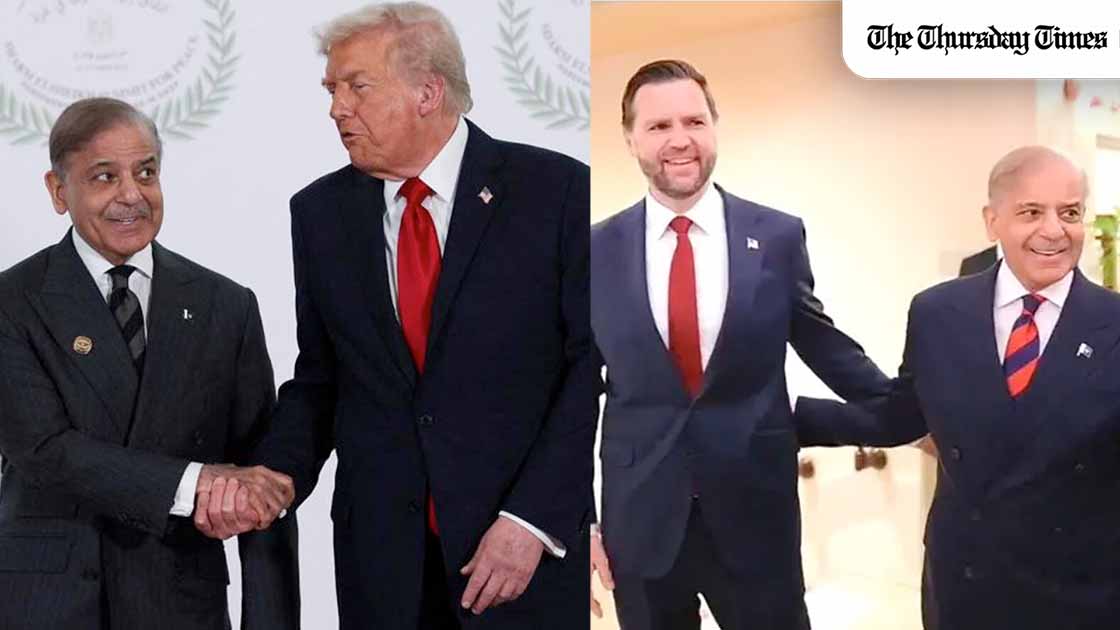
WASHINGTON, D.C. (The Thursday Times) — The shifting signals from the White House over whether Vice President JD Vance will travel to Pakistan for high-level talks have fuelled confusion in Washington and abroad. But the answer may lie not only in the uncertain state of the negotiations, but in a quieter and older doctrine of American power: never place the president and vice president in unnecessary danger at the same time.
On Sunday, the White House told CNN that Mr Vance was travelling to Pakistan alongside envoy Steve Witkoff and adviser Jared Kushner, despite earlier comments from President Donald Trump suggesting that the vice president would not attend. When asked about the contradiction, a White House official offered a terse explanation: “Things changed.”
Perhaps they did. Negotiations involving the United States and Iran have moved rapidly in recent days, with Pakistan emerging as a potential venue for direct or indirect talks. But diplomatic fluidity is only part of the picture.
For decades, American security planners have operated under a basic principle of continuity of government: the president and vice president, the two highest constitutional officers in the line of succession, are rarely placed in the same risky environment unless necessary. That logic applies during inaugurations, State of the Union addresses, foreign travel and crisis situations. It becomes even more acute when the destination is a politically sensitive or high-threat region.
Pakistan, while an increasingly important diplomatic actor, presents exactly the kind of environment where protective calculations become more complex. The country sits beside Afghanistan and Iran, has faced militant threats for years, and would instantly become one of the most scrutinised security theatres in the world if it hosted a historic American-brokered accord.
That helps explain why Mr Vance’s travel status may appear to change by the hour. Sending the vice president first allows Washington to show seriousness, dispatch senior political authority and preserve presidential distance while talks remain uncertain. But if negotiations suddenly move towards a final breakthrough, the calculus changes.
Mr Trump has long favoured dramatic personal diplomacy, preferring headline-grabbing arrivals and made-for-television summits where he can claim direct ownership of the outcome. If advisers conclude that a Pakistan visit could produce a final signing ceremony or landmark announcement, it is conceivable that Mr Trump would want to go himself.
At that point, security doctrine would likely reassert itself. If the president were to travel to Pakistan, Mr Vance would almost certainly need to leave first or remain elsewhere. The White House may be reluctant to publicly frame such decisions in those terms, but continuity planning has shaped presidential movement for generations.
This does not mean that every scheduling change is driven by succession concerns. Negotiations can collapse, intelligence warnings can shift, foreign counterparts can alter demands and weather can disrupt even the most carefully planned missions. Yet the contradiction between Mr Trump’s earlier remarks and the later White House confirmation suggests a process still in motion rather than a settled plan.
For Pakistan, the episode itself is significant. Even being discussed as a possible destination for an American vice president or president during a major international negotiation reflects a diplomatic elevation few would have predicted not long ago. Islamabad is no longer being viewed merely as a capital on the periphery, but as a potential stage for power politics.
Whether Mr Vance ultimately boards the plane may matter less than what the indecision reveals. Washington appears to be keeping multiple doors open: vice-presidential diplomacy if talks remain preliminary, presidential intervention if a final deal comes into reach.
In that sense, the changing story may not be confusion at all. It may be contingency planning in real time.