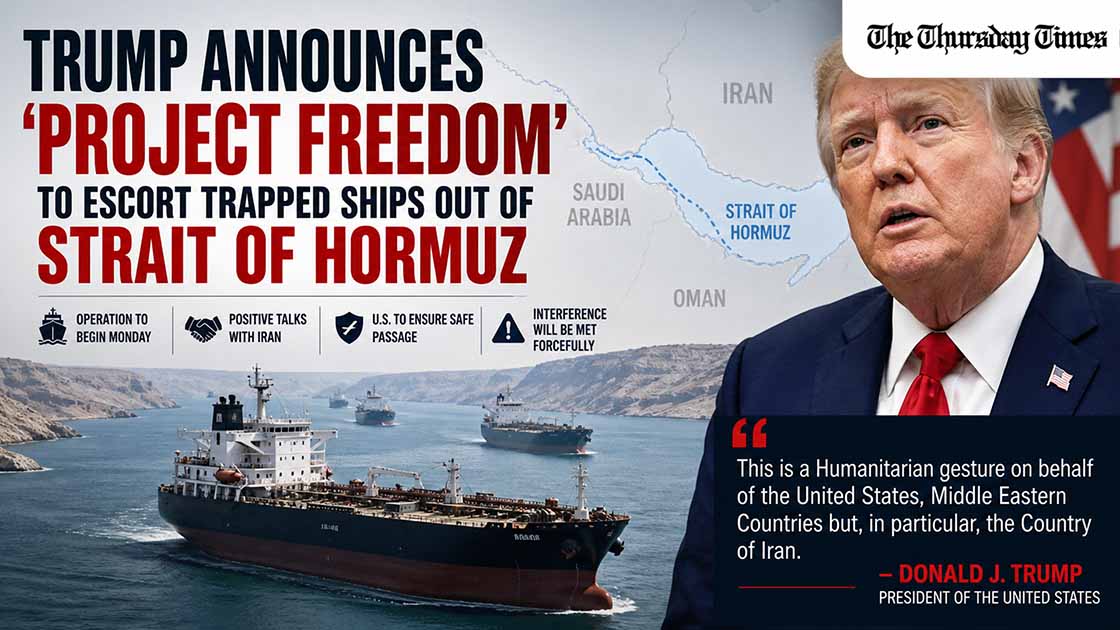
WASHINGTON (The Thursday Times) — U.S. President Donald Trump has announced a new initiative called “Project Freedom”, saying the United States will begin efforts to guide stranded international ships safely out of the Strait of Hormuz amid the ongoing Middle East crisis.
In a lengthy public statement, Trump said countries from around the world had approached Washington for assistance, claiming many vessels were effectively trapped in the strategic waterway despite having no direct involvement in the conflict.
He described the affected ships as belonging to “neutral and innocent bystanders”, adding that the U.S. had informed those governments it would use its “best efforts” to escort ships and crews out of restricted waters.
The Strait of Hormuz is among the most important shipping lanes on earth, linking Gulf energy producers to global markets. A substantial share of the world’s oil, liquefied natural gas and petrochemical exports passes through the narrow corridor each day.
Any prolonged disruption can quickly reverberate through fuel prices, freight costs, insurance markets and food supply chains.
Trump said many vessels had refused to return to normal routes until the area was deemed safe for navigation, suggesting commercial confidence in the corridor has sharply deteriorated.
‘Project Freedom’ to begin Monday
According to Trump, the operation will begin Monday morning Middle East time. He framed the move as a humanitarian mission designed to assist crews facing shortages of food and onboard necessities after being delayed at sea.
He also said the process would serve the interests of Iran, wider Middle Eastern states and the United States, arguing that restoring basic maritime movement could reduce pressure across the region.
Positive talks with Iran
One of the most notable elements of Trump’s statement was his claim that U.S. representatives are engaged in “very positive discussions” with Iran, hinting at a possible diplomatic opening alongside the shipping initiative.
No independent confirmation of those talks was immediately available, and neither Tehran nor U.S. officials publicly released details of any negotiating framework at the time of publication.
Still, the wording suggests Washington may be attempting a dual-track approach: deterrence at sea paired with backchannel diplomacy.
Warning against interference
Trump also issued a stark warning, saying that if the humanitarian process were obstructed, such interference would “have to be dealt with forcefully”.
That language is likely to be closely watched by regional capitals, shipping firms and energy traders, as it implies the possibility of military protection for escorted convoys.