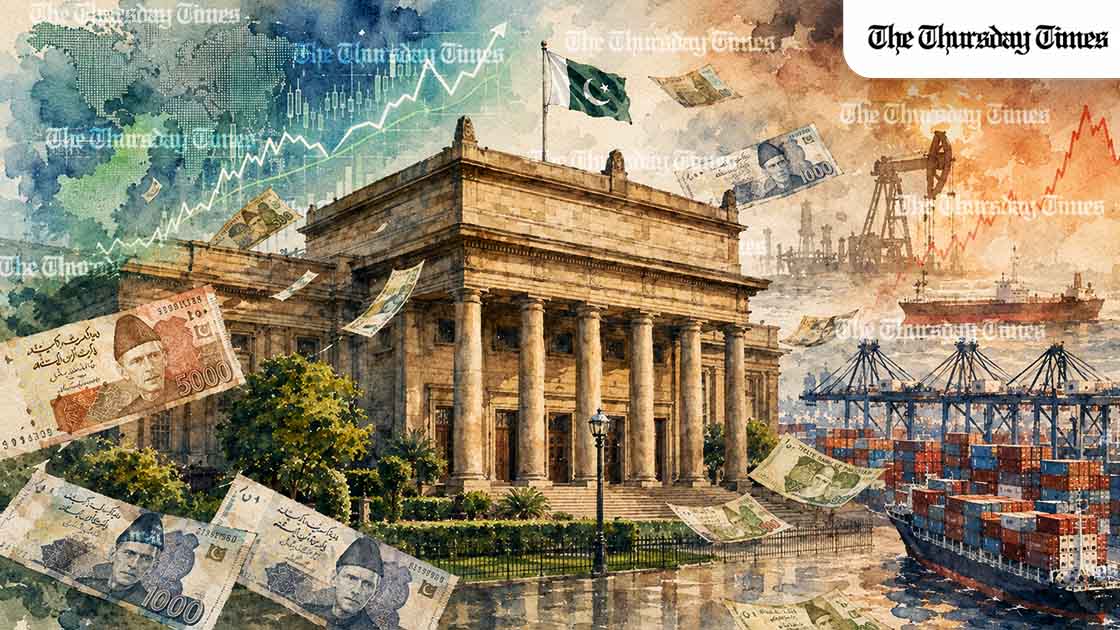
ISLAMABAD (The Thursday Times) — Islamabad is being told a cautiously encouraging story by the State Bank of Pakistan. After years of inflationary pressure, external vulnerability and stop-start growth, Pakistan entered the first half of FY26 with a firmer macroeconomic base. Growth improved, inflation moderated, foreign exchange reserves rose, the fiscal account moved into rare surplus, and the rupee remained broadly stable.
But the report is not a victory lap. It is closer to a warning wrapped inside a recovery note. The State Bank’s central message is that Pakistan has stabilised, but it has not yet transformed. The economy is growing again, but not fast enough to absorb its demographic pressures. Inflation has fallen, but food and core inflation remain stubborn. Reserves have improved, but exports are weak. Fiscal consolidation has produced breathing room, but the tax base remains narrow. And above all, the economy remains vulnerable to shocks from oil prices, war, climate events, global trade disruption and weak investment.
The report, formally submitted by SBP Governor Jameel Ahmad to Parliament under Section 39(2) of the State Bank of Pakistan Act, is based on economic data for July to December 2025 and was finalised using developments available by the end of April 2026.
Stabilisation has returned. Structural weakness remains
The first half of FY26 was marked by a clear improvement in headline macroeconomic indicators. Real GDP grew by 3.8 percent in H1-FY26, double the 1.9 percent recorded in the same period a year earlier. The rebound was led by industry, followed by services and agriculture. Large-scale manufacturing, which had been contracting for three years, expanded by 4.8 percent. National CPI inflation averaged 5.2 percent, down from 7.2 percent in H1-FY25. Foreign exchange reserves held by the SBP rose to US$16.1 billion by end-December 2025. The fiscal balance posted a surplus of 0.4 percent of GDP, the first half-year surplus since FY02, while the primary balance stood at 3.2 percent of GDP.
Those figures matter because Pakistan has often grown in ways that quickly reopen its external account crisis. A familiar cycle has played out repeatedly: domestic demand rises, imports surge, exports fail to keep pace, reserves fall, the currency comes under pressure, inflation rises, and policy must tighten again. The SBP’s report suggests that H1-FY26 broke part of that pattern, at least temporarily. Growth improved without a collapse in reserves, inflation softened, and the fiscal position improved.
Yet the recovery is uneven. Exports fell by 5 percent in H1-FY26, while imports rose by 12.4 percent. The current account moved into a deficit of US$1.4 billion, compared with a surplus of US$0.9 billion in H1-FY25. Private sector credit growth slowed sharply to 0.9 percent year-on-year, compared with 22.8 percent a year earlier. The report repeatedly returns to Pakistan’s deeper weaknesses: low savings, low investment, weak competitiveness, falling exports as a share of GDP, subdued FDI and a persistently low tax-to-GDP ratio.
In simpler terms, Pakistan has regained some control over the macroeconomic dashboard. But the engine underneath still needs repair.
Industry leads the rebound
The strongest signal in the report is the recovery in real economic activity. Real GDP growth of 3.8 percent in H1-FY26 was broad-based, but the key driver was industry. The industrial sector expanded by 8.1 percent, compared with just 0.5 percent in H1-FY25. Large-scale manufacturing grew by 4.8 percent after three years of contraction in comparable periods.
The reasons are clear. Lower inflation and easing interest rates helped revive domestic demand. A stable exchange rate reduced uncertainty for businesses. Development spending supported construction. Lower global commodity prices reduced input costs. Automobiles, textiles and wearing apparel, and petroleum products were among the leading contributors to the LSM recovery. The automobile sector benefited from stronger demand, falling borrowing costs, promotional discounts and new model launches, particularly in the SUV segment. Textiles and wearing apparel remained supported by exports, while cement and petroleum output improved with construction and transport activity.
Construction also benefited from easing input costs, higher development spending and government-backed concessional housing. Electricity, gas and water supply recorded higher value addition, though the report notes that this partly reflected higher government subsidies rather than a strong rise in grid power demand. Mining and quarrying, however, contracted.
This matters politically as well as economically. Industrial recovery creates a narrative of momentum. It gives the government evidence that stabilisation policies, IMF-backed reforms and interest rate reductions are beginning to feed into the real economy. But the deeper question is whether this industrial rebound is cyclical or structural. A rebound from a low base can lift the numbers for a few quarters. Sustained industrial expansion requires investment, productivity growth, reliable energy, regulatory predictability and export competitiveness.
The SBP is careful not to overstate the achievement. It praises the improvement but frames it as a beginning, not a destination.
Agriculture: livestock saves the sector from flood damage
Agriculture grew by 2.2 percent in H1-FY26, up from 1.4 percent in the same period last year. But this improvement masks serious stress within crops. The report says agriculture growth was primarily driven by livestock, which more than offset flood-related losses in crop output. Livestock value addition rose sharply, while crop output fell, especially in cotton and maize.
Floods damaged parts of the Kharif crop cycle, but the losses were less severe than early assessments suggested. Sugarcane and rice performed better than expected. Sugarcane benefited from higher yields and increased cultivated area, partly because farmers found it more attractive relative to competing crops. Rice output rose because yields improved, even though the area under cultivation declined.
This is one of the report’s more important underlying points. Pakistan’s agriculture remains deeply exposed to water stress, temperature shocks, floods and weak productivity. The SBP connects this to the need for agricultural credit, climate-smart farming practices, better technologies and innovations such as urban agriculture. It also highlights that food inflation has been affected by lower production of key crops, wheat supply concerns, flood-related disruptions and imperfections in commodity markets.
That link between climate, agriculture and inflation is crucial. Pakistan’s food economy is not just a rural development issue. It is now a macroeconomic stability issue. When crops fail or supply chains break, inflation rises, household purchasing power falls, and the central bank faces pressure to keep monetary policy tighter for longer.
Services and labour: recovery, but not yet enough
The services sector grew by 3.1 percent in H1-FY26, up from 2.6 percent a year earlier. The improvement was driven mainly by wholesale and retail trade, transport and storage, and public administration and social security. These gains followed the recovery in commodity-producing sectors, especially industry and agriculture.
Labour market indicators also began to improve. The report notes that online and newspaper job postings increased, and the SBP-IBA business confidence survey showed optimism about employment generation over the next six months. However, industrial employment in Punjab declined slightly, suggesting that the labour recovery remains uneven.
This is where the report’s tone becomes more cautious. Growth of around 4 percent may be positive after a difficult period, but for Pakistan it is not enough to create broad-based employment, reduce poverty meaningfully or absorb new entrants into the labour force. The report’s discussion of the Household Integrated Economic Survey also points to increased disparities in household income and consumption, with smaller gains for lower-income groups.
The recovery, in other words, is real. But it is not yet inclusive enough.
Inflation: the headline improves, but the pressure has not disappeared
Inflation is one of the clearest improvements in the report. Average national CPI inflation fell to 5.2 percent in H1-FY26 from 7.2 percent in H1-FY25. This moderation was helped by prudent monetary and fiscal policies, a relatively stable exchange rate, lower international commodity prices and downward adjustments in administered electricity tariffs.
But the composition of inflation shows why the SBP remains cautious. Energy and core inflation moderated, but food inflation rose. Urban food inflation increased to 3.1 percent, while rural food inflation rose to 3.9 percent. Non-perishable food items, especially wheat and sugar, were a key source of pressure. Perishable prices fell steeply, helping contain overall food inflation, but that does not remove the problem of supply shortages and market inefficiencies in staple goods.
Core inflation also remains a concern. Even though it declined, it stayed elevated and sticky. The report identifies house rents, gold prices, education fees and minimum wage adjustments as persistent contributors. It also notes that higher corporate margins in some sectors added to core inflation, as firms raised prices despite falling input costs.
This is why the SBP did not rush into aggressive rate cuts. The Monetary Policy Committee kept the policy rate unchanged from July to October 2025 and cut it by only 50 basis points in December, bringing the cumulative reduction since June 2024 to 1,150 basis points. The policy rate stood at 10.5 percent at the end of H1-FY26.
The inflation story is therefore not simply one of success. It is one of relief with caution. Pakistan has moved away from the acute inflation shock of previous years, but food markets, energy prices and core pressures still hold the power to reverse the gains.
Monetary policy: cautious easing, careful liquidity management
The SBP’s monetary policy position is best described as controlled easing. It has lowered rates substantially since mid-2024, but it continues to emphasise a positive real interest rate and vigilance against renewed inflation.
Liquidity management became especially important in H1-FY26. Higher government borrowing from scheduled banks, increased credit to the non-government sector, higher remittances, stronger transaction demand and withholding tax on cash withdrawals for non-filers all contributed to tighter interbank liquidity. The SBP responded through open market operations, helping reduce volatility in the weighted average overnight repo rate. The report says deviations from the policy rate fell to an average of 11.4 basis points in H1-FY26, compared with 19.6 basis points in H1-FY25.
Private sector credit appears weak at first glance, growing only 0.9 percent year-on-year by end-December 2025. But the SBP attributes much of the slowdown to a high base from the previous year, when banks expanded lending to avoid the advances-to-deposit ratio-based tax. In absolute terms, private sector credit expanded by Rs 992.3 billion in H1-FY26, compared with Rs 1,978.9 billion a year earlier. Business loans rose by Rs 867.2 billion, driven by both working capital and fixed investment lending.
The implication is that credit demand has not collapsed. It is normalising after a policy-driven spike. Lower input costs, improved activity and easier financing conditions helped demand, while increased bank deposits improved the supply of loanable funds.
Fiscal policy: rare surplus, but tax weakness remains
The fiscal chapter is one of the most politically significant parts of the report. Pakistan recorded a fiscal surplus of 0.4 percent of GDP in H1-FY26, compared with a deficit of 1.3 percent in H1-FY25. This was the first half-year surplus since FY02, when the Ministry of Finance began publishing quarterly fiscal operations data.
The improvement was driven primarily by a sharp fall in interest payments as interest rates declined and debt reprofiling reduced the servicing burden. The primary balance remained broadly unchanged because the revenue gain was matched by higher non-interest spending. Provincial surpluses also contributed more to the overall balance than last year.
Total revenue rose from Rs 9.764 trillion in H1-FY25 to Rs 10.684 trillion in H1-FY26. Tax revenues increased to Rs 6.729 trillion, while FBR taxes reached Rs 6.161 trillion. Non-tax revenue remained substantial at Rs 3.954 trillion, supported by SBP profit and petroleum development levy collections. SBP profit alone contributed Rs 2.428 trillion in H1-FY26.
But this is also the weak point. Pakistan’s fiscal consolidation still depends heavily on non-tax revenue, especially SBP profit and levies. The report explicitly warns that sustaining fiscal discipline over the medium term requires continued improvement in tax collection.
Spending also shifted in a way that helped growth. Lower mark-up payments created space for development spending, subsidies and grants. Some of the increase in non-interest expenditure was linked to flood relief, while higher subsidies reflected efforts to contain power sector circular debt.
The immediate picture is positive. The longer-term question is whether Pakistan can convert temporary fiscal space into durable reform. A surplus produced by falling interest payments is helpful. A stronger tax base would be transformative.
Public debt: slower accumulation, better maturity profile
The report says sustained fiscal consolidation and lower interest payments slowed the pace of public debt accumulation. Rupee appreciation against the US dollar and lower accumulation of government deposits also helped. Importantly, the government raised more funding through fixed-rate long-term instruments and retired short-term debt, lengthening the maturity profile of public debt.
This matters because Pakistan’s debt problem is not only about the size of the debt stock. It is also about rollover risk, interest rate exposure and the pressure of short-term maturities. Moving towards longer-term fixed-rate instruments can reduce refinancing pressure and make the debt profile more manageable.
Debt repayment capacity also improved because of lower interest payments, higher revenue collection, stronger remittances and rising reserves.
Still, the report does not suggest that Pakistan’s debt challenge has been solved. It suggests that the direction improved in H1-FY26. The durability of that improvement depends on fiscal discipline, tax reform, external inflows, controlled inflation and sustained growth.
External account: remittances carry the burden as exports disappoint
The external account is where the recovery looks most fragile. Imports rose strongly as economic activity improved. The report says import growth was volume-driven and spread across most categories, although lower energy and raw cotton prices helped contain the bill. Recent tariff rationalisation under the National Tariff Policy 2025-2030 also changed the composition of imports, with stronger growth in machinery, metals and transport-related goods where tariffs were reduced across more tariff lines.
Exports, however, fell despite growth in global trade. The decline was driven largely by rice exports, affected by lower global prices, increased competition and closure of the western border. High value-added textile exports were more resilient, but not strong enough to offset the broader weakness. The trade deficit widened by nearly 36 percent in H1-FY26.
The report’s judgement on exports is blunt. Pakistan’s export-to-GDP ratio has declined over two decades. The problem is structural: low productivity, policy inconsistency, weak integration with global value chains, narrow product concentration and limited market diversification. These weaknesses leave exports exposed to price and demand shocks.
Remittances remain the cushion. Workers’ remittances reached US$19.7 billion in H1-FY26, compared with US$17.8 billion in H1-FY25. They comfortably financed the trade in goods and services deficit and a major part of the primary income deficit, helping contain the current account deficit. A low kerb premium, stable exchange rate conditions, strong labour markets in GCC economies, increased migration and official measures to reduce transaction costs helped channel remittances through formal systems.
This is both strength and vulnerability. Remittances stabilise the external account, but they are not a substitute for export competitiveness. An economy that relies on workers abroad to finance weak domestic export performance remains exposed to labour market shocks in the Gulf and global downturns.
Reserves and the rupee: stronger buffers, but competitiveness questions
SBP foreign exchange reserves increased from US$14.5 billion at end-June 2025 to US$16.1 billion at end-December 2025. The build-up occurred despite a current account deficit and was driven by SBP foreign exchange purchases, moderate private inflows and official financial inflows. The SBP also reduced its outstanding forward and swap position, improving the quality of reserves.
The rupee remained broadly stable, hovering around 281.7 per US dollar through H1-FY26. The kerb premium narrowed and stayed below the historical level of Rs 1, suggesting improved foreign exchange market functioning.
But there is a competitiveness concern. The real effective exchange rate rose from 98 at end-June to 103.7 at end-December 2025, reflecting higher domestic inflation relative to trading partners. A stronger REER can undermine export competitiveness if productivity does not rise at the same time.
That is the deeper dilemma: exchange rate stability helps inflation and confidence, but export recovery requires productivity, competitiveness and market diversification. Without those, stability can become a comfort zone rather than a launchpad.
FDI and investment: capital is still cautious
The report highlights subdued foreign direct investment as one of Pakistan’s persistent structural weaknesses. Some export-oriented sectors, including textiles, food and food packaging, and pharmaceuticals, recorded modest net FDI inflows, linked to technological upgrading, capacity expansion and improvements in active pharmaceutical ingredient capacity. These inflows coincided with rising machinery imports and domestic capital formation, suggesting that foreign investors look for credible local project preparation and co-investment before committing capital.
At the same time, foreign portfolio investment saw a net outflow of US$592 million in H1-FY26, compared with US$71 million a year earlier. This was largely due to repayment of a US$500 million Eurobond maturing in September 2025 and foreign investor selling across several equity sectors, despite strong stock market returns.
The message is clear. Pakistan can attract capital when projects are credible, prepared and linked to productive activity. But broader investor confidence remains vulnerable to policy inconsistency, execution delays, governance gaps and macroeconomic uncertainty.
Climate change: the economic threat beneath the surface
The final chapter gives the report its most strategic dimension. Climate change is no longer treated as an environmental issue outside the economic framework. It is presented as a core macroeconomic risk.
Pakistan contributes only a small share of global greenhouse gas emissions, but it ranks among the world’s most climate-vulnerable countries. The report notes that recent climate events have had significant effects on growth and inflation, while World Bank estimates suggest that the impact on GDP could intensify by 2050. Pakistan’s emissions intensity is also relatively high, reflecting structural inefficiencies and a carbon-intensive growth process.
The chapter covers climate impacts on agriculture, labour productivity, public finances, air quality, textiles, climate finance and trade regulation. The list of figures includes temperature change, rainfall patterns, sea level change, glacier retreat, emissions intensity, agriculture water-use efficiency, methane emissions from livestock, labour-hour losses, climate vulnerability and readiness, climate finance needs, fossil fuel subsidies, renewable energy transition and carbon markets.
The economic implications are broad. Climate shocks can reduce crop yields, push food inflation higher, damage infrastructure, strain public finances, reduce labour productivity and weaken exports. Emerging global climate-related trade rules, including carbon-related regulations, could also affect Pakistan’s access to key markets if its industries do not adapt.
The report identifies weak policy coordination, implementation gaps, limited technical capacity, human capital deficits and inadequate social readiness as barriers to climate action. It also warns that the large investment required for mitigation and adaptation remains largely unmet because international climate inflows are low and domestic financing capacity is constrained.
This may be the report’s most important long-term warning: Pakistan cannot separate macroeconomic stability from climate resilience. Floods, heat, water stress and climate-linked trade barriers are now part of the economic balance sheet.
Outlook: growth near the lower bound, inflation risks rising
The SBP’s outlook for FY26 is cautiously stable but heavily qualified. It projects real GDP growth in the range of 3.75 to 4.75 percent, with growth expected to remain close to the lower bound. Average CPI inflation is projected between 5 and 7 percent. Remittances are projected at US$41 billion to US$42 billion, exports at US$29.5 billion to US$30.5 billion, imports at US$63.5 billion to US$64.5 billion, the fiscal deficit at 3.5 to 4.5 percent of GDP, and the current account deficit at 0 to 1 percent of GDP.
But the Middle East war has changed the risk environment. The report warns that higher energy prices, supply chain disruptions, freight costs and insurance premiums could weigh on the macroeconomic outlook. Energy inflation is expected to rise after the government passed on higher international oil prices. Oil shocks also pose upside risks to core inflation through cost pressures, second-round effects and inflation expectations.
Exports are expected to remain weak because of possible slower global growth, multi-year low rice prices, closure of the western border and realignment of global trade flows due to tariff adjustments. Remittances may also be affected in Q4-FY26, especially because GCC countries accounted for around 55 percent of Pakistan’s remittances between FY21 and FY25.
The SBP still expects the current account deficit to remain close to the lower bound of 0 to 1 percent of GDP, supported by strong remittances. But the report is careful to say that lingering effects of war on supply chains and global activity could pose significant medium-term challenges.
The deeper policy message
The State Bank’s report makes one argument again and again, even when it changes chapters: stabilisation is necessary, but not sufficient.
Pakistan has gained from prudent monetary policy, fiscal consolidation, IMF-backed reforms, improved remittances, reserve accumulation and lower global commodity prices. Those gains helped restore confidence and restart growth. But the country’s deeper weaknesses remain largely the same.
The export base is narrow. Investment is too low. FDI is subdued. Productivity is weak. Agriculture is climate-vulnerable. Tax collection is insufficient. Public finances remain exposed to interest costs, subsidies and non-tax revenue dependence. The energy sector still requires reform. Climate risk is rising. The labour market needs faster and more inclusive growth.
The report’s reform priorities are therefore not cosmetic. They point towards an export-oriented and investment-led growth model, stronger governance, business deregulation, trade liberalisation, credit access, labour market reform, agricultural modernisation, green finance, circular textile practices, digital capabilities and climate adaptation.
Pakistan has stabilised. Its next test is transformation
The State Bank’s Half Year Report for 2025-26 presents an economy that has moved out of immediate crisis mode. Growth has improved. Inflation has eased. The rupee has stabilised. Reserves have increased. The fiscal account has produced a rare surplus. Industry is recovering. Remittances remain strong.
But this is not yet a high-growth economy. It is a stabilising economy trying to avoid falling back into old patterns.
The central risk is that Pakistan mistakes temporary macroeconomic relief for structural change. A lower inflation print, a stronger reserve position and a fiscal surplus can create political comfort. But they do not automatically deliver export competitiveness, productivity, investment, climate resilience or inclusive employment.
The SBP’s report is therefore best read as a guarded endorsement of recent policy discipline, and a warning against complacency. The economy has found firmer ground. Whether it can build on it depends on decisions that go beyond central banking: tax reform, export strategy, energy reform, industrial productivity, climate adaptation, investment credibility and the ability of the state to execute policy consistently.
Pakistan’s recovery has begun. Its transformation has not.