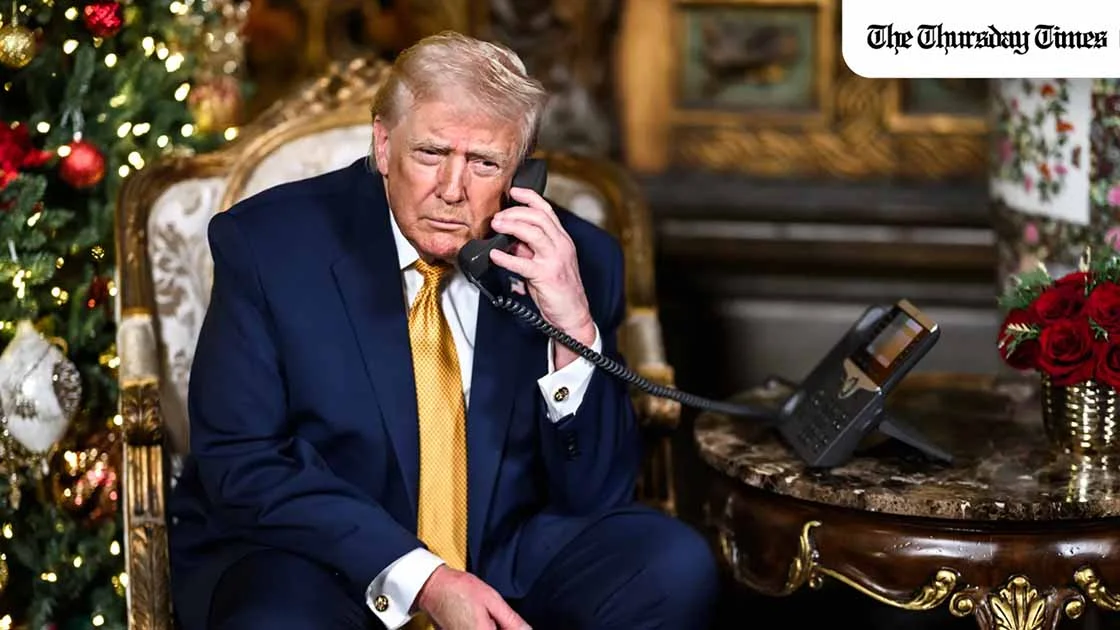
ISLAMABAD (The Thursday Times) — President Donald Trump will hold a conference call on Saturday afternoon with leaders from Saudi Arabia, Qatar, the UAE, Egypt, Jordan, Turkey and Pakistan to discuss a draft agreement with Iran, as the United States and Iran move toward what could be a decisive moment in negotiations to end the war that began on 28 February 2026. Trump said he would “only sign a deal where we get everything we want,” while simultaneously warning that if no agreement is reached, renewed strikes would begin, at a much higher level and intensity than before.
The Thursday Times has been covering Pakistan’s central role in these negotiations from the start. Field Marshal Asim Munir concluded his Tehran visit earlier today, with Pakistan’s army reporting “encouraging progress towards a final understanding.” The conference call with Arab leaders follows directly from that visit.
The conference call: who is on it
Trump is scheduled to speak by phone at 1pm ET on Saturday with leaders from Saudi Arabia, Qatar, the UAE, Egypt, Jordan, Turkey and Pakistan, according to Fox News chief foreign correspondent Trey Yingst, citing an Arab official. Axios had earlier reported the call, citing two sources familiar with the matter. The call is set to discuss the draft Iran agreement and hear the views of regional leaders before Trump makes what aides describe as a final decision on whether to pursue diplomacy or resume military action.
Qatar’s Emir Sheikh Tamim bin Hamad al-Thani had already held a separate call with Trump on Saturday morning to discuss Pakistan-led efforts to bring an end to the US-Iran war, according to the Qatar News Agency. The Emir urged Iran to seize the opportunity to avoid further escalation.
“I think one of two things will happen: either I hit them harder than they have ever been hit, or we are going to sign a deal that is good.” President Donald Trump · 23 May 2026
What the draft agreement contains
The Financial Times reported on Saturday, citing people briefed on the talks, that mediators believe they are nearing agreement to extend the US-Iran ceasefire by 60 days and set a framework for talks on Tehran’s nuclear programme. The proposed deal would include a gradual reopening of the Strait of Hormuz, discussions on diluting or transferring Iran’s stockpile of enriched uranium, and steps by Washington to ease its blockade of Iranian ports alongside sanctions relief.
Rubio spelled out Washington’s three non-negotiable demands: Iran must never obtain a nuclear weapon, the Strait of Hormuz must be reopened without tolls, and enriched uranium must be turned over. “This problem will be solved, as the president has made clear, one way or the other,” Rubio said on Saturday from New Delhi.
Iran has taken a more measured position. Iranian Foreign Ministry spokesman Esmaeil Baqaei said on Saturday that the nuclear issue would not be part of an initial framework. “At this stage, we will not discuss the details of the nuclear issue. We have decided to prioritise an urgent issue for all of us: ending the war on all fronts including Lebanon,” he told state television, adding that the nuclear file would be subject to separate discussions at a later stage. Iran is finalising a memorandum of understanding with the US, per media reports, with a final agreement expected to follow within 30 days.
Pakistan’s role at the centre
Pakistan remains the primary mediator in the negotiations. Pakistan, Qatar, Saudi Arabia, Turkey and Egypt have been working over recent days to refine the proposal and bridge gaps between Washington and Tehran, according to Axios, citing three sources. Field Marshal Munir’s 24-hour Tehran visit, which concluded earlier on Saturday, was described by the ISPR as “highly productive” with “encouraging progress towards a final understanding.”
Pakistan’s inclusion on the conference call alongside Gulf states reflects the degree to which Islamabad has been elevated in Washington’s regional framework since the ceasefire of 8 April. Saudi Arabia’s Foreign Minister Faisal bin Farhan separately praised Pakistan’s mediation efforts on Saturday, saying Riyadh “highly appreciates the ongoing mediation efforts carried out by Pakistan in this regard”.
Trump’s position: deal or strikes
Trump has made clear the decision is imminent. “I will only sign a deal where we get everything we want,” he said on Saturday. He told Axios: “I think one of two things will happen: either I hit them harder than they have ever been hit, or we are going to sign a deal that is good. Some people would much rather have a deal and others would rather resume the war.” Rubio said there was a “chance” Iran could accept a deal as soon as Saturday, while noting “this issue needs to be solved one way or the other.”
The US blockade of Iranian ports has now redirected 100 commercial ships. Oil prices remain elevated, up approximately 45 per cent since the war began on 28 February. Trump is under significant domestic political pressure to reach a deal that reopens the Strait of Hormuz and brings down fuel prices ahead of November’s congressional elections.
The Thursday Times will update this article as the conference call and its outcome become clear.
Sources: Fox News, Axios, CBS News, Financial Times, Reuters, Qatar News Agency, ISPR, Bloomberg. All quotes attributed to named public officials speaking in public forums. This is a developing story and will be updated as events unfold.∎