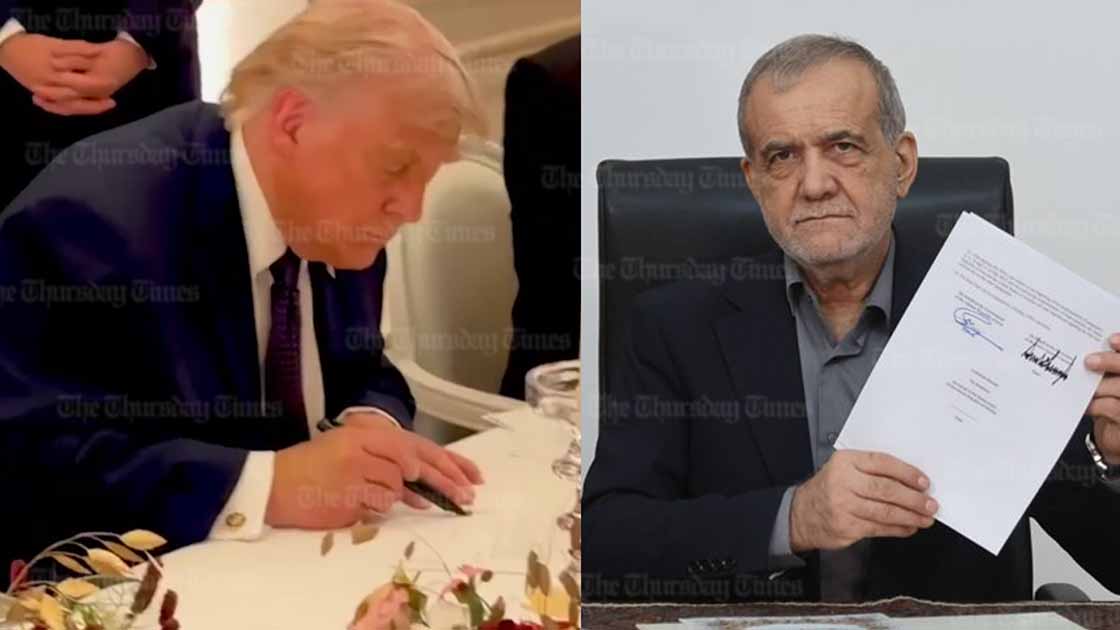
ISLAMABAD (The Thursday Times) — Pakistan Prime Minister Shehbaz Sharif has announced that the historic Islamabad Memorandum of Understanding between the United States and Iran has been electronically signed, bringing into force an agreement aimed at ending months of conflict and reopening one of the world’s most important maritime corridors.
Sharif in his statement on X, said the memorandum had been signed by the presidents of the United States and Iran and endorsed by him in his role as mediator. He said the signing at the highest level of both governments showed a shared commitment to a diplomatic resolution after a conflict that had threatened to widen across the Middle East.
Historic moment: President Trump signed the US-Iran Memorandum of Understanding in France, just before a dinner hosted by French President Emmanuel Macron.
The breakthrough, mediated by Pakistan, marks a major step toward ending the conflict and reopening the Strait of Hormuz. pic.twitter.com/CNBR26Qhqi
— The Thursday Times (@thursday_times) June 18, 2026
Under the first step announced by Pakistan, Iran is to reopen the Strait of Hormuz immediately, while the United States is to lift its naval blockade. The strait, a narrow waterway linking the Persian Gulf to the Gulf of Oman, has been central to the crisis because of its importance to global oil and gas flows.
The agreement marks a major diplomatic moment for Islamabad, which has sought to position itself as a bridge between Washington and Tehran during the crisis. Pakistani officials have presented the MoU as a product of sustained engagement by the country’s civilian and military leadership.
Sharif congratulated US President Donald Trump, saying his preference for diplomacy had helped avert consequences that could have been devastating for the region and the wider world. He also praised the work of the American negotiating team, naming Vice President JD Vance, Steve Witkoff and Jared Kushner among those who contributed to the breakthrough.
The Pakistani prime minister also paid tribute to Iran’s leadership, including Supreme Leader Ayatollah Seyyed Mojtaba Hosseini Khamenei and President Masoud Pezeshkian, for what he described as statesmanship in embracing the cause of peace. He recognised Iranian negotiators Mohammad Bagher Ghalibaf, Abbas Araghchi and Eskandar Momeni for their role in bringing the agreement to fruition.
Sharif gave special mention to Field Marshal Syed Asim Munir, saying his efforts and instrumental role were critical in facilitating the breakthrough and advancing regional stability. The acknowledgement places Pakistan’s military leadership at the centre of Islamabad’s account of how the agreement came together.
The prime minister also thanked Qatar for its constructive engagement and commended Saudi Arabia, Türkiye and Egypt for their contributions. The recognition of multiple regional actors underlines the extent to which the accord was shaped by wider diplomatic pressure from states seeking to prevent the conflict from further disrupting the Gulf.
According to accounts of the agreement read out by US officials and reported by international media, the MoU contains a framework for ending military operations, restoring maritime traffic, addressing Iran’s nuclear programme and moving toward a final settlement within a defined negotiation window.
Reuters reported that the text read to reporters described a 14-point interim understanding, including the termination of military operations, respect for sovereignty, a negotiation period of up to 60 days and steps for the phased removal of the US naval blockade. Iran, under the reported text, would use its best efforts to restore safe commercial passage through the Strait of Hormuz.
The nuclear dimension remains one of the most sensitive parts of the agreement. Reports said Iran reaffirmed that it would not procure or develop nuclear weapons, while the two sides agreed to address the future of enriched material under a mechanism to be negotiated with reference to international supervision.
The deal also appears to open the door to economic measures affecting Iran, including oil export waivers, financial transactions and discussions over frozen or restricted assets. However, several reports indicated that the most difficult sanctions and nuclear issues are still linked to the next stage of negotiations rather than fully settled at the point of signing.
The diplomatic engagement is expected to continue, with technical discussions likely to focus on implementation, maritime security, nuclear terms and the timetable for a final agreement. The immediate test will be whether shipping through Hormuz resumes smoothly and whether both sides maintain the ceasefire conditions described in the MoU.
For Pakistan, the announcement is being framed as a rare moment of international diplomatic prominence. Sharif said he hoped the Islamabad MoU would serve as a foundation for greater understanding, mutual respect and shared prosperity across the region.