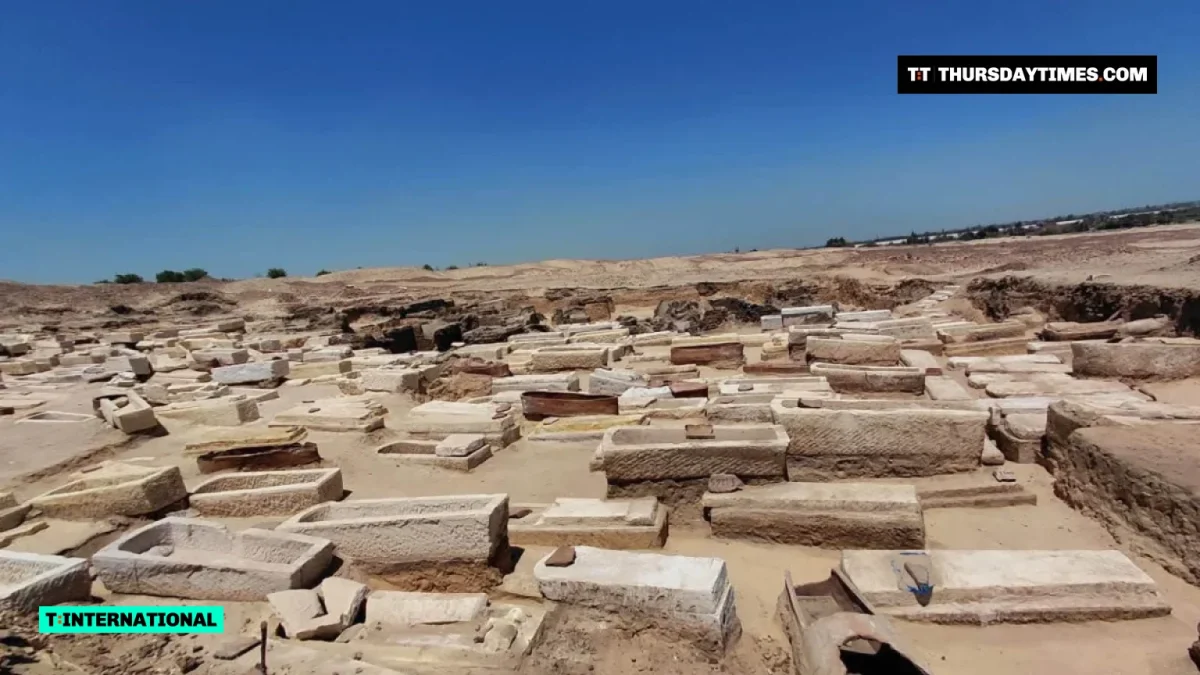
CAIRO (The Thursday Times) — Egyptian archaeologists have uncovered a cemetery of tombs and burials from the end of the Late Period, the Ptolemaic Period, and the early Roman Period at the Abu Billo site in Monufia Governorate, Egypt’s Ministry of Tourism and Antiquities said on Wednesday.
A mission of the Supreme Council of Antiquities found a large collection of stone and pottery coffins, along with the remains of several wooden coffins, vaulted tombs built of mudbrick, and another tomb constructed inside with limestone, the ministry said.
Gold tongues and figurines
Among the finds were several gold tongues, an earring, a gold necklace pendant, gold foil sheets, and scarabs. The team also recovered many figurines of different shapes and sizes, some carrying hieroglyphic inscriptions, as well as offering tables, small limestone statue heads, and fragments of terracotta figurines depicting Isis-Aphrodite. One piece is part of a fired-clay vessel lid shaped like Isis-Aphrodite seated on a lotus flower, nursing her child Harpocrates.
A cemetery for the middle class
The ministry said the necropolis was most likely used to bury middle-class members of society. Initial studies of the artefacts, stone and pottery coffins, and burials suggest it dates to the early Ptolemaic Period, in the 3rd and 2nd centuries BCE, with some burials going back to the end of the Late Period.
The site lies within the archaeological zone of the ancient city of El-Tarrana, known in antiquity as Terenuthis, at the eastern entrance of Wadi El Natrun. The area was historically known for extracting natron, a salt used in mummification, which the ministry said adds to the importance of the discovery.
The excavations also revealed a surface layer containing hundreds of stone coffins. Some are missing their lids, and others are completely shattered because of earlier looting and quarrying in the area, the ministry said.