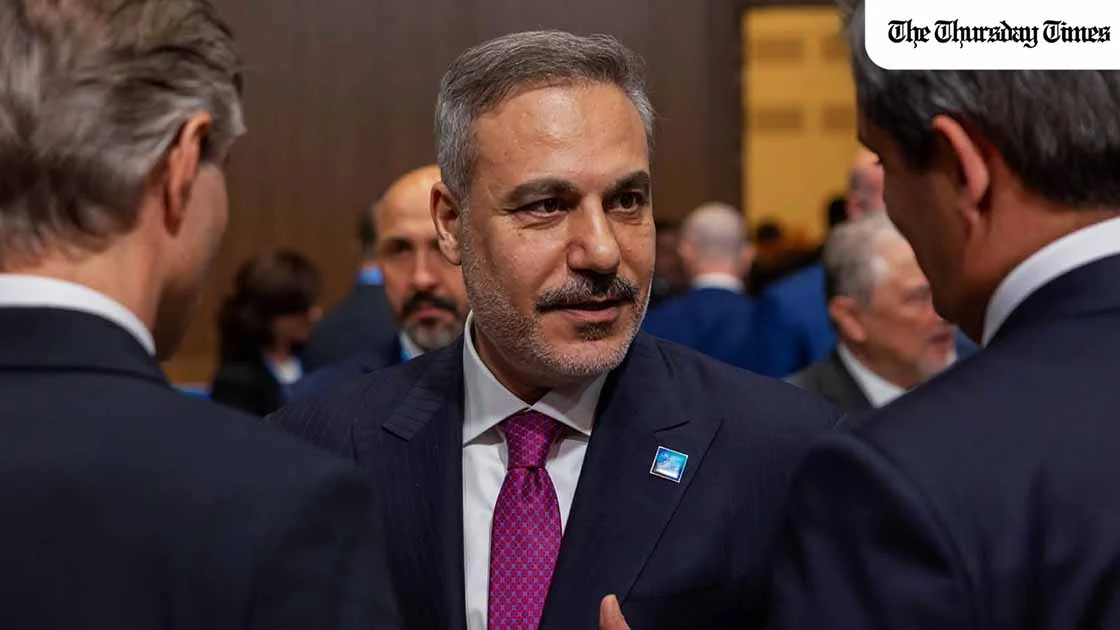
ANKARA (The Thursday Times) — Turkish Foreign Minister Hakan Fidan told broadcaster NTV that the Mecca Alliance between Türkiye, Saudi Arabia, and Pakistan has reached an advanced stage, calling it a “very game-changing platform,” with only personnel deployment and headquarters activation left before the pact becomes fully institutionalised.
Turkish FM Hakan Fidan:
The Makkah Defence Alliance has entered a strong phase, with firm political will behind it.
The secretariat and military headquarters are nearly complete, only deploying personnel and activating the headquarters remains, progress he called… pic.twitter.com/4TeWFn1wfl— The Thursday Times (@thursday_times) September 20, 2026
“The Mecca Alliance is really at a good stage. There’s a very strong will that has been put forward. We’re working with all our strength to put this will into action,” Fidan said. On the institutional progress specifically, he said the secretariat envisaged under the agreement and its affiliated military headquarters are “almost complete.” “We have reached a consensus. Now, all that remains is to send personnel and for the headquarters to operate. I am satisfied with the process in that regard,” he said. His account matches parallel statements from Pakistani officials in recent days, Defence Minister Khawaja Asif has said Pakistani forces are already present in Saudi Arabia for training and logistical purposes under the pact, while DG ISPR Lieutenant General Ahmed Sharif Chaudhry has confirmed the two countries are actively coordinating on the alliance’s practical mechanics.
Fidan also addressed the wave of Houthi attacks on Saudi Arabia directly, calling strikes on Saudi sovereignty, territorial integrity, and infrastructure “extremely serious,” and singling out attacks on Mecca and the kingdom’s oil installations in particular. He placed the current escalation in a longer history, saying tensions between the Houthis and Saudi Arabia date back roughly a decade, with a ceasefire reached in 2022 that broke down after the war in Gaza began. Asked what Türkiye would do if Saudi Arabia required military assistance, Fidan said Ankara would have “no difficulty” meeting such needs in specific technical areas, framing this as a responsibility that follows from alliance membership.
At the same time, Fidan was careful to argue that Saudi Arabia itself should remain outside the broader confrontation between Iran and the United States. “Saudi Arabia should be excluded from this equation because they are not seeking to participate,” he said, adding that Mecca Alliance members are “closely monitoring the situation” through consultations that “haven’t been made public.”
Fidan made a more contentious claim as well, one the piece treats as his own characterisation rather than an established fact. He argued that attempts by several countries, including Israel, India, and Greece, to dismiss the Mecca Alliance as a “paper alliance” were themselves evidence of how significant the pact actually is, framing criticism of the alliance as inadvertent proof of its relevance rather than a substantive critique worth engaging directly.
Turkish FM Hakan Fidan:
Attempts by some countries, including Israel and India, to dismiss the Makkah Defence Alliance as a "paper alliance" are proof of how important it is. The disinformation campaign against it, he said, reflects its growing influence. pic.twitter.com/XLvTBmcL16— The Thursday Times (@thursday_times) September 20, 2026
On the alliance’s future shape, Fidan said it remains open to other countries in the region, with discussions on new members expected once the institutionalisation process is complete. He framed the underlying goal as building a shared regional defence framework rather than deepening existing rivalries. “We have this principled decision because our President has stated it from the beginning. If this area doesn’t grow, it won’t be an alliance area. We would be creating polarisation,” he said.∎