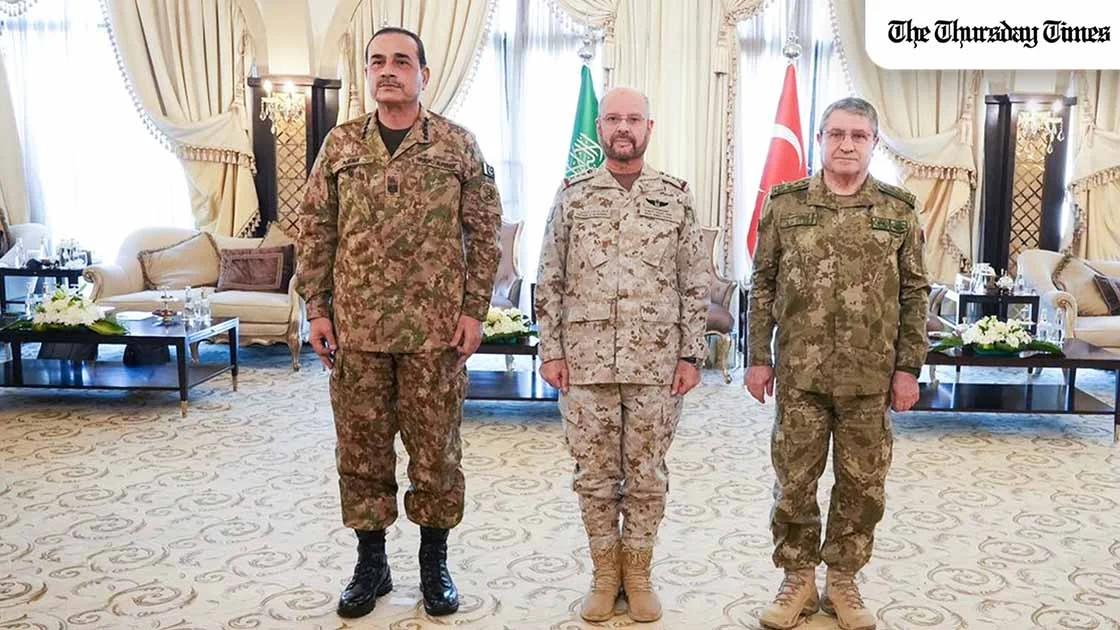
RIYADH (The Thursday Times) — Pakistan’s Field Marshal Asim Munir, Turkish Chief of General Staff General Selçuk Bayraktaroğlu, and Saudi Chief of General Staff General Fayyadh bin Hamed Al-Ruwaili held an urgent meeting in Riyadh under the Makkah Alliance, bringing together the three countries’ top military commanders at what officials describe as a sensitive moment for regional security.
The meeting comes as Houthi forces continue attacks on Saudi Arabia amid the ongoing conflict in Yemen, including a drone incursion earlier this month that targeted Mecca directly and prompted Saudi Arabia’s first-ever emergency alert for the holy city. It also follows Pakistan’s own retaliatory strikes on ten locations in Afghanistan after a separate drone incursion from Afghan territory, part of a week in which all three Makkah Alliance partners have faced direct security pressure simultaneously.
According to a statement from the Turkish Armed Forces, the talks focused on “common security architecture and military coordination processes” among the three militaries. The meeting represents a narrower, more operational gathering than the alliance’s earlier institutional session, held August 31 in Istanbul, where foreign and defence ministers, alongside the same three military chiefs, formally named the pact the Makkah Defence Alliance, agreed to seat its permanent secretariat in Riyadh, and confirmed its first Secretary-General would come from Pakistan. This week’s meeting involved only the military commanders themselves, convened on short notice, and centred on coordination rather than institution-building.
The Makkah Joint Defence Agreement, signed by Pakistan, Saudi Arabia, and Türkiye on August 7, commits each signatory to treat an armed attack on any one member as an attack on all three, a clause frequently compared to NATO’s Article 5. Pakistani officials have spent the past week publicly reinforcing that commitment: Defence Minister Khawaja Asif said Pakistan “did not need an agreement” to defend the holy sites in the first place, while DG ISPR Lieutenant General Ahmed Sharif Chaudhry has said Pakistan does not detail its operational plans in advance, describing that as a matter of deliberate strategy rather than uncertainty. Turkish Foreign Minister Hakan Fidan separately defended the alliance’s credibility this week, comparing skepticism about its inaction on Yemen to unfairly judging NATO’s Article 5, which he noted has been invoked only once in decades, by a crisis that is barely a year old.∎